
Calculate Regular Octagon Area from Side
Use this form when the side length of a regular octagon (all eight sides equal, all interior angles 135°) is known. The coefficient 2(1+√2) ≈ 4.828 comes from decomposing the octagon into 8 isosceles triangles meeting at the center.
A = 2(1 + √2) s²
Calculate Octagon Perimeter from Side
Use this form to compute the perimeter when the side length is known — fencing, trim, or edge banding for octagonal layouts like gazebos and stop signs.
P = 8s
Calculate Octagon Apothem from Side
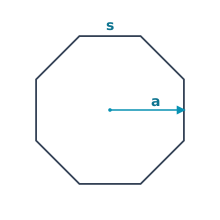
Use this form for the apothem — the perpendicular distance from the center to the midpoint of any edge. This is also the inscribed-circle radius and equals half the short (across-flats) diagonal.
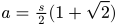
a = (s/2)(1 + √2)
Calculate Octagon Side from Area
Use this rearrangement when the area is known and you need the side length — e.g., sizing a stop sign or octagonal patio to a target footprint.
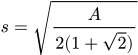
s = √(A / (2(1 + √2)))
How It Works
This regular octagon calculator solves A = 2(1+√2)s² for area, P = 8s for perimeter, and a = (s/2)(1+√2) for the apothem (the center-to-edge-midpoint distance, also the inscribed-circle radius). The inverse s = √(A / (2(1+√2))) recovers the side from the area. A regular octagon has eight equal sides, eight equal 135° interior angles, and two distinct diagonals: the long diagonal (vertex to opposite vertex) is s · √(4+2√2) ≈ 2.613s, and the short diagonal (vertex skipping one vertex) is s(1+√2) ≈ 2.414s — exactly twice the apothem.
Example Problem
A regular octagonal stop sign has 4 in sides. Compute its area, perimeter, apothem, and diagonals.
- Knowns: s = 4 in
- Area: A = 2(1 + √2) · s² = 2(1+√2) · 16 = 32(1+√2) ≈ 77.255 in²
- Perimeter: P = 8s = 8 · 4 = 32 in
- Apothem (center to edge midpoint): a = (s/2)(1+√2) = 2(1+√2) ≈ 4.828 in
- Circumradius (center to vertex): R = (s/2)√(4+2√2) ≈ 5.226 in
- Long diagonal: s·√(4+2√2) ≈ 10.453 in; Short diagonal: s(1+√2) ≈ 9.657 in
U.S. road stop signs are regular octagons. Standard MUTCD spec is 30 in across-flats (= short diagonal), which corresponds to s ≈ 30 / (1+√2) ≈ 12.43 in per side.
When to Use Each Variable
- Solve for Area — when the side length is known — stop signs, octagonal patios, gazebos, decorative tiles.
- Solve for Perimeter — when you need the boundary length — fencing for an octagonal gazebo, trim around an octagonal window.
- Solve for Apothem — when you need the inscribed-circle radius or the across-flats half-distance — tooling, machining, sign-mounting layouts.
- Solve for Side — when the area is known and you need the side length — sizing a sign or patio to a target footprint.
Key Concepts
A regular octagon has eight equal sides and eight equal interior angles of 135° (since the interior-angle sum of any n-gon is (n−2)·180°, here 6·180° = 1080°, divided by 8). The shape sits between the hexagon and the circle: as the number of sides of a regular polygon grows, the figure approaches its circumscribed circle, and the octagon already feels noticeably circular. Octagons do NOT tile the plane by themselves — they leave square gaps — which is why a stop sign placed on a square mounting plate is so natural a pairing.
Applications
- Road signs: U.S. stop signs are regular octagons (MUTCD standard 30 in across-flats)
- Architecture: octagonal towers, gazebos, cupolas, and bay windows
- Tiling: octagon + square tile patterns cover floors without gaps (the square fills the gap an octagon-only tiling leaves)
- Mechanical: octagonal sockets and bolt heads where extra wrenching surface is needed vs. a hex
- Heraldry and decor: octagonal mirrors, picture frames, and clock faces
Common Mistakes
- Confusing the apothem with the circumradius — apothem a = (s/2)(1+√2) ≈ 1.207s reaches edge midpoints, while circumradius R = (s/2)√(4+2√2) ≈ 1.307s reaches the vertices.
- Forgetting that an octagon has 8 sides — perimeter is 8s, not 6s or 4s.
- Confusing the regular octagon (all sides equal, all angles 135°) with irregular octagons (any 8-gon) — this calculator handles the regular case only.
- Using a hexagon-style ‘circumradius equals side’ rule — that property is unique to hexagons. For octagons, R > s.
- Mixing up the two diagonals: long (vertex to opposite vertex, ≈ 2.613s) vs. short (vertex skipping one, ≈ 2.414s). The short diagonal is the across-flats distance only when measured as 2·apothem, which is what stop-sign specs use.
Frequently Asked Questions
How do you calculate the area of a regular octagon?
Use A = 2(1 + √2) · s², where s is the side length. The coefficient 2(1+√2) ≈ 4.828. For s = 4 in, A = 32(1+√2) ≈ 77.255 in².
What is the formula for the perimeter of an octagon?
For a regular octagon, P = 8s (eight equal sides times the side length). For s = 4 in, P = 32 in.
What is the apothem of a regular octagon?
The apothem is the perpendicular distance from the center to the midpoint of any side. For a regular octagon, a = (s/2)(1+√2) ≈ 1.207s. For s = 4 in, a ≈ 4.828 in.
What is the interior angle of a regular octagon?
135°. The interior-angle sum of any n-gon is (n − 2) · 180°; for n = 8 that is 6 · 180° = 1080°, divided by 8 vertices gives 135° per corner.
How big is a U.S. stop sign?
Federal MUTCD spec is 30 in across-flats (the short diagonal, = 2·apothem). That implies side s = 30 / (1+√2) ≈ 12.43 in and area ≈ 746 in² (≈ 5.18 ft²).
How do you find the side of an octagon given the area?
Rearrange A = 2(1+√2)s² to s = √(A / (2(1+√2))). For A = 77.255 in², s = √(77.255 / 4.828) = √16 = 4 in.
What are the diagonals of a regular octagon?
Two distinct diagonals: the LONG diagonal (vertex to opposite vertex) is s · √(4+2√2) ≈ 2.613s, and the SHORT diagonal (vertex skipping one) is s(1+√2) ≈ 2.414s. The short diagonal also equals 2·apothem — the across-flats distance used on stop-sign specs.
Do regular octagons tile the plane?
No, not by themselves — at any vertex three 135° angles sum to 405°, which overshoots 360°, and two angles only fill 270°, which leaves a gap. Octagons can tile the plane only when paired with squares (the truncated-square tiling), which is why octagonal road tiles and patios usually include square inserts.
Reference:
Weisstein, Eric W. "Regular Octagon." MathWorld — A Wolfram Web Resource. https://mathworld.wolfram.com/RegularOctagon.html
Worked Examples
Stop Sign
How big is a U.S. stop sign?
Federal MUTCD spec sets the across-flats distance (= short diagonal = 2·apothem) at 30 in. Compute the side length and area.
- Across-flats = 30 in → apothem a = 15 in
- Solve a = (s/2)(1+√2) for s: s = 2a / (1+√2) = 30 / (1+√2)
- Rationalize: s = 30(√2 − 1) ≈ 30 · 0.4142 ≈ 12.43 in
- Area: A = 2(1+√2) · s² ≈ 4.828 · 154.5 ≈ 745.6 in²
Side s ≈ 12.43 in, area ≈ 745.6 in² (≈ 5.18 ft²)
Larger highway stop signs are 36 in or 48 in across-flats; scale s and A proportionally.
Gazebo
How much decking does an octagonal gazebo with 6 ft sides need?
Compute the floor area of a regular octagonal gazebo with 6 ft sides to estimate decking material.
- Knowns: s = 6 ft
- Formula: A = 2(1 + √2) · s²
- A = 2(1+√2) · 36 = 72(1+√2) ≈ 173.8 ft²
- Perimeter (railing): P = 8s = 48 ft
Floor area ≈ 173.8 ft², railing perimeter = 48 ft
Add 5–10% waste to the decking estimate to cover the angled cuts at each 135° corner.
Inverse Solve
What side does a 100 cm² octagonal tile need?
A decorative tile must have exactly 100 cm² area. Find the required side length.
- Knowns: A = 100 cm²
- Formula: s = √(A / (2(1+√2)))
- s = √(100 / 4.828) ≈ √20.71
- s ≈ 4.551 cm
Side ≈ 4.55 cm
Useful for sizing tiles, mosaic blocks, or octagonal coasters to a target footprint.
Regular Octagon Formulas
A regular octagon has eight equal sides and eight 135° interior angles. A single dimension, the side length s, fully determines its geometry.
Area equals two times one plus root two, times s squaredPerimeter equals eight sApothem equals s over two, times one plus root twoSide equals the square root of A divided by two times one plus root two

Where:
- A — area (m², ft², in²)
- P — perimeter (m, ft, in) = 8s
- s — side length (all sides equal)
- a — apothem (center to edge midpoint) = (s/2)(1+√2)
- R — circumradius (center to vertex) = (s/2)√(4+2√2) ≈ 1.307s
- Long diagonal — vertex to opposite vertex = s · √(4+2√2) ≈ 2.613s = 2R
- Short diagonal — vertex skipping one = s(1+√2) ≈ 2.414s = 2·apothem (across-flats)
Related Calculators
- Hexagon Calculator — regular 6-gon — area, perimeter, apothem, and diagonals
- Pentagon Calculator — regular 5-gon — area, perimeter, apothem, and diagonals
- Square Calculator — compute area, perimeter, and diagonal for a square (paired with octagons in truncated-square tilings)
- Circle Calculator — compute area and circumference — the octagon's inscribed circle has radius equal to its apothem
- Area Converter — switch between m², ft², in², and other area units
Related Sites
- Temperature Tool — Temperature unit converter
- Z-Score Calculator — Z-score, percentile, and probability calculator
- OptionsMath — Options trading profit and loss calculators
- Medical Equations — Hemodynamic, pulmonary, and dosing calculators
- Dollars Per Hour — Weekly paycheck calculator with overtime
- Percent Off Calculator — Discount and sale price calculator