
Calculate Regular Pentagon Area from Side
Use this form when the side length of a regular pentagon (all five sides equal, all interior angles 108°) is known. The numeric coefficient is approximately 1.720477.
A = (1/4) · √(5(5 + 2√5)) · s²
Calculate Pentagon Perimeter from Side
Use this form to compute the perimeter when the side length is known — fencing, trim, or framing for pentagonal layouts.
P = 5s
Calculate Pentagon Apothem from Side
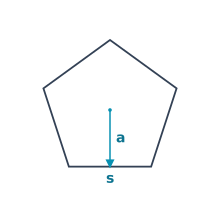
Use this form for the apothem — the perpendicular distance from the center of the pentagon to the midpoint of any edge. Equals the inscribed-circle radius. tan(π/5) = tan 36°, so a ≈ 0.6882·s.
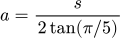
a = s / (2·tan(π/5))
Calculate Pentagon Side from Area
Use this rearrangement when the area is known and you need the side length.
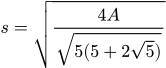
s = √(A · 4 / √(5(5+2√5)))
How It Works
This regular pentagon calculator solves A = (1/4)·√(5(5+2√5))·s² for area, P = 5s for perimeter, and a = s / (2·tan(π/5)) for the apothem (center-to-edge-midpoint distance). The inverse s = √(A · 4 / √(5(5+2√5))) recovers the side from the area. The pentagon's diagonal (vertex to non-adjacent vertex) has the elegant relation d = s·φ, where φ = (1+√5)/2 ≈ 1.618 is the golden ratio — the defining geometric property of the regular pentagon. The circumradius (center to vertex) is R = s / (2·sin(π/5)) ≈ 0.8507·s.
Example Problem
A regular pentagonal sign has a side length of 4 cm. Compute its area, perimeter, apothem, circumradius, and diagonal.
- Knowns: s = 4 cm
- Area: A = (1/4) · √(5(5 + 2√5)) · s² = 1.720477 · 16 ≈ 27.528 cm²
- Perimeter: P = 5s = 5 · 4 = 20 cm
- Apothem: a = s / (2·tan 36°) = 4 / 1.4531 ≈ 2.7528 cm
- Circumradius: R = s / (2·sin 36°) = 4 / 1.1756 ≈ 3.4026 cm
- Diagonal: d = s · φ = 4 · 1.6180 ≈ 6.4721 cm (φ is the golden ratio)
The diagonal-to-side ratio of a regular pentagon is exactly the golden ratio φ = (1+√5)/2. This relationship was known to the ancient Greeks and underlies the pentagon's appearance in Penrose tilings, the symbol of the Pythagorean school, and many natural growth patterns.
When to Use Each Variable
- Solve for Area — when the side length is known — pentagonal tiles, signs, or decorative panels.
- Solve for Perimeter — when you need the boundary length — pentagonal fencing, frame trim, or perimeter cabling.
- Solve for Apothem — when you need the inscribed-circle radius — pentagonal tooling, machining, or inscribed-pattern designs.
- Solve for Side — when the area is known and you need the side length — sizing a pentagonal panel to a target area.
Key Concepts
A regular pentagon has five equal sides and five interior angles of 108° each. It does NOT tile the plane on its own — that's the distinction from triangles, squares, and hexagons. The pentagon's most striking geometric feature is the golden ratio φ = (1+√5)/2 ≈ 1.618, which appears as the ratio of a diagonal to a side: d/s = φ. The diagonals of a regular pentagon intersect to form a smaller pentagon inside, and that inner pentagon's diagonals form a yet-smaller one — each scaled down by a factor of φ². This recursive self-similarity is the basis of the pentagram (five-pointed star), the symbol of the Pythagorean school, and shows up in Penrose tilings and many botanical growth patterns.
Applications
- Architecture: the Pentagon building (Arlington, VA) is the most famous example; pentagonal floor plans and window tracery in Gothic cathedrals
- Signs and symbols: pentagonal road signs, military insignia, and pentagram-based logos
- Tiling and design: while regular pentagons can't tile alone, they combine with rhombs in Penrose tilings to produce non-periodic patterns
- Botany: the five-fold symmetry of many flowers (apple blossoms, roses, hibiscus) and starfish reflects regular-pentagon geometry
- Soccer balls: a truncated icosahedron pattern alternates 12 regular pentagons with 20 regular hexagons
Common Mistakes
- Using a non-standard interior angle — every interior angle of a regular pentagon is exactly 108°, not 120° (that's the hexagon) or 90°
- Assuming the circumradius equals the side length — that property is unique to the regular hexagon. For a regular pentagon, R = s / (2·sin 36°) ≈ 0.8507·s, smaller than s
- Forgetting that a regular pentagon does not tile the plane — the interior angle 108° doesn't divide 360° evenly, so it leaves gaps
- Confusing the apothem with the circumradius — the apothem (s/(2·tan 36°) ≈ 0.688·s) is shorter than the circumradius (≈ 0.851·s) because the apothem stops at the edge midpoint while the circumradius reaches the vertex
Frequently Asked Questions
How do you calculate the area of a regular pentagon?
Use A = (1/4) · √(5(5 + 2√5)) · s², where s is the side length. The numeric coefficient works out to approximately 1.720477. For s = 4 cm, A ≈ 27.53 cm².
What is the formula for the perimeter of a pentagon?
For a regular pentagon, P = 5s (five equal sides times the side length). For s = 4 cm, P = 20 cm. Irregular pentagons need each side measured individually and summed.
What is the apothem of a regular pentagon?
The apothem is the perpendicular distance from the center to the midpoint of any side. For a regular pentagon, a = s / (2·tan 36°) ≈ 0.6882·s. For s = 4 cm, apothem ≈ 2.753 cm. The apothem also equals the radius of the inscribed circle.
Why is the golden ratio in a pentagon?
The ratio of a regular pentagon's diagonal to its side is exactly the golden ratio φ = (1+√5)/2 ≈ 1.618. So d = s·φ. This appears because the angles 36°, 72°, and 108° involved in pentagon geometry produce isosceles triangles whose sides are in golden-ratio proportion.
What is the interior angle of a regular pentagon?
Each interior angle of a regular pentagon is 108°. This comes from the general formula (n−2)·180°/n with n=5: (5−2)·180°/5 = 540°/5 = 108°. The sum of all interior angles is 540°.
Does a regular pentagon tile the plane?
No. Three regular pentagons meeting at a vertex sum to 3·108° = 324°, leaving a 36° gap. Four would overlap. Regular pentagons cannot tile the plane on their own, unlike triangles, squares, and hexagons. They CAN tile in combination with other shapes — most famously in Penrose tilings.
How do you find the side of a pentagon given the area?
Rearrange A = 1.720477·s² to s = √(A / 1.720477) = √(A · 4 / √(5(5+2√5))). For A = 27.53 cm², s = √(27.53 / 1.720477) = √16 = 4 cm.
What is the circumradius of a regular pentagon?
The circumradius is the distance from the center to any vertex, R = s / (2·sin 36°) ≈ 0.8507·s. For s = 4 cm, R ≈ 3.403 cm. Unlike the regular hexagon, where circumradius equals side length, the pentagon's circumradius is shorter than its side.
Reference:
Weisstein, Eric W. "Regular Pentagon." MathWorld — A Wolfram Web Resource. https://mathworld.wolfram.com/RegularPentagon.html
Worked Examples
Pentagonal Tile
How much surface does a 4 cm regular pentagonal tile cover?
A pentagonal floor tile has 4 cm sides. Compute its area to estimate tile count for a given floor.
- Knowns: s = 4 cm
- Formula: A = (1/4) · √(5(5 + 2√5)) · s²
- A ≈ 1.720477 · 16 ≈ 27.53 cm²
Each tile covers ≈ 27.53 cm² (≈ 0.00275 m²)
Pentagonal tiles never tile alone — the 108° interior angle doesn't fit around a point. They're typically combined with rhombs (Penrose), triangles, or laid in decorative star patterns.
Pentagonal Sign
What is the apothem of a 30 cm pentagonal road sign?
A regulatory pentagonal sign has 30 cm sides. Find the apothem (center-to-edge distance), which determines the radius of the largest circle that fits inside.
- Knowns: s = 30 cm
- Formula: a = s / (2·tan 36°)
- a = 30 / (2 · 0.7265) = 30 / 1.4531
- a ≈ 20.65 cm
Apothem ≈ 20.65 cm — the inscribed circle has radius ≈ 20.65 cm
Useful for sizing a circular logo or text block that must fit inside the pentagonal frame without touching the edges.
Pentagonal Panel
What side length does a 500 cm² pentagonal panel need?
A pentagonal wall panel must have exactly 500 cm² of surface area. Find the required side length.
- Knowns: A = 500 cm²
- Formula: s = √(A · 4 / √(5(5+2√5))) = √(A / 1.720477)
- s = √(500 / 1.720477) = √290.62
- s ≈ 17.05 cm
Side ≈ 17.05 cm
Diagonal length d = s·φ ≈ 17.05 · 1.618 ≈ 27.58 cm — useful for checking that the panel will fit across the available wall width.
Regular Pentagon Formulas
A regular pentagon has five equal sides and five 108° interior angles. A single dimension, the side length s, fully determines its geometry.
Area equals one quarter times the square root of five times the quantity five plus two root five, all times s squaredPerimeter equals five sApothem equals s divided by the quantity two times tangent of pi over fiveSide equals the square root of A times four divided by the square root of five times the quantity five plus two root five

Where:
- A — area (m², ft², in²)
- P — perimeter (m, ft, in) = 5s
- s — side length (all five sides equal)
- a — apothem (center to edge midpoint) = s / (2·tan 36°) ≈ 0.6882·s
- R — circumradius (center to vertex) = s / (2·sin 36°) ≈ 0.8507·s
- d — diagonal (vertex to non-adjacent vertex) = s · φ, where φ = (1+√5)/2 ≈ 1.618 is the golden ratio
Related Calculators
- Hexagon Calculator — regular hexagon area, perimeter, apothem, and diagonals — the next regular polygon
- Triangle Calculator — sides, angles, and area for any triangle (regular pentagons decompose into 5 isosceles triangles)
- Square Calculator — area, perimeter, and diagonal of a square
- Geometric Formulas Calculator — explore area and perimeter formulas for many shapes
- Area Converter — switch between m², ft², and other area units
Related Sites
- Temperature Tool — Temperature unit converter
- Z-Score Calculator — Z-score, percentile, and probability calculator
- OptionsMath — Options trading profit and loss calculators
- Medical Equations — Hemodynamic, pulmonary, and dosing calculators
- Dollars Per Hour — Weekly paycheck calculator with overtime
- Percent Off Calculator — Discount and sale price calculator