Square Calculator
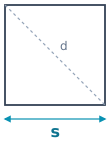
Area equals side squared
Use this form when the side length is known and you need the enclosed area — square plots, tiles, square tables.
A = s²
Use this form to compute the perimeter when the side length is known — fencing or trim around a square area.
P = 4s
Use this form to compute the diagonal — fitting a square into a circular opening, or finding the longest distance inside the square.
d = s√2
Use this rearrangement when the area is known and you need the side length — sizing a square plot to a target area.
s = √A
This square calculator solves the basic square formulas: area A = s², perimeter P = 4s, and diagonal d = s√2. Pick the unknown with the solve-for toggle, enter the remaining value in any supported length or area unit, and the calculator converts to SI internally before computing. All four quantities (s, A, P, d) are always shown together so you get the complete picture from a single page.
A square tile has a 4 cm side length. What are its area, perimeter, and diagonal?
Square is the only rectangle where area and perimeter have the same numeric value at s = 4 (16 = 16). For s < 4 perimeter exceeds area; for s > 4 area dominates.
A square is a regular quadrilateral — four equal sides and four right angles. A single number, the side length s, fully determines its geometry. Every property (area, perimeter, diagonal) derives from s. The diagonal d = s√2 follows directly from the Pythagorean theorem applied to two adjacent sides. Squares are the foundational unit for tiling, grid systems, and area measurement.
Square the side length: A = s². For a square with s = 4 cm, A = 16 cm².
P = 4s. Multiply the side length by 4. For s = 4 cm, P = 16 cm.
d = s√2. The diagonal of a square is its side length multiplied by √2 (approximately 1.4142). For s = 4 cm, d ≈ 5.657 cm.
Take the square root: s = √A. For A = 16 cm², s = √16 = 4 cm.
The diagonal cuts the square into two right triangles with legs s and s. By the Pythagorean theorem, the hypotenuse (the diagonal) is √(s² + s²) = √(2s²) = s√2.
A square is a rectangle where all four sides are equal. Every square is a rectangle, but only the rectangles with l = w are squares. Squares have a single side dimension; rectangles need two.
10² = 100 square units. The unit depends on the side unit — 10 cm gives 100 cm², 10 inches gives 100 in², 10 m gives 100 m².
Take the square root of the area: s = √50 ≈ 7.071 m. So a 50 m² square plot is about 7.07 m × 7.07 m.
Reference:
Weisstein, Eric W. "Square." MathWorld — A Wolfram Web Resource. https://mathworld.wolfram.com/Square.html
Tiling
A square floor measures 3 m × 3 m. Compute the area and divide by the tile area to count tiles.
100 tiles cover the floor exactly
Add waste factor (5–10%) when ordering tiles to account for cuts.
Land
A square land parcel measures 50 m on each side. Find the perimeter to estimate fencing.
Perimeter = 200 m (about 656 ft)
Real-world fencing typically includes a gate and corner posts — budget extra material.
Sizing
A square plot has an area of exactly 100 m². Find the side length.
Side ≈ 10 m (10 m × 10 m square)
Most square land plots are not perfect squares in practice — survey marks usually have small angular and dimensional tolerances.
All square properties follow from a single dimension: the side length s. Area, perimeter, and diagonal all derive from it:
Where:


