Rectangle Calculator
Area equals length times width
Use this form when you know both side lengths and need the enclosed area — flooring, fabric, roofing, or any rectangular surface.
A = l × w
Use this form when you need the perimeter — fencing, baseboard trim, or framing material to surround a rectangular area.
P = 2(l + w)
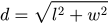
Use this form to compute the diagonal length — bracing a frame, fitting a TV into a wall niche, or any Pythagorean-theorem application.
d = √(l² + w²)
Use this rearrangement when the area and width are known and you need the corresponding length — sizing a room to a target area, for example.
l = A / w
Use this rearrangement when the area and length are known and you need the width.
w = A / l
This rectangle calculator solves the basic rectangle formulas: area A = l·w, perimeter P = 2(l+w), and diagonal d = √(l²+w²). Pick the unknown with the solve-for toggle, enter the remaining two values in any supported length or area unit, and the calculator converts to SI internally before computing. All five quantities (l, w, A, P, d) are always shown together so you get the full picture from a single page.
A garden bed measures 5 m long by 3 m wide. What is its area, perimeter, and diagonal?
The diagonal here is irrational — Pythagorean triples (3-4-5, 5-12-13, etc.) produce integer diagonals; arbitrary side ratios usually don't.
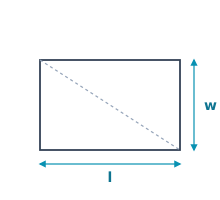
A rectangle is a four-sided polygon with four right angles and opposite sides of equal length. Two numbers — length l and width w — fully determine its geometry. From those, area, perimeter, and diagonal all follow. A rectangle with l = w is a square (a special case where the diagonal is exactly l√2). The diagonal is the hypotenuse of a right triangle with legs l and w, so the Pythagorean theorem gives d = √(l² + w²).
Multiply length by width: A = l × w. For example a 5 m × 3 m rectangle has area 5 × 3 = 15 m².
P = 2(l + w). Add the length and width and multiply by two. For a 5 × 3 rectangle, P = 2 × 8 = 16 units.
Use the Pythagorean theorem: d = √(l² + w²). For a 5 × 3 rectangle, d = √(25 + 9) = √34 ≈ 5.831.
Divide: l = A / w. For A = 15 m² and w = 3 m, l = 5 m.
A square is a rectangle with all four sides equal. Every square is a rectangle, but only rectangles with l = w are squares. For a square with side s, A = s², P = 4s, and d = s√2.
Divide: w = A / l. For A = 15 m² and l = 5 m, w = 3 m.
Usually yes. The diagonal is rational only when l and w form a Pythagorean pair (3-4-5, 5-12-13, 8-15-17, etc.). For arbitrary side ratios the diagonal is irrational — for example a 1×1 square has diagonal √2.
The calculator handles unit conversion automatically — enter inputs in any supported length unit (m, cm, in, ft, yd), and select the desired output unit for area (m², ft², in², acres, etc.). The ResultTable shows the area in all common units.
Reference:
Weisstein, Eric W. "Rectangle." MathWorld — A Wolfram Web Resource. https://mathworld.wolfram.com/Rectangle.html
Flooring
A rectangular living room measures 5 m by 3 m. Find its area to size the hardwood order.
Area = 15 m² ≈ 161.5 ft²
Add 5–10% waste factor for cuts and pattern matching when ordering wood.
Fencing
A backyard 50 m long by 30 m wide needs perimeter fencing. Compute the total run.
Perimeter = 160 m (≈ 525 ft)
Add a gate's worth of post-and-rail at any access points.
TV Diagonal
A flat-panel TV has a 16:9 aspect ratio and a screen width of 121 cm. Find the diagonal (the 'inch size' is the diagonal).
Diagonal ≈ 138.8 cm ≈ 55 inch TV
TV size is always quoted as the diagonal of the screen, not the width or height alone.
All rectangle properties follow from two dimensions: the length l and the width w. From those, area, perimeter, and diagonal derive:
Where: