Hexagon Calculator (Regular)
Area equals three root three over two s squared
Use this form when the side length of a regular hexagon (all six sides equal) is known. The formula comes from decomposing the hexagon into 6 equilateral triangles.
A = (3√3 / 2) s²
Use this form to compute the perimeter when the side length is known — fencing, framing, or trim for hexagonal layouts.
P = 6s
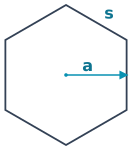
Use this form for the apothem — the perpendicular distance from the center of the hexagon to the midpoint of any edge. Common in tiling and inscribed-circle calculations.
a = s√3 / 2
Use this rearrangement when the area is known and you need the side length.
s = √(2A / (3√3))
This regular hexagon calculator solves A = (3√3/2)s² for area, P = 6s for perimeter, and a = s√3/2 for the apothem (center-to-edge-midpoint distance). The inverse s = √(2A/(3√3)) recovers the side from the area. For a regular hexagon, the circumradius equals the side length (R = s) — a nice property that doesn't hold for other regular polygons. The long diagonal (vertex to opposite vertex) is 2s, and the short diagonal (edge midpoint to opposite edge midpoint) is s√3.
A regular hexagonal tile has a side length of 4 cm. Compute its area, perimeter, apothem, and diagonals.
The circumradius equals the side length for a regular hexagon because the hexagon decomposes into 6 equilateral triangles meeting at the center — each triangle has all sides equal to s.
A regular hexagon has six equal sides and six equal angles (each 120°). It tiles the plane perfectly without gaps — the reason honeycomb cells, soccer-ball panels, and Allen-key heads use hexagonal geometry. A regular hexagon decomposes into six equilateral triangles meeting at the center. This makes the circumradius (center to vertex) equal to the side length, a special property that holds only for hexagons among regular polygons. The apothem (center to edge midpoint) is the altitude of one equilateral triangle: s√3/2.
Use A = (3√3 / 2) · s², where s is the side length. For s = 4 cm, A = 24√3 ≈ 41.57 cm².
For a regular hexagon, P = 6s (six equal sides times the side length). For s = 4 cm, P = 24 cm.
The apothem is the perpendicular distance from the center to the midpoint of any side. For a regular hexagon, apothem = s√3/2. For s = 4 cm, apothem = 2√3 ≈ 3.464 cm.
A regular hexagon decomposes into 6 equilateral triangles meeting at the center. Each triangle has the side length on its base and the circumradius on its two other sides — but all sides of an equilateral triangle are equal, so the circumradius = s. This is unique to hexagons among regular polygons.
Rearrange A = (3√3/2)s² to s = √(2A / (3√3)). For A = 41.57 cm², s = √(83.14 / 5.196) = √16 = 4 cm.
Two distinct diagonals: the LONG diagonal (vertex to opposite vertex) is 2s, and the SHORT diagonal (edge midpoint to opposite edge midpoint) is s√3. For s = 4, long = 8 and short ≈ 6.928.
Each interior angle of a regular hexagon is 120°. Three hexagons meeting at a vertex sum to 3 × 120° = 360°, exactly filling the plane around that point. Only three regular polygons tile the plane on their own: triangles, squares, and hexagons.
Real honeycomb cells are about 5–6 mm across (vertex to vertex), corresponding to s ≈ 2.5–3 mm. With s = 3 mm: area ≈ 23.4 mm², apothem ≈ 2.6 mm. The cell is also slightly elongated; this calculator handles the idealized hexagonal cross-section.
Reference:
Weisstein, Eric W. "Hexagon." MathWorld — A Wolfram Web Resource. https://mathworld.wolfram.com/Hexagon.html
Hex Tile
A hexagonal floor tile has 4 cm sides. Compute its area to count tiles needed for a given floor.
Each tile covers ≈ 41.57 cm² (≈ 0.0042 m²)
A 10 m² floor needs about 10 / 0.0042 ≈ 2,381 tiles, plus 5–10% waste for cuts at the perimeter.
Hex Nut
An M10 hex nut has a wrench size (across-flats) determined by the apothem times 2. For s = 8 mm (typical for M10), find the across-flats distance.
Across-flats ≈ 13.86 mm (M10 nuts are typically spec'd at 14 mm)
Standard wrenches are 14 mm for M10 nuts because the apothem-derived distance rounds up.
Inverse Solve
A tile must have exactly 100 cm² area. Find the required side length.
Side ≈ 6.20 cm
Useful for sizing tiles, hex bolts, or designing hexagonal grids to match a target area per cell.
A regular hexagon has six equal sides and six 120° interior angles. A single dimension, the side length s, fully determines its geometry.
Where:


