AJ Designer

IRR Calculator

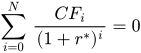
IRR is the discount rate r such that the sum of each cash flow divided by one plus r raised to the period number equals zero.
4 periods

Sign convention: enter the initial investment as a negative number (outflow). Future inflows are positive. IRR requires at least one sign change in the cash-flow stream.

IRR =

10.6517%

NPV at this rate ≈ 0 (converged in 4 iterations)

Show Your Work

Goal: find r such that Σ CFᵢ / (1 + r)ⁱ = 0
Initial guess: r₀ = 10% (Newton-Raphson method)
t=0: -1000 / (1 + 0.1065)^0 = -1000
t=1: 500 / (1 + 0.1065)^1 = 451.87
t=2: 400 / (1 + 0.1065)^2 = 326.7
t=3: 300 / (1 + 0.1065)^3 = 221.44
Σ discounted cash flows = 0 ≈ 0
Converged in 4 iterations
Final answer: IRR = 10.6517%
Share:

Internal Rate of Return

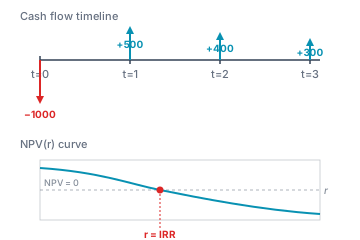
IRR is the discount rate r* that drives the Net Present Value of a cash-flow stream to zero. Given the initial outflow at t=0 plus inflows at t=1, 2, …, n, solve iteratively for the rate at which the present value of every future cash flow exactly cancels the original investment.

Σ CFᵢ / (1 + r)ⁱ = 0

How It Works

Internal Rate of Return is the per-period discount rate that makes the Net Present Value of a cash-flow stream equal zero. Because the NPV equation is a polynomial in (1 + r) of degree n — the number of periods — there's no closed-form solution beyond a handful of low-degree special cases. This calculator solves for IRR with Newton-Raphson iteration, falling back to bisection on [−99%, 1000%] if Newton diverges. Convergence requires at least one sign change in the cash-flow stream (typically a negative outflow at t = 0 followed by positive inflows), and the answer is reported as both a decimal and a percentage. Use IRR alongside NPV to decide whether a project's expected return exceeds your hurdle rate.

Example Problem

Find the IRR for an investment with an initial outflow of $1,000 today, followed by inflows of $500, $400, and $300 over the next three years.

  1. Write out the NPV equation: NPV(r) = −1,000 + 500/(1+r)¹ + 400/(1+r)² + 300/(1+r)³.
  2. Set NPV(r) = 0 and solve for r. Because the equation is cubic in (1+r), there's no closed-form solution — use iterative root-finding.
  3. Start with an initial guess r₀ = 0.10 (10%). At r = 0.10: NPV ≈ −1,000 + 454.55 + 330.58 + 225.39 = 10.52 (positive, so the true IRR is slightly higher).
  4. Apply Newton-Raphson: r₁ = r₀ − f(r₀) / f'(r₀). Repeat until |Δr| < 1e-10 (typically <10 iterations).
  5. The iteration converges to r ≈ 0.106517, or about 10.6517% per period.
  6. Decision: if your required hurdle rate (cost of capital) is less than 10.65%, the project creates value; if greater, reject the project.

At r = 10.6517%, NPV ≈ 0 to within floating-point precision. This is the rate at which the project breaks even on a present-value basis — accept the project when your hurdle rate is below this IRR.

Key Concepts

Three IRR concepts cause the most confusion. First, the decision rule: accept a project if IRR > hurdle rate (your cost of capital), reject if IRR < hurdle rate. The hurdle rate isn't built into the calculator — you compare it externally. Second, multiple IRRs: when a cash-flow stream has more than one sign change (e.g., outflow, then inflows, then another outflow for closing costs), the polynomial can have several real roots. Each is a mathematically valid IRR, but the decision rule becomes ambiguous; use NPV or Modified IRR (MIRR) for non-conventional streams. Third, the reinvestment assumption: standard IRR implicitly assumes intermediate cash flows are reinvested at the IRR itself. For high-IRR projects this is unrealistic — MIRR explicitly separates the financing and reinvestment rates, and many analysts prefer it for capital-budgeting decisions.

Applications

  • Capital budgeting — rank competing projects by IRR and accept those exceeding the firm's weighted average cost of capital.
  • Real estate investing — compute the levered or unlevered IRR on a rental property given purchase price, annual net operating income, and a projected sale price.
  • Private equity and venture capital — benchmark fund performance via IRR over the fund's life (annualized money-in vs money-out).
  • Loan analysis from the borrower's side — IRR is mathematically identical to the effective interest rate when sign conventions are flipped (cash in at t=0, payments out).
  • Bond yield-to-maturity — YTM is the IRR of a bond's cash flows (purchase price as outflow, coupons + face value as inflows).
  • Project economics in engineering — compare a capital-intensive design against a low-capex alternative on a discounted cash-flow basis.

Common Mistakes

  • Using IRR alone to compare mutually exclusive projects of different scale — a small project with a 50% IRR can have less dollar NPV than a large project with 15% IRR. For scale-different choices, use NPV.
  • Ignoring multiple IRRs on non-conventional cash flows — streams with multiple sign changes can have several mathematical roots. Always plot NPV(r) and use NPV or MIRR when the picture isn't clean.
  • Assuming reinvestment at the IRR rate — standard IRR builds this in implicitly. For projects with very high IRR, the assumption inflates the value-add; switch to MIRR with an explicit reinvestment rate.
  • Confusing IRR with the project's profit rate — IRR is the per-period rate that zeroes out NPV, not the average annual return on invested capital.
  • Forgetting the sign convention — the initial investment must be negative (an outflow). Entering all-positive cash flows yields no real IRR and the calculator will report no solution.
  • Mixing periods — annual cash flows and monthly cash flows can't be mixed in a single IRR. Compound or aggregate to one consistent period before solving.

Frequently Asked Questions

What is the Internal Rate of Return (IRR)?

IRR is the per-period discount rate at which the Net Present Value of a stream of cash flows equals zero. Equivalently, it's the rate of return at which the present value of all future cash inflows exactly equals the initial investment. If your project's IRR exceeds your hurdle rate, the project is creating value.

How do you calculate IRR?

Set up the NPV equation — the sum of each cash flow divided by (1 + r) raised to its period number — and solve for r such that NPV = 0. Because the equation is a polynomial of degree n (where n is the number of periods), there's no closed-form solution beyond simple cases, so we use iterative root-finding: typically Newton-Raphson starting from a guess of 10%, with bisection as a fallback. This calculator handles the iteration automatically.

What is a good IRR?

A 'good' IRR is one that exceeds your required rate of return (hurdle rate). For public-equity benchmarks the long-run S&P 500 IRR is around 10%; private equity funds typically target 15–25%; venture capital often shoots for 25%+ on individual deals. The right benchmark depends on the project's risk: a low-risk corporate bond can have a 5% IRR and still be attractive, while a speculative startup at 30% IRR may not compensate for the risk.

What's the difference between IRR and NPV?

NPV is a dollar amount: the present-value sum of all cash flows discounted at your hurdle rate. IRR is a rate: the discount rate at which NPV would equal zero. NPV tells you how much value a project adds in today's dollars; IRR tells you the project's break-even return. They give the same accept/reject decision for conventional cash flows but can rank mutually exclusive projects differently — when they disagree, prefer NPV because IRR ignores scale.

Can IRR be negative?

Yes. If the sum of future cash inflows is less than the initial outflow even without discounting, the IRR will be negative — meaning the project loses money on a time-value-of-money basis at any positive discount rate. For example, investing $1,000 today and receiving $800 back next year yields an IRR of −20%.

Why are there sometimes multiple IRRs?

Descartes' rule of signs says a polynomial can have as many positive real roots as it has sign changes in its coefficients. A conventional cash flow has one sign change (outflow at t=0, inflows after) and one IRR. Non-conventional streams — e.g., a mining project with cleanup costs at the end, or a construction project with progress payments — can have multiple sign changes, producing multiple mathematical IRRs. When this happens the decision rule becomes ambiguous; use NPV or MIRR instead.

What is the IRR decision rule?

For an independent project: accept if IRR > hurdle rate (cost of capital), reject if IRR < hurdle rate. For mutually exclusive projects (you can only pick one), prefer the project with higher NPV — IRR can mislead when projects differ in scale or timing. Always sanity-check with NPV if the IRR comparison feels too close to call.

What's the difference between IRR and MIRR?

Standard IRR implicitly assumes that intermediate cash inflows are reinvested at the IRR itself, which is unrealistic for high-IRR projects. Modified IRR (MIRR) splits this assumption in two: it discounts outflows at the firm's financing rate and compounds inflows forward at a separately specified reinvestment rate. MIRR is generally considered a more conservative and economically realistic measure than plain IRR.

Reference: Standard textbook definition (Brealey/Myers/Allen, Principles of Corporate Finance; Ross/Westerfield/Jordan, Fundamentals of Corporate Finance). Newton-Raphson with bisection fallback is the canonical numerical approach used in Excel's IRR() function and most financial-calculator implementations.

IRR Formula

Internal Rate of Return is the discount rate that makes the Net Present Value of a cash-flow stream equal zero:

Σ CFᵢ / (1 + r)ⁱ = 0

Where:

  • CFᵢ — the cash flow in period i (negative for outflows, positive for inflows)
  • r — the unknown discount rate we solve for; this is the IRR
  • i — the period index (0 = today, 1 = end of period 1, …, n = end of period n)
  • Σ — sum over every period in the stream

Because the equation is a polynomial in (1 + r) of degree n, there's no closed-form solution beyond a handful of low-degree cases. This calculator uses Newton-Raphson iteration starting from r₀ = 10%, with bisection on [−99%, 1000%] as a fallback when Newton can't converge.

Worked Examples

Canonical Three-Year Project

What is the IRR of a project that costs $1,000 today and returns $500, $400, and $300 over the next three years?

  • NPV(r) = −1,000 + 500/(1+r) + 400/(1+r)² + 300/(1+r)³
  • Set NPV = 0 and iterate from r₀ = 10%.
  • Newton-Raphson converges in <10 iterations.
  • IRR ≈ 10.6517% per year.

10-Year Coupon Bond

What is the yield-to-maturity of a $1,000 bond paying $100/year for 10 years plus $1,000 face value at year 11?

  • CF₀ = −1,000, CF₁ through CF₁₀ = +100, CF₁₁ = +1,100
  • The cash-flow pattern matches a 10% coupon bond purchased at par.
  • NPV(0.10) = 0 by construction, so IRR = YTM = 10%.

Money-Losing Investment

What is the IRR of investing $1,000 and getting only $800 back next year?

  • NPV(r) = −1,000 + 800/(1+r) = 0
  • (1 + r) = 800 / 1,000 = 0.80
  • r = −0.20 = −20%

A negative IRR means the project loses money on a present-value basis at any positive discount rate. Reject the project.

Related Calculators

Related Sites