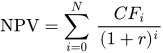
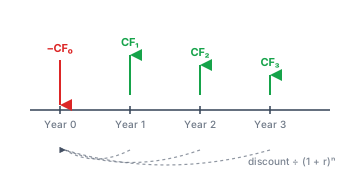
Discount each future cash flow CFᵢ back to today by dividing by (1 + r) raised to the period number i, then sum across every period (including period 0). A positive NPV means the project's discounted inflows exceed its discounted outflows at the chosen discount rate.
NPV = Σᵢ CFᵢ / (1 + r)ⁱ
How It Works
Net Present Value (NPV) compares the value of money received in the future to the value of money you have today. Because a dollar received in five years is worth less than a dollar in hand — you could have invested it — each future cash flow gets divided by (1 + r)ⁿ before being added to the total, where r is your discount rate (your required rate of return, opportunity cost, or cost of capital). NPV sums all the discounted cash flows, including the initial investment as a negative number at period 0. A positive NPV means the project is expected to earn more than your discount rate; a negative NPV means it earns less. The discount rate is the lever — raise it and future cash gets discounted harder, pushing NPV down. This is the cornerstone metric of capital budgeting, used to evaluate factory expansions, real estate purchases, equipment upgrades, and any project where money goes out today to bring money back later.
Example Problem
A company is considering a project that requires a $1,000 investment today and will return $500 in year 1, $400 in year 2, and $300 in year 3. The company's required rate of return is 10%. Should they take the project?
List every cash flow with its period: CF₀ = −$1,000, CF₁ = $500, CF₂ = $400, CF₃ = $300.
Compute the discount factor at each period: (1 + 0.10)⁰ = 1, (1.10)¹ = 1.1, (1.10)² = 1.21, (1.10)³ = 1.331.
Sum the present values: −1000 + 454.545 + 330.579 + 225.394 = $10.52.
Interpret: NPV ≈ $10.52 > 0, so at a 10% required return the project clears the hurdle — it's expected to earn slightly more than 10% annually. The internal rate of return (IRR), which makes NPV exactly zero, is just above 10%.
Decision: accept the project. If the company's required return were 12% instead, NPV would be negative (about −$24.20), and the same cash flow stream would be rejected.
NPV is highly sensitive to the discount rate. Always run sensitivity analysis at rates above and below your base assumption — a project that's a clear winner at 8% can flip negative at 12%.
Key Concepts
Three ideas anchor every NPV calculation. First, the time value of money: a dollar today is worth more than a dollar tomorrow because you can invest today's dollar and earn a return. The discount rate quantifies how much more. Second, the NPV decision rule: accept any project with NPV > 0 at your required rate of return, reject any with NPV < 0, and treat NPV = 0 as exact break-even (the project earns precisely the discount rate). When ranking mutually exclusive projects, pick the one with the highest NPV in absolute dollars — not the highest IRR. Third, NPV's relationship to IRR: the internal rate of return is the discount rate that makes NPV equal zero. If IRR > your required return, NPV is positive at that required return; if IRR < your required return, NPV is negative. NPV and IRR usually agree on accept/reject for independent projects, but NPV is the more reliable decision rule when projects have unusual cash flow timing or scale.
Applications
Capital budgeting — evaluating equipment purchases, factory expansions, IT infrastructure, and any project where money goes out today to bring money back over multiple years.
Real estate investment — discounting projected rent, appreciation, and sale proceeds back to today to compare against the purchase price.
Project comparison — ranking mutually exclusive projects by NPV in dollars (highest NPV wins) when capital is constrained.
Bond valuation — pricing a bond as the NPV of its coupon stream plus face value, discounted at the prevailing market yield.
Business valuation — discounted cash flow (DCF) models value an entire company as the NPV of projected free cash flows plus a terminal value.
Lease vs. buy analysis — comparing the NPV of lease payments against the NPV of purchase, maintenance, and resale to choose the cheaper option.
Mergers and acquisitions — buyers compute the NPV of expected synergies and incremental cash flows to set a maximum offer price.
Common Mistakes
Forgetting that period 0 is not discounted — the initial investment counts at face value because (1 + r)⁰ = 1. Discounting it would understate the outflow.
Putting the wrong sign on the initial outlay — it must be entered as a negative number. Treating it as positive flips every project to look profitable.
Mixing nominal and real discount rates with the wrong cash flows — if your cash flows include inflation, use a nominal discount rate; if they're in today's dollars, use a real rate. Mixing the two systematically biases NPV.
Using an arbitrary discount rate — most companies use their weighted average cost of capital (WACC) as the baseline; using the risk-free rate makes nearly every project look profitable.
Ignoring sunk costs incorrectly — sunk costs (money already spent) don't belong in any future cash flow; only incremental cash flows attributable to the decision should appear.
Forgetting terminal value — for ongoing projects, omit the final salvage or perpetuity value and you'll systematically undervalue long-lived investments.
Treating after-tax and pre-tax inconsistently — discount after-tax cash flows with an after-tax discount rate, or pre-tax with pre-tax. Mixing them double-counts taxes.
Frequently Asked Questions
How do you calculate NPV?
List every cash flow with its period (year 0 is the initial investment, usually negative). Divide each cash flow by (1 + r)ⁿ, where r is the discount rate as a decimal and n is the period number. Sum all the discounted cash flows. The result is the NPV — positive means the project earns more than the discount rate, negative means it earns less.
What is the formula for NPV?
NPV = Σᵢ CFᵢ / (1 + r)ⁱ, summed from i = 0 to N. CFᵢ is the cash flow at the end of period i (typically year 0 is the initial outlay as a negative number, and years 1 through N are subsequent inflows or outflows). r is the discount rate as a decimal, and N is the final period. Period 0 contributes CF₀ undiscounted because (1 + r)⁰ = 1.
What is NPV?
Net Present Value is the sum of all of a project's cash flows after each has been discounted back to today's dollars at the chosen discount rate. It tells you, in present-day dollars, how much value the project is expected to create (positive NPV) or destroy (negative NPV) compared to investing the same money at the discount rate instead.
What does a positive NPV mean?
A positive NPV means the project is expected to earn more than the discount rate — it creates value. If you assumed your required return is 10% and NPV came out positive, the project clears that 10% hurdle. The size of the positive NPV is the present-value dollar amount the project adds beyond simply earning the discount rate on the same capital.
What is the difference between NPV and IRR?
NPV is the dollar value a project adds at a given discount rate. IRR (internal rate of return) is the discount rate that makes NPV equal exactly zero. NPV gives an absolute dollar answer that depends on the rate you choose; IRR gives a single rate that depends only on the cash flow stream. They usually agree on accept/reject for a single project, but NPV is more reliable when comparing projects of different scale or with unusual cash flow patterns.
What discount rate should I use for NPV?
Use a rate that reflects the risk and opportunity cost of the project. For a corporate capital budgeting decision, the standard is the company's weighted average cost of capital (WACC), often in the 7–12% range. For a personal investment, use your next-best alternative return (a diversified stock index has averaged about 7% real). For a high-risk venture, add a risk premium. The rate matters — small changes can flip NPV from positive to negative.
Can NPV be negative?
Yes. A negative NPV means the project's discounted inflows are less than its discounted outflows at the chosen rate — the project is expected to earn less than the discount rate and destroys value relative to the alternative of earning that rate elsewhere. The standard decision rule is to reject negative-NPV projects.
How does the discount rate affect NPV?
Raising the discount rate lowers NPV because future cash flows get divided by a larger number — they're worth less in today's dollars. Lowering the rate raises NPV. Long-dated cash flows are especially sensitive: a cash flow 10 years out at 5% has a present value of about 61% of its face; at 10% it drops to 39%; at 15% it's only 25%. Always run NPV at a range of rates to see how sensitive your conclusion is.
Reference:
Net present value is a standard capital budgeting metric defined in every introductory finance textbook (e.g., Brealey, Myers, and Allen, Principles of Corporate Finance; Ross, Westerfield, and Jaffe, Corporate Finance). The formula is consistent across academic and industry practice.
NPV Formula
Net Present Value is the credit-weighted sum of every cash flow, with each future cash flow discounted back to today by dividing by one plus the discount rate raised to the period number:
NPV = Σᵢ CFᵢ / (1 + r)ⁱ
Where:
CFᵢ — the cash flow at the end of period i. Period 0 is "now" (typically the initial investment as a negative number); periods 1 through N are future inflows or outflows.
r — the discount rate as a decimal (10% = 0.10). Use your required rate of return, weighted average cost of capital, or opportunity cost.
i — the period index. The exponent is what makes far-future cash flows worth so much less than near-term ones.
Σ — sum across every period from 0 to N.
A positive NPV means the project earns more than the discount rate — it creates value. A negative NPV means it earns less. NPV equal to zero means the project earns exactly the discount rate (the internal rate of return equals r).
Worked Examples
Classic Capital Budget
Should we take a $1,000 project that returns $500, $400, and $300 over three years at 10%?
A company evaluates a project requiring $1,000 up front and yielding declining returns of $500, $400, and $300 across years 1, 2, and 3. Required return: 10%.
CF₀ = −1000, CF₁ = 500, CF₂ = 400, CF₃ = 300.
Discount factors: 1, 1.1, 1.21, 1.331.
Present values: −1000, 454.55, 330.58, 225.39.
NPV = −1000 + 454.55 + 330.58 + 225.39 = $10.52.
NPV ≈ $10.52 — accept the project.
Just barely positive — the project earns slightly more than the 10% required return. At a 12% required return, NPV flips to about −$24.20 and the same project would be rejected.
Real Estate
What's the NPV of a $200K rental that produces $18K/year for 5 years and sells for $230K?
Investor buys a rental for $200,000, nets $18,000/year in rent for 5 years, then sells in year 5 for $230,000 (so year-5 cash flow is $18K + $230K = $248K). Required return: 8%.
If property values were flat (no $230K resale lift), NPV at 8% drops to about −$28,150 and the deal becomes a loser. NPV is exquisitely sensitive to your terminal value assumption.
High-Rate Sensitivity
What happens to the classic project's NPV at a 20% discount rate?
Same $1,000 / $500 / $400 / $300 cash flow stream as Example 1, but a venture-style 20% required return.
Same project, same cash flows, opposite decision. The break-even discount rate (IRR) for this stream is about 10.65%; any required return above that flips NPV negative.
Related Calculators
Present Value Calculator — discount a single future amount back to today (the building block of NPV)