
Calculate Icosahedron Volume from Edge
Use this form when the edge length is known and you need the enclosed volume — d20 dice, geodesic domes, virus capsids.
V = (5/12) (3 + √5) a³
Calculate Icosahedron Surface Area from Edge
Use this form for the total area of all 20 equilateral-triangle faces — coatings, decals, modeling.
S = 5 √3 a²
Calculate Icosahedron Circumradius from Edge
Use this form for the distance from the center to any vertex — useful when fitting an icosahedron inside a sphere.
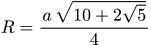
R = a √(10 + 2 √5) / 4
Calculate Icosahedron Edge from Volume
Use this rearrangement when the volume is known and you need the edge length.
a = ∛(6 V / (5 φ²))
How It Works
This regular icosahedron calculator solves V = (5/12)(3 + √5) a³ for volume, S = 5 √3 a² for the total surface area of all 20 equilateral-triangle faces, and R = a √(10 + 2 √5) / 4 for the circumradius (center-to-vertex distance). The inverse a = ∛(6 V / (5 φ²)) recovers the edge from a known volume. Every dimension of a regular icosahedron is fixed by a single number — the edge length a — and the golden ratio φ = (1 + √5) / 2 appears throughout, because φ² = φ + 1 = (3 + √5) / 2.
Example Problem
A regular icosahedron has edge length a = 2 m. What are its volume, surface area, circumradius, inradius, and midradius?
- Knowns: a = 2 m (all 30 edges equal length, all 20 faces are equilateral triangles)
- Volume: V = (5/12)(3 + √5) · a³ = (5/12)(3 + √5) · 8 = (10/3)(3 + √5) ≈ 17.4536 m³
- Surface area: S = 5 √3 · a² = 5 √3 · 4 = 20 √3 ≈ 34.6410 m²
- Circumradius: R = a · √(10 + 2 √5) / 4 = √(10 + 2 √5) / 2 ≈ 1.9021 m (center to vertex)
- Midradius: ρ = a · φ / 2 = φ ≈ 1.6180 m (center to edge midpoint — equals the golden ratio for a = 2)
- Inradius: r = a · φ² / (2 √3) = φ² / √3 ≈ 1.5115 m (center to face center)
- Sanity check (inverse): from V ≈ 17.4536, a = ∛(6 · 17.4536 / (5 φ²)) = 2 m. ✓
The icosahedron is one of the five Platonic solids and the dual of the dodecahedron — its 12 vertices correspond to the 12 faces of a dodecahedron, and vice versa. The familiar d20 die used in tabletop role-playing games is a regular icosahedron.
When to Use Each Variable
- Solve for Volume — when the edge length is known — d20 dice, geodesic domes, virus capsid models.
- Solve for Surface Area — when you need the total area of all 20 triangular faces — paint, vinyl wrap, panel coverage.
- Solve for Circumradius — when you need the radius of the smallest sphere that contains the icosahedron — fits inside a spherical enclosure.
- Solve for Edge — when the volume is known and you need the edge length — sizing an icosahedral container to a target capacity.
Key Concepts
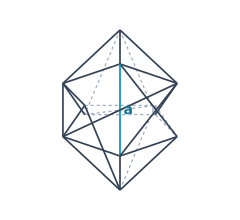
A regular icosahedron is the fifth and largest of the five Platonic solids — a convex polyhedron with 20 congruent equilateral-triangle faces, 30 edges of equal length, and 12 vertices where exactly 5 triangles meet. Every property follows from a single dimension, the edge length a, and the golden ratio φ = (1 + √5) / 2 appears in every formula because the 12 vertices of a regular icosahedron can be placed at the cyclic coordinates (0, ±1, ±φ), (±1, ±φ, 0), and (±φ, 0, ±1). Useful identities: φ² = φ + 1 = (3 + √5) / 2, so the volume coefficient (5/12)(3 + √5) is exactly 5 φ² / 6 ≈ 2.18170. The icosahedron is the dual of the regular dodecahedron — connecting the centers of the 12 pentagonal faces of a dodecahedron gives the 12 vertices of an icosahedron, and they share the icosahedral symmetry group (I_h). The dihedral angle between adjacent faces is arccos(-√5 / 3) ≈ 138.19°.
Applications
- Tabletop gaming: the d20 die used in Dungeons & Dragons and many other systems is a regular icosahedron — 20 congruent faces give every roll equal probability
- Geodesic domes: Buckminster Fuller's geodesic dome designs subdivide the faces of an icosahedron into smaller triangles to approximate a sphere with flat panels
- Virology: many spherical viruses (poliovirus, herpesvirus, HIV core, adenovirus) have an icosahedral capsid — the protein shell is built from a small repeating subunit arranged with icosahedral symmetry
- Materials & sphere packing: the icosahedral close-packed cluster of 12 atoms around a central atom is a local minimum-energy structure in many metal alloys and Lennard-Jones clusters
- Cartography: icosahedral map projections (like the Dymaxion map) unfold the 20 triangular faces of the icosahedron into a flat layout with minimal distortion
- Quasicrystals: the discovery of icosahedral quasicrystals (Shechtman, 1984 Nobel Prize in Chemistry 2011) revealed solid materials with long-range order but icosahedral five-fold symmetry that classical crystallography had ruled out
Common Mistakes
- Confusing the icosahedron (20 triangular faces, 12 vertices) with the dodecahedron (12 pentagonal faces, 20 vertices) — they are duals of each other, so the face/vertex counts are swapped
- Forgetting that the volume coefficient depends on the golden ratio — V = (5/12)(3 + √5) a³ ≈ 2.1817 a³ is not a round number
- Using the surface-area formula for a regular tetrahedron or octahedron (which also have equilateral-triangle faces) instead of multiplying by 20 — an icosahedron has 20 faces, not 4 or 8
- Mixing up the circumradius R (center to vertex, the largest radius), midradius ρ (center to edge midpoint), and inradius r (center to face center, the smallest) — for an icosahedron r ≈ 0.756 a, ρ ≈ 0.809 a, R ≈ 0.951 a
- Computing cube root from a non-round volume and losing precision — the calculator uses BigNumber for accurate cube roots even at very large or very small volumes
Frequently Asked Questions
How do you calculate the volume of a regular icosahedron?
V = (5/12) (3 + √5) a³, where a is the edge length. Equivalently, V = 5 φ² a³ / 6, with the golden ratio φ = (1 + √5)/2. For a = 2, V = (10/3)(3 + √5) ≈ 17.4536 cubic units.
What is the formula for the surface area of an icosahedron?
S = 5 √3 · a². The icosahedron has 20 equilateral-triangle faces, each with area (√3 / 4) a², so the total is 20 · (√3/4) a² = 5 √3 a². For a = 2, S = 20 √3 ≈ 34.6410 square units.
How many faces, edges, and vertices does an icosahedron have?
A regular icosahedron has 20 equilateral-triangle faces, 30 edges of equal length, and 12 vertices where exactly five triangles meet. Euler's formula V − E + F = 12 − 30 + 20 = 2 confirms it's a valid convex polyhedron.
What is the circumradius of a regular icosahedron?
R = a · √(10 + 2 √5) / 4, the distance from the center to any vertex. Equivalently, R = a · √(φ² + 1) / 2 with φ the golden ratio. For a = 2, R = √(10 + 2 √5) / 2 ≈ 1.9021 — the radius of the smallest sphere that contains the icosahedron.
What is an icosahedron used for?
An icosahedron is the standard shape of the 20-sided die (d20) used in tabletop role-playing games, the structural template for geodesic domes, and the symmetry pattern of many spherical viruses (poliovirus, HIV core, adenovirus). Its 20 congruent faces make it the Platonic solid that best approximates a sphere.
What is the difference between an icosahedron and a dodecahedron?
An icosahedron has 20 equilateral-triangle faces and 12 vertices. A dodecahedron has 12 regular-pentagon faces and 20 vertices. They are dual polyhedra — connecting the face centers of one gives the vertices of the other, and they share the same icosahedral symmetry group (I_h).
Why does the golden ratio appear in icosahedron formulas?
The 12 vertices of a regular icosahedron can be placed at the cyclic coordinates (0, ±1, ±φ), (±1, ±φ, 0), and (±φ, 0, ±1), where φ = (1 + √5)/2 is the golden ratio. This is the simplest set of integer-and-φ coordinates that yields all edges of equal length, so φ ends up in every derived dimension (volume, circumradius, midradius, inradius).
Is an icosahedron the same as a d20 die?
Yes. The standard 20-sided die used in Dungeons & Dragons and many other tabletop role-playing systems is a regular icosahedron — 20 congruent equilateral-triangle faces, each numbered 1 through 20, with opposite faces summing to 21.
Reference:
Weisstein, Eric W. "Regular Icosahedron." MathWorld — A Wolfram Web Resource. https://mathworld.wolfram.com/RegularIcosahedron.html
Worked Examples
Tabletop Gaming
How big is a standard d20 die at 18 mm edge length?
A typical d20 RPG die has roughly 18 mm edges. Compute its volume and surface area to estimate resin or material usage.
- Knowns: a = 0.018 m (18 mm)
- Formula: V = (5/12)(3 + √5) a³
- V = (5/12)(3 + √5) · (0.018)³ ≈ 1.27 × 10⁻⁵ m³ ≈ 12.73 cm³
- Surface area: S = 5 √3 · (0.018)² ≈ 2.81 × 10⁻³ m² ≈ 28.05 cm²
Volume ≈ 12.73 cm³, surface area ≈ 28.05 cm²
Real d20 dice have slightly rounded edges and may be slightly hollow, so the practical resin volume is a bit less than the geometric ideal.
Virology
What is the surface area of a 30 nm icosahedral virus capsid?
Many spherical viruses (poliovirus, adenovirus) have an icosahedral protein capsid roughly 30 nm across the longest diagonal. Estimate its surface area to find how many capsid proteins coat it.
- Diameter ≈ 30 nm corresponds to a circumradius R ≈ 1.5 × 10⁻⁸ m
- From R = a √(10 + 2 √5) / 4 ≈ 0.951 a, we get a ≈ R / 0.951 ≈ 1.578 × 10⁻⁸ m
- Surface area: S = 5 √3 · a² ≈ 5 √3 · (1.578 × 10⁻⁸)² m²
- S ≈ 2.16 × 10⁻¹⁵ m² ≈ 2156 nm²
Surface area ≈ 2156 nm² for a 30 nm icosahedral capsid
Real virus capsids are quasi-icosahedral — the protein subunits sit at lattice points that obey icosahedral symmetry but allow more than 12 subunits via triangulation numbers T = 1, 3, 4, 7, ...
Architecture
What edge length gives a 10-meter geodesic dome based on an icosahedron?
A geodesic dome based on a regular icosahedron has its 12 vertices on a circumscribed sphere. Find the edge length that gives a sphere diameter of 10 m (R = 5 m).
- Knowns: R = 5 m (the dome radius — half the diameter)
- Formula: R = a · √(10 + 2 √5) / 4, so a = 4R / √(10 + 2 √5)
- a = 4 · 5 / √(10 + 2 √5) = 20 / √(10 + 2 √5) ≈ 20 / 3.8042 m
- a ≈ 5.257 m
Edge length ≈ 5.26 m for a 10 m diameter icosahedral dome
Real geodesic domes subdivide each triangular face into many smaller triangles to better approximate a sphere — these are characterized by their frequency (1V, 2V, 3V, ...).
Icosahedron Formulas
All regular-icosahedron properties follow from a single dimension: the edge length a. The golden ratio φ = (1 + √5) / 2 appears throughout, with the useful identity φ² = φ + 1 = (3 + √5) / 2.
Volume equals five times the golden ratio squared, times a cubed, divided by sixSurface area equals five times the square root of three, times a squaredCircumradius equals a times the square root of ten plus two times the square root of five, divided by fourEdge equals the cube root of six V divided by five times the golden ratio squared


Where:
- V — volume (m³, L, gal, ft³)
- S — total surface area of all 20 equilateral-triangle faces
- R — circumradius: center to vertex, R = a √(10 + 2 √5) / 4 ≈ 0.951 a
- ρ — midradius: center to edge midpoint, ρ = a φ / 2 ≈ 0.809 a
- r — inradius: center to face center, r = a φ² / (2 √3) ≈ 0.756 a
- a — edge length (all 30 edges equal)
- φ — golden ratio, φ = (1 + √5) / 2 ≈ 1.618
Related Calculators
- Dodecahedron Calculator — the dual of the icosahedron — 12 pentagonal faces
- Octahedron Calculator — the third Platonic solid with 8 triangular faces
- Cube Calculator — the fourth Platonic solid with 6 square faces
- Sphere Calculator — compare volume and surface area to the circumscribed sphere
- Geometric Formulas Calculator — explore volume formulas for many shapes
- Volume Converter — switch between m³, L, gallons, ft³
Related Sites
- Temperature Tool — Temperature unit converter
- Z-Score Calculator — Z-score, percentile, and probability calculator
- OptionsMath — Options trading profit and loss calculators
- Medical Equations — Hemodynamic, pulmonary, and dosing calculators
- Dollars Per Hour — Weekly paycheck calculator with overtime
- Percent Off Calculator — Discount and sale price calculator