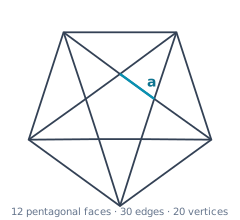
Calculate Dodecahedron Volume from Edge
Use this form when the edge length is known and you need the enclosed volume — d12 dice, fullerene-like cages, classical Platonic solids.
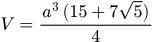
V = a³ (15 + 7√5) / 4
Calculate Dodecahedron Surface Area from Edge
Use this form for the total area of all twelve regular-pentagon faces — coating, decals, surface modeling.
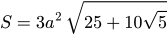
S = 3 a² √(25 + 10√5)
Calculate Dodecahedron Circumradius
Use this form for the radius of the sphere passing through all 20 vertices, where φ = (1 + √5)/2 is the golden ratio.
R = a √3 · φ / 2
Calculate Dodecahedron Edge from Volume
Use this rearrangement when the volume is known and you need the edge length.
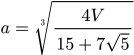
a = ∛(4 V / (15 + 7√5))
How It Works
This regular dodecahedron calculator solves V = a³ (15 + 7√5) / 4 for volume, S = 3 a² √(25 + 10√5) for the total surface area of all twelve regular-pentagon faces, and R = a √3 · φ / 2 for the circumradius (radius of the sphere through all 20 vertices), where φ = (1 + √5)/2 is the golden ratio. Inverse: a = ∛(4 V / (15 + 7√5)) recovers the edge from the volume. Pick the unknown with the solve-for toggle, enter the remaining value in any supported length, area, or volume unit, and the calculator handles unit conversions internally.
Example Problem
A regular dodecahedron has edge length a = 2 m. What are its volume, surface area, inradius, midradius, and circumradius?
- Knowns: a = 2 m (all 30 edges equal length, all 12 faces regular pentagons)
- Volume: V = a³ (15 + 7√5) / 4 = 8 · (15 + 7√5) / 4 = 2(15 + 7√5) ≈ 61.305 m³
- Surface area: S = 3 a² √(25 + 10√5) = 12 √(25 + 10√5) ≈ 82.583 m²
- Inradius (center to face): r = a √((25 + 11√5)/10) / 2 = √((25 + 11√5)/10) ≈ 2.227 m
- Midradius (center to edge midpoint): ρ = a φ² / 2 = φ² ≈ 2.618 m
- Circumradius (center to vertex): R = a √3 · φ / 2 = √3 · φ ≈ 2.803 m
- Sanity check (inverse): from V ≈ 61.305, a = ∛(4 · 61.305 / (15 + 7√5)) = 2 m. ✓
The dodecahedron is the fourth Platonic solid and the dual of the icosahedron — its 12 face centers correspond to the 12 vertices of an icosahedron. Every formula above is laced with the golden ratio φ = (1 + √5)/2, the same constant that defines the proportions of a regular pentagon.
When to Use Each Variable
- Solve for Volume — when the edge length is known — d12 dice, fullerene shells, Platonic-solid puzzles.
- Solve for Surface Area — when you need the total area of all twelve pentagonal faces — coating, modeling, wrapping.
- Solve for Circumradius — when you need the radius of the smallest sphere that encloses the dodecahedron (touches every vertex).
- Solve for Edge — when the volume is known and you need the edge length.
Key Concepts
A regular dodecahedron is the fourth of the five Platonic solids — a convex polyhedron with 12 regular-pentagon faces, 30 equal edges, and 20 vertices. Three pentagons meet at every vertex. Because the regular pentagon is itself defined by the golden ratio φ = (1 + √5)/2, every property of the dodecahedron is laced with √5: V = a³ (15 + 7√5)/4, S = 3 a² √(25 + 10√5), midradius ρ = a φ²/2, circumradius R = a √3 · φ/2. The dodecahedron is the dual of the icosahedron — connect the 12 face centers of one and you get the 20 vertices of the other, so the two share the same symmetry group (icosahedral symmetry, I_h). Euler’s formula confirms a valid convex polyhedron: V − E + F = 20 − 30 + 12 = 2.
Applications
- Tabletop gaming: the d12 die used in Dungeons & Dragons and many other systems is a regular dodecahedron
- Chemistry: the dodecahedrane molecule (C₂₀H₂₀) places 20 carbon atoms at the vertices of a regular dodecahedron
- Crystallography: pyrite famously grows as 'pyritohedral' (near-dodecahedral) crystals, and several quasicrystals exhibit icosahedral/dodecahedral symmetry
- Cosmology: in 2003 a 'Poincaré dodecahedral space' model briefly emerged as a candidate topology for the universe based on WMAP data anomalies
- Art & architecture: the dodecahedron features in Plato’s Timaeus as the symbol of the cosmos and recurs in Renaissance art (Leonardo, Pacioli), Escher prints, and modern sculpture
Common Mistakes
- Confusing the regular dodecahedron with the rhombic dodecahedron — they both have 12 faces but the rhombic version uses rhombuses, not regular pentagons, and is not a Platonic solid
- Confusing the dodecahedron (12 pentagonal faces) with the icosahedron (20 triangular faces) — they are dual, so they share many symmetry properties but differ in face shape and count
- Using the edge length where the circumradius is required (or vice versa) — R ≈ 1.401 · a is noticeably larger than a, so swapping them in V or S gives a result several times too large
- Dropping the factor of √5 in the volume or surface coefficients — both formulas contain it, and rounding (15 + 7√5)/4 to a tidy integer loses meaningful precision
- Forgetting that the regular dodecahedron requires regular pentagons — a 12-faced cage with irregular pentagons (like a soccer ball cap or some fullerene fragments) is not a regular dodecahedron
Frequently Asked Questions
How do you calculate the volume of a dodecahedron?
V = a³ (15 + 7√5) / 4, where a is the edge length. The numeric coefficient (15 + 7√5)/4 ≈ 7.6631, so V ≈ 7.6631 · a³. For a = 2, V = 2(15 + 7√5) ≈ 61.305 cubic units.
What is the formula for surface area of a dodecahedron?
S = 3 a² √(25 + 10√5). Each of the 12 regular-pentagon faces has area (a²/4) · √(25 + 10√5), and 12 · (1/4) = 3. The coefficient 3 √(25 + 10√5) ≈ 20.6457, so S ≈ 20.6457 · a².
How many faces, edges, and vertices does a dodecahedron have?
A regular dodecahedron has 12 regular-pentagon faces, 30 equal edges, and 20 vertices. Three pentagons meet at every vertex. Euler’s formula V − E + F = 20 − 30 + 12 = 2 confirms it’s a valid convex polyhedron.
What is a dodecahedron used for?
Common modern uses include the d12 die in tabletop role-playing games and educational geometry kits. In chemistry it models the C₂₀H₂₀ dodecahedrane molecule; in mineralogy, pyrite crystals; in art, classical and Renaissance depictions of the cosmos (Plato’s Timaeus, Leonardo, Escher); and it surfaces in physics as the candidate Poincaré dodecahedral space topology of the universe.
How is the dodecahedron related to the golden ratio?
The golden ratio φ = (1 + √5)/2 ≈ 1.618 appears in every key formula. The midradius is exactly ρ = a φ²/2, the circumradius is R = a √3 · φ/2, and the volume and surface area both involve √5 (since √5 = 2φ − 1). This is because each face is a regular pentagon, whose own diagonal-to-side ratio is φ.
What is the difference between a dodecahedron and an icosahedron?
They are dual Platonic solids. A regular dodecahedron has 12 pentagonal faces, 30 edges, and 20 vertices; a regular icosahedron has 20 triangular faces, 30 edges, and 12 vertices — exactly the face and vertex counts swapped. Connecting the face centers of one produces the vertices of the other, so they share the same icosahedral symmetry group (I_h).
Is a dodecahedron a Platonic solid?
Yes. The regular dodecahedron is one of the five Platonic solids (alongside the tetrahedron, cube, octahedron, and icosahedron). Every face is a congruent regular pentagon, every edge has equal length, and every vertex has the same configuration of three pentagons meeting.
What is the circumradius of a regular dodecahedron?
R = a · √3 · φ / 2 ≈ 1.4013 · a, where φ = (1 + √5)/2 is the golden ratio. This is the radius of the sphere that passes through all 20 vertices. For a = 2, R = √3 · φ ≈ 2.803.
Reference:
Weisstein, Eric W. "Regular Dodecahedron." MathWorld — A Wolfram Web Resource. https://mathworld.wolfram.com/RegularDodecahedron.html
Worked Examples
Tabletop Gaming
How big is a standard d12 die at 16 mm edge length?
A standard d12 RPG die has roughly 16 mm edges. Compute its volume and surface area to estimate resin usage for casting.
- Knowns: a = 0.016 m (16 mm)
- Formula: V = a³ (15 + 7√5) / 4, with (15 + 7√5)/4 ≈ 7.6631
- V = (0.016)³ · 7.6631 ≈ 4.096 × 10⁻⁶ · 7.6631 ≈ 3.14 × 10⁻⁵ m³ ≈ 31.4 cm³
- Surface area: S = 3 (0.016)² √(25 + 10√5) with √(25+10√5) ≈ 6.8819
- S = 3 · 2.56 × 10⁻⁴ · 6.8819 ≈ 5.29 × 10⁻³ m² ≈ 52.9 cm²
Volume ≈ 31.4 cm³, surface area ≈ 52.9 cm²
Real injection-molded d12 dice have slightly rounded vertices, so the practical resin volume is a bit less. The dodecahedron is bulkier than a d8 of the same edge length because of its 12 vs 8 faces.
Chemistry
What is the volume of a dodecahedrane (C₂₀H₂₀) cage?
Dodecahedrane is a hydrocarbon with 20 carbon atoms at the vertices of a regular dodecahedron. The C–C bond length is about 1.54 Å, so the edge a ≈ 1.54 Å. Compute the volume enclosed by the carbon cage.
- Knowns: a = 1.54 Å = 1.54 × 10⁻¹⁰ m
- Formula: V = a³ (15 + 7√5) / 4
- V = (1.54 × 10⁻¹⁰)³ · 7.6631 ≈ 2.80 × 10⁻²⁹ m³ ≈ 28.0 ų
- Compare: the van der Waals cavity inside dodecahedrane is small enough to be observable but too small to host a He atom comfortably
Cage volume ≈ 28.0 ų
C₂₀H₂₀ was first synthesized in 1982 by Leo Paquette. Its strained geometry forces all bond angles to 108° (the regular-pentagon interior angle), close to the ideal sp³ tetrahedral angle of 109.5°.
Geometry
What is the circumradius of a regular dodecahedron with edge a = 1?
When studying the Platonic solids in pure form, it’s common to compute the circumradius (the radius of the sphere through all 20 vertices) for a unit-edge dodecahedron.
- Knowns: a = 1 (unit edge)
- Formula: R = a · √3 · φ / 2, where φ = (1 + √5)/2 ≈ 1.6180
- R = √3 · φ / 2 ≈ 1.7321 · 1.6180 / 2 ≈ 1.4013
- Inradius for comparison: r = √((25 + 11√5)/10) / 2 ≈ 1.1135
- Midradius: ρ = φ² / 2 ≈ 1.3090
Circumradius R ≈ 1.4013 (inradius ≈ 1.1135, midradius ≈ 1.3090)
Notice r < ρ < R: the inradius is shortest (center to face midpoint), the circumradius is longest (center to vertex), and the midradius lies between (center to edge midpoint). All three are laced with the golden ratio φ.
Dodecahedron Formulas
All regular-dodecahedron properties follow from a single dimension: the edge length a. The golden ratio φ = (1 + √5)/2 appears throughout.
Volume equals a cubed times the quantity fifteen plus seven times the square root of five, all divided by fourSurface area equals three times a squared times the square root of the quantity twenty-five plus ten times the square root of fiveCircumradius equals a times the square root of three, times the golden ratio phi, divided by twoEdge equals the cube root of four V divided by the quantity fifteen plus seven times the square root of five

Where:
- V — volume (m³, L, gal, ft³)
- S — total surface area of all twelve regular-pentagon faces
- R — circumradius: center to vertex, R = a √3 · φ / 2 (radius of the sphere through all 20 vertices)
- r — inradius: center to face midpoint, r = a √((25 + 11√5)/10) / 2
- ρ — midradius: center to edge midpoint, ρ = a φ² / 2
- a — edge length (all 30 edges equal)
- φ — the golden ratio, φ = (1 + √5)/2 ≈ 1.6180
Related Calculators
- Icosahedron Calculator — the dual of the dodecahedron — same symmetry group, swapped faces and vertices
- Octahedron Calculator — another Platonic solid — 8 equilateral-triangle faces
- Cube Calculator — the simplest Platonic solid — 6 square faces, dual of the octahedron
- Sphere Calculator — compare volume and surface area to the circumscribed sphere
- Volume Converter — switch between m³, L, gallons, ft³
Related Sites
- Temperature Tool — Temperature unit converter
- Z-Score Calculator — Z-score, percentile, and probability calculator
- OptionsMath — Options trading profit and loss calculators
- Medical Equations — Hemodynamic, pulmonary, and dosing calculators
- Dollars Per Hour — Weekly paycheck calculator with overtime
- Percent Off Calculator — Discount and sale price calculator