
Calculate Octahedron Volume from Edge
Use this form when the edge length is known and you need the enclosed volume — d8 dice, octahedral crystals, two-pyramid geometry.
V = (√2 / 3) a³
Calculate Octahedron Surface Area from Edge
Use this form for the total area of all eight equilateral-triangle faces — coating, decals, modeling.
S = 2 √3 a²
Calculate Octahedron Long Diagonal
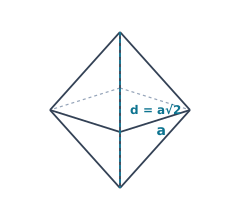
Use this form for the distance between the two opposite vertices — also the height of the two pyramids joined base-to-base.
d = a √2
Calculate Octahedron Edge from Volume
Use this rearrangement when the volume is known and you need the edge length.
a = ∛(3 V / √2)
How It Works
This regular octahedron calculator solves V = (√2 / 3) a³ for volume, S = 2 √3 a² for the total surface area of all eight equilateral-triangle faces, and d = a √2 for the long diagonal between opposite vertices. Inverse: a = ∛(3 V / √2) recovers the edge from the volume. Pick the unknown with the solve-for toggle, enter the remaining value in any supported length, area, or volume unit, and the calculator handles unit conversions internally.
Example Problem
A regular octahedron has edge length a = 4 m. What are its volume, surface area, long diagonal, inradius, and circumradius?
- Knowns: a = 4 m (all 12 edges equal length)
- Volume: V = (√2 / 3) a³ = (√2 / 3) · 64 = 64 √2 / 3 ≈ 30.170 m³
- Surface area: S = 2 √3 a² = 2 √3 · 16 = 32 √3 ≈ 55.426 m²
- Long diagonal: d = a √2 = 4 √2 ≈ 5.657 m (distance between opposite vertices)
- Inradius: r = a √6 / 6 = 4 √6 / 6 ≈ 1.633 m (center to face)
- Circumradius: R = a √2 / 2 = 2 √2 ≈ 2.828 m (center to vertex — half the long diagonal)
- Sanity check (inverse): from V ≈ 30.170, a = ∛(3 · 30.170 / √2) = 4 m. ✓
The octahedron is the second Platonic solid (after the tetrahedron). It is the dual of the cube — its 6 vertices correspond to the 6 faces of a cube, and vice versa. The familiar d8 die used in tabletop games is a regular octahedron.
When to Use Each Variable
- Solve for Volume — when the edge length is known — d8 dice, octahedral molecules, crystal cells.
- Solve for Surface Area — when you need the total area of all eight triangular faces — coating, decals, paint coverage.
- Solve for Long Diagonal — when you need the corner-to-opposite-corner distance — also equals 2R, twice the circumradius.
- Solve for Edge — when the volume is known and you need the edge length.
Key Concepts
A regular octahedron is the second of the five Platonic solids — a convex polyhedron with 8 equilateral-triangle faces, 12 equal edges, and 6 vertices. It has the geometry of two congruent square pyramids glued base-to-base along a shared square equator. Every property follows from a single dimension, the edge length a: volume V = (√2 / 3) a³, surface area S = 2 √3 a², long diagonal d = a √2 (twice the circumradius), inradius r = a √6 / 6, and circumradius R = a √2 / 2. The octahedron is the dual of the cube: a cube's face centers form an octahedron and an octahedron's face centers form a cube, so they share the same symmetry group (octahedral symmetry, O_h). Among Platonic solids, the inradius-to-circumradius ratio for the octahedron equals √3 / 3, the same as for the cube — another consequence of their duality.
Applications
- Tabletop gaming: the d8 die used in Dungeons & Dragons and many other systems is a regular octahedron
- Crystallography: diamond and many transition-metal halides crystallize in octahedral arrangements — the corner atoms of a face-centered cubic lattice define octahedral interstitial sites
- Chemistry: octahedral molecular geometry (e.g., SF6, [Co(NH3)6]³⁺) places six ligands at the vertices of a regular octahedron around a central atom — bond angles 90°
- Mineralogy: fluorite, magnetite, and spinel commonly form natural octahedral crystals
- Architecture & art: the octahedron is the simplest space-filling unit when alternated with tetrahedra (the tetrahedral-octahedral honeycomb)
Common Mistakes
- Confusing the regular octahedron with a generic 8-faced solid — only the regular octahedron has all faces congruent equilateral triangles
- Using the cube-volume formula V = a³ instead of V = (√2 / 3) a³ — they share the same edge variable but very different volumes (cube is about 2.1× the octahedron)
- Forgetting the factor of √2 in the volume coefficient — the surface-area formula S = 2 √3 a² has √3 (equilateral-triangle area), the volume formula has √2 (pyramid heights)
- Mixing the long diagonal (vertex to opposite vertex, a √2) with the edge length — d is the largest interior distance
- Computing cube root from a non-perfect volume and losing precision — the calculator uses BigNumber for accurate cube roots even at very large or very small volumes
Frequently Asked Questions
How do you calculate the volume of a regular octahedron?
V = (√2 / 3) · a³, where a is the edge length. For a = 4, V = 64 √2 / 3 ≈ 30.170 cubic units. Equivalently, treat it as two square pyramids of base side a and height a √2 / 2 stacked base-to-base.
What is the formula for the surface area of an octahedron?
S = 2 √3 · a². The octahedron has 8 equilateral-triangle faces; each has area (√3 / 4) a², so the total is 8 · (√3 / 4) a² = 2 √3 a². For a = 4, S = 32 √3 ≈ 55.426 square units.
What is the long diagonal of a regular octahedron?
d = a √2 — the straight-line distance between the two opposite (apex) vertices. It is also twice the circumradius, since the apex vertices lie on the circumscribed sphere directly opposite each other. For a = 4, d = 4 √2 ≈ 5.657.
How many faces, edges, and vertices does a regular octahedron have?
8 equilateral-triangle faces, 12 edges of equal length, and 6 vertices. Euler's formula V − E + F = 6 − 12 + 8 = 2 confirms it's a valid convex polyhedron.
Why is the d8 die shaped like an octahedron?
A regular octahedron is one of only five fully symmetric convex polyhedra (the Platonic solids), so every face has the same probability when the die is fair. With 8 congruent triangular faces, it is the natural choice for an 8-sided die used in role-playing and tabletop games.
Is an octahedron the dual of a cube?
Yes. The 6 face centers of a cube define the 6 vertices of an octahedron, and the 8 face centers of an octahedron define the 8 vertices of a cube. The two solids share the same symmetry group (octahedral symmetry, O_h) and are mutually dual.
What is the relationship between the octahedron and the diamond crystal?
Diamond crystallizes in the face-centered cubic system, and its natural growth habit often produces octahedral crystals — eight equilateral-triangle faces meeting at six points. Miners describe a top-quality natural diamond rough as an 'octahedron' for this reason.
What does 'octahedral molecular geometry' mean in chemistry?
An octahedral molecule has six ligand atoms arranged at the vertices of a regular octahedron around a central atom, with 90° bond angles between adjacent ligands. Examples include SF6, [Fe(CN)6]³⁻, and the [Co(NH3)6]³⁺ complex ion.
Reference:
Weisstein, Eric W. "Regular Octahedron." MathWorld — A Wolfram Web Resource. https://mathworld.wolfram.com/RegularOctahedron.html
Worked Examples
Tabletop Gaming
How big is a standard d8 die at 16 mm edge length?
A standard d8 RPG die has roughly 16 mm edges. Compute its volume and surface area to estimate material and resin usage.
- Knowns: a = 0.016 m (16 mm)
- Formula: V = (√2 / 3) a³
- V = (√2 / 3) · (0.016)³ ≈ 1.93 × 10⁻⁶ m³ ≈ 1.93 cm³
- Surface area: S = 2 √3 · (0.016)² ≈ 8.87 × 10⁻⁴ m² ≈ 8.87 cm²
Volume ≈ 1.93 cm³, surface area ≈ 8.87 cm²
Real injection-molded d8 dice have slightly rounded edges and may include a hollow core, so the practical resin volume is a bit less.
Crystallography
What is the volume of a 4 mm octahedral diamond crystal?
A natural diamond rough is found in classic octahedral habit with 4 mm edges. Estimate its volume to predict the rough-stone weight.
- Knowns: a = 0.004 m (4 mm)
- Formula: V = (√2 / 3) a³
- V = (√2 / 3) · (0.004)³ ≈ 3.02 × 10⁻⁸ m³ ≈ 0.0302 cm³
- Mass = ρ · V ≈ 3.52 g/cm³ · 0.0302 cm³ ≈ 0.106 g ≈ 0.53 carats
Volume ≈ 0.030 cm³ → about 0.53 carats of rough diamond
Octahedral is one of the classic natural growth habits of diamond. The density of diamond is 3.52 g/cm³ and 1 carat = 0.2 g.
Chemistry
What is the long diagonal of an octahedral [Co(NH3)6]³⁺ complex?
In an octahedral coordination complex, the central metal sits at the center and six ligands occupy the vertices. A typical Co–N bond is about 1.96 Å. Find the long diagonal (the distance from one ligand to the opposite ligand).
- The long diagonal d passes through the center, so d = 2 · (Co–N bond length)
- From d = a √2 and R = a √2 / 2, the circumradius R equals the Co–N bond length
- R = 1.96 Å, so a = R · √2 = 1.96 · √2 ≈ 2.77 Å
- d = 2R = 2 · 1.96 ≈ 3.92 Å
Long diagonal d ≈ 3.92 Å (edge length a ≈ 2.77 Å)
This is why bond angles between trans ligands in octahedral complexes are exactly 180° — the central metal and the two opposite ligands are colinear along the long diagonal.
Octahedron Formulas
All regular-octahedron properties follow from a single dimension: the edge length a.
Volume equals the square root of two divided by three, times a cubedSurface area equals two times the square root of three, times a squaredLong diagonal equals a times the square root of twoEdge equals the cube root of three V divided by the square root of two


Where:
- V — volume (m³, L, gal, ft³)
- S — total surface area of all eight equilateral-triangle faces
- d — long diagonal: distance between the two opposite vertices (d = 2R)
- r — inradius: center to face midpoint, r = a √6 / 6
- R — circumradius: center to vertex, R = a √2 / 2
- a — edge length (all 12 edges equal)
Related Calculators
- Cube Calculator — the dual of the octahedron — same symmetry group
- Square Pyramid Calculator — half of an octahedron is a square pyramid
- Sphere Calculator — compare volume and surface area to the inscribed/circumscribed spheres
- Geometric Formulas Calculator — explore volume formulas for many shapes
- Volume Converter — switch between m³, L, gallons, ft³
Related Sites
- Temperature Tool — Temperature unit converter
- Z-Score Calculator — Z-score, percentile, and probability calculator
- OptionsMath — Options trading profit and loss calculators
- Medical Equations — Hemodynamic, pulmonary, and dosing calculators
- Dollars Per Hour — Weekly paycheck calculator with overtime
- Percent Off Calculator — Discount and sale price calculator