Pyramid Calculator (Square Base)
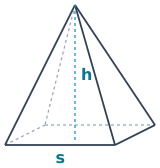
Volume equals one-third s squared h
Use this form when the base side length and perpendicular height are known. A pyramid holds exactly one-third the volume of the cube with the same base and height.
V = (1/3) s² h
Use this form for the entire exterior — square base plus four triangular faces. Common for material-takeoff on architectural pyramids and packaging.
S = s² + 2 s ℓ
Use this form when only the four sloping triangular faces matter — paint, banner, or label coverage on a pyramid (excluding the base).
L = 2 s ℓ
Use this rearrangement when a target volume and fixed height are known and you need the base side length.
s = √(3V / h)
Use this rearrangement when the base side and target volume are known and you need the perpendicular height.
h = 3V / s²
This square pyramid calculator solves V = (1/3) s² h for volume and S = s² + 2 s ℓ for total surface area, where ℓ = √((s/2)² + h²) is the slant height of a triangular face (from base-edge midpoint up to the apex). The lateral surface area L = 2 s ℓ excludes the base. Pick the unknown with the solve-for toggle, enter the remaining values in any supported length or volume unit, and the calculator converts to SI internally. The base perimeter P = 4s and face slant height ℓ are always shown as supplementary outputs.
A square pyramid has a base side of 6 m and a perpendicular height of 4 m. Compute its volume, surface areas, and slant height.
The s = 6, h = 4 example is constructed to make ℓ = 5 exactly (3-4-5 right triangle from (s/2, h, ℓ)). In general, ℓ is irrational.
A square pyramid is a polyhedron with a square base and four triangular faces meeting at a single apex point. For a 'right' square pyramid (the apex directly above the base center), two numbers fully determine the geometry: the base side s and the perpendicular height h. The face slant height ℓ — from the midpoint of a base edge up to the apex along a triangular face — follows by the Pythagorean theorem: ℓ = √((s/2)² + h²). A pyramid holds one-third the volume of a prism with the same base and height, a classical Eudoxus/Archimedes result.
Use V = (1/3) s² h. Square the base side, multiply by the height, divide by 3. For a pyramid with s = 6 m and h = 4 m, V = (1/3) · 36 · 4 = 48 m³.
The slant height ℓ is the distance from the midpoint of a base edge up to the apex along a triangular face. By the Pythagorean theorem ℓ = √((s/2)² + h²). For s = 6 m and h = 4 m, ℓ = √(9 + 16) = 5 m.
Total surface area S = s² + 2 s ℓ (base + four triangular faces). Lateral surface area (faces only) L = 2 s ℓ. Note ℓ = √((s/2)² + h²) is the face slant height, not the pyramid's perpendicular height.
Three identical square pyramids of side s and height s can be assembled to fill a cube of side s exactly. This is one of the foundational results of solid geometry, proven by Eudoxus and made rigorous by Archimedes.
Rearrange V = (1/3) s² h to s = √(3V/h). For V = 48 m³ and h = 4 m, s = √(144/4) = √36 = 6 m.
The perpendicular height h goes straight down from the apex to the base center. The slant height ℓ runs from the apex down to the midpoint of a base edge along a triangular face. ℓ > h because ℓ is the hypotenuse of the right triangle with legs h and s/2.
Not directly. A rectangular pyramid has TWO different slant heights — one for the faces over each pair of parallel base edges — so its surface-area formula is more complex. The volume formula V = (1/3) · base_area · h still applies: just use l × w in place of s².
The Great Pyramid has approximately s = 230 m and h = 147 m (originally taller before erosion). Volume ≈ (1/3) · 230² · 147 ≈ 2.59 million m³. Plug those values into the calculator to verify.
Reference:
Weisstein, Eric W. "Pyramid." MathWorld — A Wolfram Web Resource. https://mathworld.wolfram.com/Pyramid.html
Architectural
An architectural pyramid has a square base of 6 m on a side and rises 4 m to the apex. Compute its volume.
Volume = 48 m³
Compare to a cube of the same base: a 6×6×6 m cube has V = 216 m³, so the pyramid is exactly one-third (72 m³). Our 4 m pyramid is less because h < s.
Surface Coating
The same architectural pyramid (s = 6 m, h = 4 m) needs roofing material on its four sloping faces. Compute the lateral area.
Lateral area = 60 m² (≈ 646 ft²)
Total surface (including the square base) is S = 36 + 60 = 96 m². For roof coverage, use lateral; for full enclosure including the floor, use total.
Inverse Solve
A monument design requires a 100 m³ pyramid with a fixed 8 m square base. Find the required apex height.
Height ≈ 4.69 m (about 15.4 ft)
For comparison, the Great Pyramid of Giza has roughly 230 m base and 147 m height — about 5,300 times the volume of this example.
A square pyramid is defined by two dimensions: the base side s and the perpendicular height h. The face slant height ℓ follows from the Pythagorean theorem.
Where:


