Cone Calculator
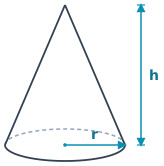
Volume equals one-third pi r squared h
Use this form when the base radius and height of a right circular cone are known. The cone holds exactly one-third the volume of a cylinder with the same base and height.
V = (1/3) π r² h
Use this form when you need the entire exterior surface — circular base plus the curved lateral side. Common for material-takeoff on conical roofs, funnels, and party hats.
S = π r (r + √(r²+h²))
Use this form when only the slanted side matters — paint coverage on a tipi or silo cone, wraps and labels, or the unrolled sheet metal needed to form a cone.
L = π r √(r² + h²)
Use this rearrangement when a target volume and fixed height are known, and you need the base radius. Common when sizing a conical hopper to fit a vertical drop.
r = √(3V / (π h))
Use this rearrangement when the base radius is fixed by available stock and you need the height that gives a target volume.
h = 3V / (π r²)
This cone calculator uses V = (1/3) π r² h plus the surface-area pair S = π r (r + s) and L = π r s, where s = √(r² + h²) is the slant height. Pick the unknown with the solve-for toggle, enter the remaining two values in any supported length or volume unit, and the calculator converts to SI internally before computing all related quantities — including diameter d = 2r, base circumference C = 2π r, and the slant height s — so a single page covers funnels, hoppers, party hats, traffic cones, and conical roofs.
A traffic-cone-shaped hopper has a base radius of 3 m and a height of 4 m. What volume does it hold, and what is its lateral surface area?
The 3-4-5 right triangle makes this example arithmetic clean. In real applications, slant height s is usually computed from r and h rather than measured directly.
A right circular cone is the solid formed by rotating a right triangle around one of its legs — equivalently, a circular base joined to a single apex point. The geometry is fully determined by two numbers: the base radius r and the height h. From those, the slant height s = √(r² + h²) is the hypotenuse of the cross-section triangle and is what scales the lateral surface area. A cone holds exactly one-third the volume of a cylinder with the same base and height, a result that goes back to Eudoxus and Archimedes.
Use V = (1/3) π r² h. Square the base radius, multiply by the height, multiply by π, and divide by 3. For example a cone with r = 3 m and h = 4 m has V = (1/3) · π · 9 · 4 = 12π ≈ 37.7 m³.
Total surface area S = π r (r + s), where s = √(r² + h²) is the slant height. Lateral surface area (curved side only) is L = π r s.
The slant height s is the distance from the apex to any point on the base edge, measured along the curved surface. By the Pythagorean theorem s = √(r² + h²), so for a cone with r = 3 m and h = 4 m, s = √(9+16) = 5 m.
Rearrange V = (1/3) π r² h to r = √(3V / (π h)). For a cone with V = 37.7 m³ and h = 4 m, r = √(3 · 37.7 / (4π)) = √9 = 3 m.
The cone of radius r and height h fits inside a cylinder of the same base and height, and three identical cones can be assembled to fill the cylinder exactly. This result is one of the foundational theorems of solid geometry, proven by Eudoxus and made rigorous by Archimedes.
Lateral surface area is the curved side only: L = π r s. Total surface area adds the circular base: S = L + π r² = π r (r + s). For an open-top cone like a traffic cone or party hat, use only the lateral area.
The lateral surface unrolls into a circular sector with radius equal to the slant height s and arc length equal to the base circumference 2π r. The sector angle is θ = 2π r / s radians, or 360° · r / s degrees. This is the pattern a sheet-metal shop cuts to roll a cone.
Volume V = (1/3) π r² h still holds for oblique cones (where the apex is not directly above the base center) — only the perpendicular height matters. Surface-area formulas, however, assume the apex is directly above the center; oblique cones need a different lateral-surface calculation.
Reference:
Weisstein, Eric W. "Cone." MathWorld — A Wolfram Web Resource. https://mathworld.wolfram.com/Cone.html
Hopper Sizing
A grain silo terminates in a conical hopper with base radius 3 m and height 4 m. Use V = (1/3)πr²h to find its capacity.
Volume ≈ 37.7 m³ ≈ 37,699 liters
Real hoppers have a discharge opening at the apex — for working volume subtract a small cone or use an effective height to the bottom of the cylindrical section above.
Sheet Metal
A fabricator needs to roll a 3-m-radius, 4-m-tall cone from sheet metal. The amount of material is the lateral surface area L = π r s.
Lateral surface area ≈ 47.1 m² (~507 ft²)
When rolled flat, the cone unfolds into a circular sector of radius s = 5 m and arc length 2π r = 6π ≈ 18.85 m — that's the pattern the shop cuts.
Inverse Solve
A funnel must hold 10 L (0.01 m³) of fluid with a fixed slope height of 0.5 m. Solve r = √(3V / (π h)) for the required base radius.
Radius ≈ 0.138 m → diameter ≈ 0.276 m
For pouring or draining funnels, the practical base radius is set by the discharge spout, so this calculator is most useful for sizing the upper rim or transition.
All cone properties follow from two dimensions: the base radius r and the height h. From those, slant height, volume, both surface areas, diameter, and base circumference all derive:
Where:




