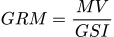
Gross Rent Multiplier Equation
The gross rent multiplier divides a property's market value by its annual gross rental income. It provides a fast way to compare properties without digging into expenses. A lower GRM generally suggests better value.
GRM = MV / GSI
How It Works
The gross rent multiplier divides a property's price by its annual gross rental income. It provides a fast way to compare properties without digging into expenses. A lower GRM generally suggests better value. GRM does not account for operating expenses, vacancies, or financing, so it works best as a first-pass screening tool. Use cap rate and cash-on-cash return for deeper analysis.
Example Problem
A duplex is listed for $400,000 and generates $48,000 per year in gross rent. Calculate the gross rent multiplier.
- Identify the known values: Market Value (MV) = $400,000 and Gross Scheduled Income (GSI) = $48,000 per year.
- Write the GRM formula: GRM = Market Value / Gross Scheduled Income.
- Substitute the values: GRM = $400,000 / $48,000.
- Divide to get the result: GRM = 8.33.
- Interpret the result: it takes about 8.33 years of gross rent to equal the purchase price.
- Compare with similar properties: a comparable duplex with a GRM of 10 would be a relatively worse value, while one at 7 would be better.
A comparable duplex priced at $480,000 with $48,000 in rent has a GRM of 10, making the first property the better value by this metric.
When to Use Each Variable
- Solve for GRM — when you know the property price and gross rent, e.g., comparing investment properties in the same market.
- Solve for Market Value — when you know the GRM and gross income, e.g., estimating property value from rental income and market GRM.
- Solve for Income — when you know the market value and GRM, e.g., determining the required rent to meet a target GRM.
Key Concepts
The gross rent multiplier is a quick valuation metric that divides a property's price by its annual gross rental income. A lower GRM suggests better value relative to income. Unlike cap rate, GRM ignores operating expenses, vacancies, and financing costs, making it a fast screening tool rather than a comprehensive analysis metric. GRM works best when comparing similar properties in the same market.
Applications
- Property screening: quickly filtering investment properties by value relative to rental income
- Market analysis: comparing average GRMs across neighborhoods to identify undervalued areas
- Appraisal: estimating property value by multiplying local GRM by the property's gross income
- Seller pricing: setting a listing price based on market GRM and current rental income
Common Mistakes
- Comparing GRMs across different markets — a GRM of 10 is great in one city but average in another
- Using monthly rent instead of annual rent — the standard formula uses gross scheduled annual income
- Relying on GRM alone for investment decisions — it ignores expenses, so a low GRM can mask high operating costs
- Comparing GRMs across different property types — single-family, multifamily, and commercial properties have different typical ranges
Frequently Asked Questions
What does the gross rent multiplier tell you about a property?
The gross rent multiplier tells you how many years of gross rental income it would take to equal the property's purchase price. A GRM of 8 means 8 years of gross rent covers the price. It is a quick screening metric — not a profitability measure — because it ignores operating expenses, vacancies, taxes, and financing costs.
Is a lower or higher GRM better for investors?
A lower GRM is generally better for investors because it means the property costs fewer years of gross rent to pay off. However, a very low GRM could signal higher risk, deferred maintenance, or an undesirable location. Always verify with cap rate, cash-on-cash return, and a physical inspection before investing.
What is a good gross rent multiplier?
GRM varies by market. In expensive coastal cities, GRMs of 15-20 are common. In affordable Midwest markets, 6-10 is typical. Always compare within the same area and property type.
How do you calculate the gross rent multiplier?
Divide the property's market value (or purchase price) by its annual gross scheduled income. For example, a $400,000 property with $48,000 annual rent has a GRM of $400,000 / $48,000 = 8.33.
Is GRM the same as cap rate?
No. GRM uses gross income and ignores expenses, while cap rate uses net operating income. A property with a low GRM could still have a poor cap rate if expenses are high.
Should I use monthly or annual rent for GRM?
The standard convention uses annual gross scheduled income. If monthly rent is $4,000, multiply by 12 to get $48,000 annual GSI before dividing into the property price.
Can GRM be used for commercial properties?
Yes, but with caution. Commercial properties have different operating expense ratios than residential properties, so a commercial GRM is not directly comparable to a residential one. Cap rate and net income multiplier are more commonly used in commercial real estate valuation.
Reference:
Brueggeman, William B. & Fisher, Jeffrey D. Real Estate Finance and Investments. McGraw-Hill Education.
Gross Rent Multiplier Formula
The gross rent multiplier relates a property's purchase price to its annual gross rental income:
GRM = Market Value / Gross Scheduled Income
Where:
- GRM — gross rent multiplier (dimensionless ratio)
- Market Value (MV) — the purchase price or fair market value of the property in dollars
- Gross Scheduled Income (GSI) — the total annual gross rental income before any vacancy or expense deductions
The formula can be rearranged to solve for market value (MV = GRM × GSI) or gross scheduled income (GSI = MV / GRM). GRM does not account for operating expenses, vacancies, or financing costs, so it works best as a quick screening tool for comparing similar properties.
Worked Examples
Residential Investment
Which single-family rental is the better value?
Property A is listed at $350,000 and rents for $42,000 per year. Property B is listed at $420,000 and rents for $48,000 per year. Compare using GRM.
- Property A: GRM = $350,000 / $42,000 = 8.33
- Property B: GRM = $420,000 / $48,000 = 8.75
Property A has the lower GRM (8.33), suggesting better value relative to rent.
GRM alone does not capture expenses. Property B could still be the better deal if it has lower maintenance costs, taxes, or vacancy rates.
Multi-family
What is a fair price for a 12-unit apartment building?
A 12-unit apartment building generates $144,000 in gross annual rent. The local market GRM for similar buildings is 9.5. Estimate the market value.
- MV = GRM × GSI
- MV = 9.5 × $144,000
MV = $1,368,000
This estimate is a starting point. A full appraisal would also consider net operating income, building condition, and comparable sales.
Market Analysis
What rent does a property need to meet a target GRM?
An investor wants a GRM of 7 or lower. A property is priced at $525,000. What annual gross rent is required?
- GSI = MV / GRM
- GSI = $525,000 / 7
GSI = $75,000 per year ($6,250/month)
If the property currently rents for less than $75,000/year, it does not meet the investor's GRM target at the asking price.
Related Calculators
- Capitalization Rate Calculator — compare returns using net income
- Net Income Multiplier Calculator — relate value to net income
- Gross Operating Income Calculator — compute income after vacancy losses
- Loan to Value Calculator — assess lending risk relative to property value
- Vacancy & Credit Loss Calculator — estimate income lost to vacancies when computing gross income
Related Sites
- Dollars Per Hour — Weekly paycheck calculator with overtime
- OptionsMath — Options trading profit and loss calculators
- Percent Off Calculator — Discount and sale price calculator
- CameraDOF — Depth of field calculator for photographers
- Medical Equations — Hemodynamic, pulmonary, and dosing calculators
- InfantChart — Baby and child growth percentile charts