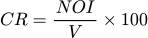
Capitalization Rate Formula
The cap rate expresses a property's net operating income as a percentage of its market value. A higher cap rate suggests higher returns but often higher risk.
CR = (NOI / V) x 100
How It Works
The cap rate expresses a property's net operating income as a percentage of its market value. It gives investors a quick way to compare returns across properties without factoring in financing. A higher cap rate suggests higher returns but often higher risk. Properties in prime locations typically have lower cap rates (4-6%) while riskier markets may see rates of 8-12%.
Example Problem
A commercial building generates $50,000 in NOI and has a market value of $625,000. Calculate the capitalization rate.
- Identify the formula: Cap Rate = (NOI / Property Value) x 100.
- Gather the inputs: NOI = $50,000, Property Value = $625,000.
- Divide NOI by Property Value: $50,000 / $625,000 = 0.08.
- Multiply by 100 to convert to a percentage: 0.08 x 100 = 8%.
- Interpret the result: an 8% cap rate means the property generates 8 cents of net income for every dollar of value.
- Compare to market benchmarks: an 8% cap rate suggests a moderate-risk investment — lower than distressed assets (10%+) but higher than prime urban Class A properties (4-5%).
Alternatively, if you know the cap rate is 8% and NOI is $50,000, the property value is $50,000 / 0.08 = $625,000.
When to Use Each Variable
- Solve for Cap Rate — when you know the NOI and property value and want to assess the unlevered return, e.g., comparing two apartment buildings in different markets.
- Solve for NOI — when you know the cap rate and property value and need to determine the required net income, e.g., setting rental income targets for a new acquisition.
- Solve for Property Value — when you know the NOI and market cap rate and need to estimate what a property is worth, e.g., appraising a commercial building using the income approach.
Key Concepts
The capitalization rate expresses net operating income as a percentage of property value, providing a financing-independent measure of investment return. Cap rate and value move inversely: when market cap rates compress (fall), property values rise for the same NOI. Cap rates vary by asset class, location, and risk — prime urban office buildings trade at 4-5% while secondary-market retail may exceed 8-10%.
Applications
- Commercial real estate appraisal: estimating property value using the income capitalization approach
- Investment screening: quickly comparing return potential across properties regardless of financing
- Market analysis: tracking cap rate trends to gauge whether a market is heating up or cooling down
- Portfolio management: benchmarking individual property performance against market cap rates
Common Mistakes
- Using gross income instead of net operating income — cap rate requires NOI (after operating expenses, before debt service); using gross income overstates the return
- Comparing cap rates across different property types without adjusting for risk — a 7% cap rate on a single-tenant retail building is not comparable to 7% on a stabilized multifamily complex
- Treating cap rate as total return — cap rate ignores appreciation, mortgage principal paydown, and tax benefits; total return includes all of these components
Frequently Asked Questions
What is a good cap rate for a rental property?
A good cap rate depends on location, asset class, and risk tolerance. Class A properties in major metros often trade at 4-5%, while suburban single-family rentals may range from 6-8% and value-add properties in secondary markets can reach 8-12%. Compare within the same asset class and market for meaningful results.
How does cap rate help you compare investment properties?
Cap rate strips out financing differences so you can compare properties on their income performance alone. A $500,000 duplex with $35,000 NOI (7% cap) generates more unlevered return per dollar than a $1M property with $50,000 NOI (5% cap). This makes cap rate the standard first-pass screening metric in commercial real estate.
Does cap rate include mortgage payments?
No. Cap rate uses net operating income before debt service. This makes it useful for comparing properties regardless of how they are financed. Use cash-on-cash return to account for leverage and mortgage terms.
How do cap rates relate to property value?
Cap rate and value move inversely. If cap rates compress from 8% to 6% while NOI stays at $80,000, the property value rises from $1,000,000 to $1,333,333. Falling cap rates signal rising property prices in a market.
What is the difference between cap rate and ROI?
Cap rate measures unlevered income yield (NOI / property value) and ignores financing, appreciation, and tax benefits. ROI (return on investment) includes all sources of return — cash flow, principal paydown, appreciation, and tax savings — relative to total cash invested. Cap rate is a snapshot of income performance; ROI is a comprehensive measure of total wealth creation.
Why do cap rates vary by property type?
Cap rates reflect risk. Stable, predictable asset classes like Class A multifamily in major cities command low cap rates (4-5%) because investors accept lower yields for lower risk. Higher-risk properties — single-tenant retail, rural industrial, or value-add projects — must offer higher cap rates (7-10%+) to compensate for vacancy risk, tenant concentration, and market volatility.
Can you use cap rate for residential single-family homes?
Yes, but with caveats. Cap rate works best for income-producing properties where NOI is the primary value driver. For owner-occupied single-family homes, appreciation and personal utility matter more than rental yield, so cap rate alone does not capture the full picture. For rental single-family homes, cap rate is a useful screening tool alongside cash-on-cash return and gross rent multiplier.
Reference:
Brueggeman, William B. & Fisher, Jeffrey D. Real Estate Finance and Investments. McGraw-Hill Education.
Capitalization Rate Formula
The capitalization rate (cap rate) measures a property's income yield relative to its market value:
Cap Rate = (NOI / Property Value) x 100
Where:
- Cap Rate — capitalization rate, expressed as a percentage (%)
- NOI — net operating income, annual income after operating expenses but before debt service ($)
- Property Value — current market value or purchase price of the property ($)
Cap rate is a financing-independent metric — it strips out mortgage terms, down payments, and tax structures so you can compare properties on their fundamental income performance alone. It assumes a stabilized property with predictable operating expenses.
Worked Examples
Residential Rental
What is the cap rate on a duplex generating $24,000 annual NOI?
You are evaluating a duplex listed at $400,000. After accounting for property taxes, insurance, maintenance, and vacancy, the net operating income is $24,000 per year.
- Cap Rate = ($24,000 / $400,000) x 100
- Cap Rate = 0.06 x 100
Cap Rate = 6%
A 6% cap rate is typical for a well-located residential rental. Compare this to local market averages to determine whether the price is reasonable.
Commercial Real Estate
What is a suburban office building worth at a 7.5% market cap rate?
A suburban office building generates $150,000 in annual NOI. The local market cap rate for comparable office properties is 7.5%. Use the income approach to estimate the property's value.
- Property Value = NOI / (Cap Rate / 100)
- Property Value = $150,000 / 0.075
Property Value = $2,000,000
This income capitalization approach is the standard method for appraising income-producing commercial properties.
REIT Analysis
What NOI must a property produce to justify a $5M valuation at a 6.5% cap rate?
A REIT is evaluating whether to acquire a mixed-use building valued at $5,000,000. Their target cap rate for this asset class is 6.5%. What annual NOI does the property need to generate?
- NOI = (Cap Rate x Property Value) / 100
- NOI = (6.5 x $5,000,000) / 100
NOI = $325,000
If the property currently produces less than $325,000 NOI, the REIT would need a value-add strategy to bridge the gap or negotiate a lower purchase price.
Related Calculators
- Net Operating Income Calculator — compute NOI for cap rate analysis
- Cash on Cash Rate Calculator — measure returns after financing
- Gross Rent Multiplier Calculator — quick screening metric for rentals
- Return on Equity Calculator — measure leveraged returns on your equity position
Related Sites
- Dollars Per Hour — Weekly paycheck calculator with overtime
- OptionsMath — Options trading profit and loss calculators
- Percent Off Calculator — Discount and sale price calculator
- CameraDOF — Depth of field calculator for photographers
- Medical Equations — Hemodynamic, pulmonary, and dosing calculators
- InfantChart — Baby and child growth percentile charts