Simple Return on Equity
Use simple ROE when you want to compare annual after-tax cash flow against the original cash invested in the deal. It is a quick measure of how hard your initial equity is working.
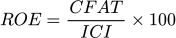
ROE = CFAT / ICI × 100
Resale Return on Equity
Use resale ROE when you want to compare annual after-tax cash flow against current equity, defined as resale value minus mortgage balance. This is useful for hold-vs-sell and refinance decisions.
ROE = CFAT / (RV − MB) × 100
How It Works
Return on equity measures the profit you earn relative to the equity you have invested. The simple form divides annual after-tax cash flow by your initial cash investment. The resale form uses current equity (resale value minus mortgage balance). ROE changes over time as the mortgage is paid down and the property appreciates. The resale version captures this evolving equity position.
Example Problem
You invest $80,000 as a down payment and earn $9,600/year in cash flow after taxes.
- Write the simple ROE formula: ROE = CFAT / ICI × 100.
- Substitute CFAT = $9,600 and ICI = $80,000.
- Divide annual cash flow by the original cash invested: 9,600 / 80,000 = 0.12.
- Convert the decimal return to a percentage by multiplying by 100.
- Simple ROE = 12%.
- If you later switch to the resale version, replace ICI with current equity (RV − MB).
Five years later, the property is worth $450,000 with a $280,000 mortgage balance. Equity = $170,000. If CFAT is still $9,600, the resale ROE is ($9,600 / $170,000) × 100 = 5.65%. This declining ROE may signal it is time to sell or refinance.
When to Use Each Variable
- Solve for ROE (Simple) — when you know the annual after-tax cash flow and your initial cash investment, e.g., evaluating whether a rental property meets your return threshold.
- Solve for Cash Flow After Taxes — when you know your target ROE and investment amount, e.g., determining the minimum rent to charge.
- Solve for Initial Cash Investment — when you know expected cash flow and target ROE, e.g., deciding the maximum down payment you can afford.
- Solve for ROE (Resale) — when you want to measure return based on current equity rather than original investment, e.g., deciding whether to hold, sell, or refinance.
- Solve for Resale Value — when you know the mortgage balance, CFAT, and target ROE, e.g., determining the minimum sale price to justify holding.
- Solve for Mortgage Balance — when you want to see how paying down the mortgage affects ROE, e.g., evaluating a lump-sum principal payment.
Key Concepts
Return on equity measures how efficiently your invested capital generates income. In real estate, ROE can be calculated two ways: simple ROE uses the original down payment as the denominator, while resale ROE uses current equity (property value minus remaining mortgage). As equity grows through appreciation and loan paydown, ROE typically declines even if cash flow is stable, which signals it may be time to redeploy capital.
Applications
- Rental property analysis: comparing ROE across multiple investment properties to allocate capital
- Hold-vs-sell decisions: tracking resale ROE over time to identify when equity is underperforming
- Refinance evaluation: modeling how a cash-out refinance resets equity and boosts ROE
- Portfolio benchmarking: comparing real estate ROE against stock market or bond returns
Common Mistakes
- Confusing ROE with cash-on-cash return — ROE uses after-tax cash flow, while cash-on-cash typically uses pre-tax
- Using purchase price instead of current equity for resale ROE — this overstates the return on your actual capital position
- Ignoring equity growth from mortgage paydown — even flat cash flow reduces ROE as equity accumulates
- Forgetting to subtract vacancy, maintenance, and management costs from cash flow before calculating ROE
Frequently Asked Questions
What is the formula for return on equity?
The simple real-estate ROE formula is ROE = cash flow after taxes / initial cash investment × 100. A resale-based version replaces the initial investment with current equity, which is resale value minus mortgage balance.
What is a good ROE for real estate?
Many investors target 10–15% ROE on rental properties. Leveraged properties often achieve higher ROE in early years. If ROE drops below alternative investment returns, consider selling or refinancing.
Why does ROE decrease over time?
As you pay down the mortgage and the property appreciates, your equity grows faster than cash flow. Your denominator increases while the numerator stays flat, reducing the percentage return.
How is ROE different from cash-on-cash return?
Cash-on-cash measures pre-tax cash flow against initial investment. ROE measures after-tax cash flow and can use either initial investment or current equity. ROE accounts for tax effects and evolving equity.
Why use resale value minus mortgage balance?
Resale value minus mortgage balance measures the equity you could unlock today if you sold the property. Using current equity instead of the original down payment shows whether your trapped capital is still producing a competitive return.
Should ROE be calculated before or after taxes?
This calculator uses after-tax cash flow because taxes materially affect the income you keep. If you want a pre-tax view, cash-on-cash return is often the better metric.
Can ROE help decide when to refinance?
Yes. If ROE has fallen because equity has grown faster than cash flow, a refinance or sale may redeploy capital more efficiently. Investors often compare current ROE against other available investments before deciding.
What inputs matter most for resale ROE?
The biggest drivers are current cash flow, resale value, and mortgage balance. A rising property value or faster loan paydown increases equity, which can lower ROE unless cash flow also grows.
Reference:
Gallinelli, Frank. What Every Real Estate Investor Needs to Know About Cash Flow. McGraw-Hill Education.
Return on Equity Formulas
Use the simple ROE formula when you want to measure return against the original cash invested, and the resale version when you want to measure return against current equity.
Simple ROE
ROE = CFAT / ICI × 100
Resale ROE
ROE = CFAT / (RV − MB) × 100
- CFAT = cash flow after taxes
- ICI = initial cash investment
- RV = resale value
- MB = mortgage balance
- ROE = return on equity, expressed as a percent
Worked Examples
Rental Property
If CFAT is $12,000 and initial cash investment is $100,000, what is simple ROE?
- ROE = CFAT / ICI × 100
- ROE = 12,000 / 100,000 × 100
- ROE = 12%
Hold vs Sell
If CFAT is $15,000, resale value is $360,000, and mortgage balance is $210,000, what is resale ROE?
- ROE = CFAT / (RV − MB) × 100
- ROE = 15,000 / (360,000 − 210,000) × 100
- ROE = 10%
Target Cash Flow
If you want 14% ROE on $90,000 invested, what CFAT do you need?
- CFAT = ROE × ICI / 100
- CFAT = 14 × 90,000 / 100
- CFAT = $12,600
Related Calculators
- Cash on Cash Rate Calculator — pre-tax cash flow returns
- Capitalization Rate Calculator — property returns before financing
- Profitability Index Calculator — rank investment opportunities
- Net Operating Income Calculator — compute NOI for property performance analysis
- Loan to Value Calculator — assess leverage that affects equity returns
Related Sites
- Dollars Per Hour — Weekly paycheck calculator with overtime
- OptionsMath — Options trading profit and loss calculators
- Percent Off Calculator — Discount and sale price calculator
- CameraDOF — Depth of field calculator for photographers
- Medical Equations — Hemodynamic, pulmonary, and dosing calculators
- InfantChart — Baby and child growth percentile charts