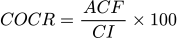
Cash-on-Cash Return Rate
The cash-on-cash return rate measures the percentage return on the actual cash invested in a property.
COCR = (ACF / CI) × 100
Annual Cash Flow
Rearranges the formula to find the annual cash flow required to achieve a target return.
ACF = (COCR × CI) / 100
Cash Invested
Determines how much cash you need to invest to achieve a target return.
CI = ACF / (COCR / 100)
How It Works
Cash-on-cash return measures the actual cash income you earn relative to the cash you put in. Unlike cap rate, it accounts for mortgage payments and shows the real return on your out-of-pocket investment. This metric is especially useful for leveraged investments where the down payment is a fraction of the property value.
Example Problem
You invest $50,000 as a down payment on a rental property. After paying the mortgage, taxes, insurance, and all operating expenses, the property generates $4,500 in annual cash flow. Calculate the cash-on-cash return.
- Identify the annual cash flow (ACF): $4,500 — this is the net cash received after all expenses and debt service.
- Identify the total cash invested (CI): $50,000 — includes the down payment, closing costs, and any upfront renovation.
- Write the formula: COCR = (ACF / CI) × 100.
- Substitute the values: COCR = ($4,500 / $50,000) × 100.
- Divide: $4,500 / $50,000 = 0.09.
- Multiply by 100: COCR = 9%. You earn 9 cents of cash income for every dollar of cash invested each year.
A 9% cash-on-cash return means you earn 9 cents for every dollar of cash invested each year, before taxes and without counting appreciation or principal paydown.
When to Use Each Variable
- Solve for Cash-on-Cash Rate — when you know the annual cash flow and cash invested and want to evaluate a property's return on your actual out-of-pocket investment.
- Solve for Annual Cash Flow — when you have a target return rate and know your cash investment, e.g., determining the minimum annual income a rental property must produce.
- Solve for Cash Invested — when you know the expected cash flow and target return and need to determine the maximum down payment, e.g., structuring a deal to hit a 10% return.
Key Concepts
Cash-on-cash return measures the annual pre-tax cash income relative to the actual cash invested, making it the most direct measure of leveraged investment performance. Unlike cap rate, it accounts for mortgage payments and shows the real return on your out-of-pocket money. Higher leverage can amplify cash-on-cash returns when the property's cap rate exceeds the mortgage interest rate, but it also increases risk if income drops.
Applications
- Rental property evaluation: comparing the cash returns of different investment properties after accounting for financing
- Deal structuring: determining optimal down payment amounts to achieve target cash-on-cash returns
- Portfolio performance tracking: monitoring annual cash returns across multiple leveraged real estate investments
- Investor reporting: presenting realized cash yields to limited partners in real estate syndications
Common Mistakes
- Including principal paydown or appreciation in the cash flow — cash-on-cash only counts actual cash received, not paper gains from equity buildup or property value increases
- Using pre-financing cash flow (NOI) instead of after-debt cash flow — the whole point of COCR is to measure return after mortgage payments; using NOI gives you the cap rate instead
- Forgetting to include all cash invested — closing costs, renovation expenses, and reserves are part of the cash outlay; omitting them inflates the calculated return
Frequently Asked Questions
What is considered a good cash-on-cash return for rental property?
Most residential investors target 8–12% cash-on-cash returns. Returns above 12% are excellent but may signal higher risk or deferred maintenance. Markets with strong appreciation potential (coastal cities, tech hubs) often show lower cash returns of 4–6% because purchase prices are higher relative to rents.
How is cash-on-cash return different from cap rate?
Cap rate compares net operating income (NOI) to the total property value and ignores how the purchase is financed. Cash-on-cash return compares after-debt cash flow to the cash you actually invested. If you buy with a mortgage, cash-on-cash will differ from cap rate — leverage amplifies returns when the cap rate exceeds the loan rate.
Does cash-on-cash return include appreciation?
No. It only measures annual cash flow relative to cash invested. Appreciation, principal paydown, and tax benefits are separate components of total return that are not captured by this metric. Use internal rate of return (IRR) to account for all return components over time.
What counts as cash invested in the COCR formula?
Cash invested includes every dollar you put in up front: the down payment, loan origination fees, closing costs, inspection and appraisal fees, initial renovation, and cash reserves set aside for the property. Omitting any of these inflates the calculated return.
Can cash-on-cash return be negative?
Yes. If annual expenses and debt payments exceed rental income, the annual cash flow is negative, producing a negative cash-on-cash return. This is common in the first year of a heavy-renovation BRRRR strategy or in markets where investors rely on appreciation rather than cash flow.
How does leverage affect cash-on-cash return?
Leverage magnifies cash-on-cash return when the property’s unlevered yield (cap rate) exceeds the mortgage interest rate. For example, a 7% cap-rate property financed at 5% will produce a cash-on-cash return above 7%. However, leverage also magnifies losses if the cap rate falls below the loan rate.
Should I use pre-tax or after-tax cash flow for COCR?
The standard calculation uses pre-tax cash flow. After-tax cash-on-cash return is a separate metric that subtracts income tax from cash flow before dividing by cash invested. Pre-tax is more common because tax situations vary by investor, making it a better apples-to-apples comparison.
Reference:
Brueggeman, William B. & Fisher, Jeffrey D. Real Estate Finance and Investments. McGraw-Hill Education.
Cash on Cash Return Formula
The cash-on-cash return formula measures the annual pre-tax cash income earned on the cash you actually invested:
COCR = (ACF / CI) × 100
Where:
- COCR — cash-on-cash return rate, expressed as a percentage (%)
- ACF — annual cash flow, the net after-debt cash income in dollars ($)
- CI — total cash invested, including down payment, closing costs, and renovation ($)
The formula assumes a single year of operation. For multi-year analysis, calculate COCR for each year separately since cash flow typically changes as rents adjust and mortgage balances decline.
Worked Examples
Residential Rental
What is the cash-on-cash return on a single-family house investment?
You buy a rental house with a $40,000 down payment plus $5,000 in closing costs ($45,000 total cash invested). After mortgage, taxes, insurance, and maintenance, the property nets $4,950 per year.
- COCR = ($4,950 / $45,000) × 100
- COCR = 0.11 × 100
COCR = 11%
An 11% cash-on-cash return is above the 8-12% target most residential investors aim for, making this a solid deal before considering appreciation.
Airbnb / Short-Term Rental
How much annual cash flow does a vacation rental need to hit a 15% return?
You put $60,000 into a vacation property (down payment + furnishings). You want at least a 15% cash-on-cash return to justify the extra management effort of short-term rentals.
- ACF = (COCR × CI) / 100
- ACF = (15 × $60,000) / 100
ACF = $9,000 per year
The property must generate at least $9,000 in after-expense cash flow ($750/month) to meet your 15% target. Factor in seasonal vacancy and higher turnover costs for STRs.
Multi-family
How much should you invest in an apartment building to get a 10% return?
A 12-unit apartment building generates $36,000 in annual after-debt cash flow. You want a 10% cash-on-cash return. What is the maximum cash you should invest?
- CI = ACF / (COCR / 100)
- CI = $36,000 / (10 / 100)
- CI = $36,000 / 0.10
CI = $360,000
Your total cash outlay (down payment + closing costs + reserves) should not exceed $360,000 to achieve a 10% return. Negotiating purchase price or seller concessions can reduce cash needed.
Related Calculators
- Capitalization Rate Calculator — compare property returns before financing
- Return on Equity Calculator — measure returns on your equity position
- Net Operating Income Calculator — calculate NOI for investment analysis
- Debt Coverage Ratio Calculator — assess a property's ability to cover debt payments
Related Sites
- Dollars Per Hour — Weekly paycheck calculator with overtime
- OptionsMath — Options trading profit and loss calculators
- Percent Off Calculator — Discount and sale price calculator
- CameraDOF — Depth of field calculator for photographers
- Medical Equations — Hemodynamic, pulmonary, and dosing calculators
- InfantChart — Baby and child growth percentile charts