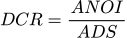
Debt Coverage Ratio
Divides annual net operating income by annual debt service. DCR above 1.0 means income exceeds debt payments.
DCR = ANOI ÷ ADS
Annual Net Operating Income
Determines how much income is needed to meet a target DCR.
ANOI = DCR × ADS
Annual Debt Service
Finds the maximum mortgage payment while maintaining target DCR.
ADS = ANOI ÷ DCR
How It Works
The debt coverage ratio divides a property’s annual net operating income by its annual debt service. A DCR above 1.0 means sufficient income to cover the mortgage; below 1.0 means a shortfall that the owner must fund from other sources. Lenders typically require 1.20–1.25 for conventional commercial loans and 1.15 for SBA-backed financing.
Example Problem
A commercial property has $90,000 in annual net operating income (NOI) and $72,000 in annual mortgage payments (debt service). Calculate the debt coverage ratio.
- Identify the formula: DCR = Annual NOI / Annual Debt Service.
- Gather the inputs: Annual NOI = $90,000 and Annual Debt Service = $72,000.
- Substitute values into the formula: DCR = $90,000 / $72,000.
- Divide: DCR = 1.25.
- Interpret the result: the property generates 25% more income than needed to cover its debt payments.
- Compare to lender requirements: most commercial lenders require DCR ≥ 1.25, so this property meets the threshold.
The property generates 25% more income than needed to cover its debt, satisfying the typical 1.25 minimum DCR requirement.
When to Use Each Variable
- Solve for DCR — when evaluating whether a property qualifies for financing.
- Solve for NOI — when determining the minimum income target to meet a lender’s DCR requirement.
- Solve for Debt Service — when finding the maximum affordable mortgage payment at a given DCR.
Key Concepts
The debt coverage ratio (DCR), also called the debt service coverage ratio (DSCR), measures whether a property’s income can cover its mortgage payments. A DCR of 1.0 means income exactly equals debt service — there is no margin of safety. Lenders typically require 1.20–1.25, meaning 20–25% more income than the minimum needed. The DCR is calculated from annual figures: annual net operating income (ANOI) divided by annual debt service (ADS). NOI is gross rental income minus operating expenses (vacancy, taxes, insurance, maintenance) but before mortgage payments.
Applications
- Commercial real estate: qualifying for a commercial mortgage by demonstrating sufficient income coverage
- Property investment analysis: comparing the financial health of multiple investment properties
- Loan underwriting: setting maximum loan amounts based on projected property income
- Portfolio management: monitoring existing properties for declining debt coverage as rents or expenses change
Common Mistakes
- Using gross income instead of net operating income — NOI subtracts vacancy, taxes, insurance, and maintenance from gross rent
- Forgetting to annualize monthly figures — both NOI and debt service must be on the same annual basis
- Ignoring capital reserves — some lenders deduct capital replacement reserves from NOI before calculating DCR
Frequently Asked Questions
What DCR do lenders require for commercial loans?
Most commercial lenders require a minimum DCR of 1.20 to 1.25. This means the property must generate 20–25% more net operating income than its annual debt payments. SBA 504 and 7(a) loans often accept a lower threshold of 1.15.
What happens if the debt coverage ratio drops below 1.0?
A DCR below 1.0 means the property’s net operating income cannot cover its mortgage payments. The owner must cover the shortfall from personal funds, reserves, or other income sources. Lenders view a sub-1.0 DCR as a default risk and may require loan restructuring.
How do you calculate the debt coverage ratio?
Divide the property’s annual net operating income (NOI) by its annual debt service (total mortgage payments): DCR = Annual NOI / Annual Debt Service. Both figures must be annualized for the formula to work correctly.
What is the difference between DCR and DSCR?
DCR (debt coverage ratio) and DSCR (debt service coverage ratio) are the same metric with different names. Both use the formula NOI / Debt Service. DSCR is more common in banking and corporate finance; DCR is more common in real estate appraisal.
Does the DCR formula use gross income or net income?
The DCR formula uses net operating income (NOI), not gross income. NOI subtracts vacancy losses, property taxes, insurance, and maintenance costs from gross rental income. It does not subtract mortgage payments — that’s what the ratio measures.
How can I improve the debt coverage ratio on a property?
Increase NOI by raising rents, reducing vacancy, or cutting operating expenses. Alternatively, reduce annual debt service by refinancing to a lower interest rate, extending the loan term, or making a larger down payment to lower the loan balance.
What is a good DCR for an apartment building?
Most apartment lenders consider a DCR of 1.20 to 1.35 acceptable. Fannie Mae and Freddie Mac multifamily loans typically require 1.25. Higher DCR values (1.40+) indicate strong cash flow and make it easier to qualify for favorable loan terms.
Reference:
Brueggeman, William B. & Fisher, Jeffrey D. Real Estate Finance and Investments. McGraw-Hill Education.
Debt Coverage Ratio Formula
The debt coverage ratio (also called debt service coverage ratio or DSCR) measures a property's ability to cover its mortgage from operating income:
DCR = Annual NOI / Annual Debt Service
Where:
- DCR — debt coverage ratio, a dimensionless number (1.25 means 25% surplus income)
- Annual NOI — annual net operating income, gross rent minus vacancy, taxes, insurance, and maintenance ($)
- Annual Debt Service — total annual mortgage payments including principal and interest ($)
The formula assumes all figures are annualized. A DCR of exactly 1.0 means break-even — every dollar of NOI goes to debt payments with no safety margin.
Worked Examples
Commercial Lending
Does a retail strip mall qualify for a conventional commercial mortgage?
A retail property generates $180,000 in annual NOI. The proposed mortgage has annual debt service of $144,000. The lender requires a minimum DCR of 1.25.
- DCR = $180,000 / $144,000
DCR = 1.25
The property exactly meets the 1.25 threshold. The lender may approve but could request a lower loan amount to provide a wider safety margin.
Apartment Investment
What NOI does a 20-unit apartment building need to qualify for refinancing?
An investor wants to refinance an apartment building. The new loan has annual debt service of $96,000. The lender requires a 1.20 DCR.
- ANOI = DCR × ADS
- ANOI = 1.20 × $96,000
ANOI = $115,200
The building must produce at least $115,200 in annual NOI. If current NOI is lower, the investor needs to raise rents or reduce expenses before refinancing.
SBA Loans
What is the maximum mortgage payment for an SBA 504 loan?
A small business owns a mixed-use property with $210,000 in annual NOI. The SBA requires a minimum 1.15 DCR. What is the maximum annual debt service?
- ADS = ANOI / DCR
- ADS = $210,000 / 1.15
ADS = $182,609
The business can carry up to $182,609 in annual mortgage payments ($15,217/month). Exceeding this would drop the DCR below the SBA minimum.
Related Calculators
- Break Even Ratio Calculator — measure income needed to cover all obligations
- Net Operating Income Calculator — compute NOI for DCR analysis
- Loan Calculator — determine monthly payments and total debt service
- Capitalization Rate Calculator — evaluate property value from NOI
Related Sites
- Dollars Per Hour — Weekly paycheck calculator with overtime
- OptionsMath — Options trading profit and loss calculators
- Percent Off Calculator — Discount and sale price calculator
- CameraDOF — Depth of field calculator for photographers
- Medical Equations — Hemodynamic, pulmonary, and dosing calculators
- InfantChart — Baby and child growth percentile charts