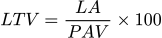
Loan-to-Value Ratio
The loan-to-value ratio compares the mortgage amount to the appraised property value. It tells lenders how much equity the borrower has at stake. A lower LTV means more equity and less risk for the lender.
LTV = (LA / PAV) × 100
Loan Amount from LTV
Rearranges the LTV formula to find the maximum loan amount when you know the desired LTV ratio and the property's appraised value.
LA = (LTV × PAV) / 100
Property Appraised Value
Determines the minimum property appraised value needed to achieve a target LTV ratio for a given loan amount.
PAV = LA / (LTV / 100)
How It Works
The loan-to-value ratio compares the mortgage amount to the appraised property value. It tells lenders how much equity the borrower has at stake. A lower LTV means more equity and less risk for the lender. Most conventional loans require an LTV of 80% or less to avoid private mortgage insurance (PMI). FHA loans allow up to 96.5% LTV, while VA loans can go up to 100%.
Example Problem
A home is appraised at $400,000 and the buyer takes a $320,000 mortgage. Calculate the loan-to-value ratio.
- Identify the formula: LTV = (Loan Amount / Property Appraised Value) × 100.
- Write down the known values: Loan Amount = $320,000, Property Appraised Value = $400,000.
- Divide the loan amount by the property value: $320,000 / $400,000 = 0.80.
- Multiply by 100 to convert to a percentage: 0.80 × 100 = 80%.
- Interpret the result: 80% LTV means the buyer is financing 80% of the home's value.
- Check the PMI threshold: at exactly 80% LTV with 20% down ($80,000), most conventional lenders waive PMI.
If the loan were $360,000 instead, the LTV would be 90%, requiring PMI of roughly $150–$250/month until the balance drops below 80% of the appraised value.
When to Use Each Variable
- Solve for LTV Ratio — when you know the loan amount and property value and want to check if you'll need PMI.
- Solve for Loan Amount — when you have a target LTV and property value and want to know the maximum you can borrow.
- Solve for Property Value — when you know the loan amount and desired LTV and want to find the minimum appraisal needed.
Key Concepts
The loan-to-value ratio measures borrower equity as a percentage of the property's appraised value. Lenders use LTV to assess risk — a lower LTV means more borrower equity and less exposure if the borrower defaults. Most conventional mortgages require 80% LTV or less to avoid private mortgage insurance (PMI), while government-backed loans (FHA, VA) allow higher ratios.
Applications
- Mortgage approval: lenders use LTV to determine loan eligibility, interest rates, and PMI requirements
- Refinancing: homeowners calculate LTV to determine if they qualify for a lower rate or PMI removal
- Investment property: investors use LTV to assess leverage and required down payment for rental properties
- Home equity loans: banks calculate combined LTV (CLTV) to set borrowing limits on second mortgages
Common Mistakes
- Using the purchase price instead of the appraised value — lenders use the lower of the two, so a low appraisal raises the effective LTV
- Forgetting about PMI — LTV above 80% on conventional loans triggers PMI, adding $100-$300+ per month to the payment
- Ignoring combined LTV — when a home equity loan or HELOC exists, lenders look at the total of all loans divided by the appraised value
Frequently Asked Questions
What LTV ratio do you need to avoid paying PMI?
You need an LTV of 80% or less — meaning a 20% down payment — to avoid PMI on a conventional mortgage. Once your LTV drops to 80% through payments or appreciation, you can request PMI removal. Under federal law, lenders must automatically cancel PMI when LTV reaches 78% based on the original amortization schedule.
How does loan-to-value ratio affect your mortgage interest rate?
Higher LTV means higher risk for the lender, which translates to higher interest rates. A borrower at 95% LTV may pay 0.25–0.50% more than someone at 80% LTV on the same loan. Dropping below key thresholds (80%, 75%, 60%) often unlocks progressively better rate tiers because the lender has more collateral cushion.
What is a good loan-to-value ratio?
An LTV of 80% or less is ideal for conventional loans, avoiding PMI. For investment properties, lenders often require 75% or lower. The lower the LTV, the better your interest rate and terms — but tying up too much cash in a down payment can reduce your liquidity.
How do you calculate the loan-to-value ratio?
Divide the loan amount by the property's appraised value, then multiply by 100. For example, a $240,000 loan on a $300,000 property gives LTV = ($240,000 / $300,000) × 100 = 80%. Lenders use the lower of the purchase price or appraised value as the denominator.
What is the difference between LTV and CLTV?
LTV uses only the primary mortgage in the numerator. Combined LTV (CLTV) adds all liens — first mortgage, home equity loans, and HELOCs — then divides by the property value. A home worth $400,000 with a $280,000 first mortgage and $40,000 HELOC has an LTV of 70% but a CLTV of 80%.
What LTV do FHA and VA loans allow?
FHA loans allow up to 96.5% LTV (3.5% minimum down payment) but require mortgage insurance for the life of the loan. VA loans allow 100% LTV (zero down payment) with no PMI for eligible veterans and active-duty service members. USDA loans also allow 100% LTV for eligible rural properties.
Can your LTV ratio change after closing?
Yes. LTV decreases as you make principal payments and as the property appreciates in value. It can also increase if property values decline. To get an updated LTV for PMI removal or refinancing, you typically need a new appraisal to establish the current property value.
Reference:
Brueggeman, William B. & Fisher, Jeffrey D. Real Estate Finance and Investments. McGraw-Hill Education.
LTV Formula
The loan-to-value ratio measures the relationship between the mortgage balance and the property's appraised value:
LTV = (Loan Amount / Property Appraised Value) × 100
Where:
- LTV — loan-to-value ratio, expressed as a percentage (%)
- Loan Amount (LA) — the total mortgage or loan balance, in dollars ($)
- Property Appraised Value (PAV) — the current market value determined by an appraiser, in dollars ($)
Lenders use the lower of the purchase price or appraised value as the denominator. A low appraisal can push the effective LTV higher than expected, potentially requiring a larger down payment or triggering PMI.
Worked Examples
Home Purchase
What LTV does a first-time buyer get with 10% down?
A first-time buyer purchases a home appraised at $350,000 with a 10% down payment ($35,000), taking a $315,000 mortgage.
- LTV = ($315,000 / $350,000) × 100
- LTV = 0.9 × 100
LTV = 90%
At 90% LTV, this conventional loan requires PMI — typically $125–$200/month on this loan size. The buyer needs to reach 80% LTV to remove it.
Refinancing
Has a homeowner built enough equity to drop PMI on a refinance?
A homeowner has a remaining balance of $195,000 on a home now appraised at $260,000. They want to refinance and check if they can eliminate PMI.
- LTV = ($195,000 / $260,000) × 100
- LTV = 0.75 × 100
LTV = 75%
At 75% LTV, the homeowner is well below the 80% threshold. They qualify to refinance without PMI and may also secure a lower interest rate due to the strong equity position.
Commercial Lending
What is the maximum loan for a commercial property at 75% LTV?
An investor wants to buy a commercial building appraised at $1,200,000. The lender allows a maximum 75% LTV for commercial loans.
- LA = (LTV × Property Value) / 100
- LA = (75 × $1,200,000) / 100
LA = $900,000
The investor can borrow up to $900,000 and must bring $300,000 as a down payment. Commercial lenders typically cap LTV at 65–80% depending on property type and borrower strength.
Related Calculators
- Mortgage Loan Calculator — compute monthly payments and total interest
- Mortgage Points Calculator — calculate the cost of buying down your rate
- Debt Coverage Ratio Calculator — assess property debt service ability
- Loan Calculator — compute payments and amortization for the loan amount
- Capitalization Rate Calculator — evaluate investment return on the appraised value
Related Sites
- Dollars Per Hour — Weekly paycheck calculator with overtime
- OptionsMath — Options trading profit and loss calculators
- Percent Off Calculator — Discount and sale price calculator
- CameraDOF — Depth of field calculator for photographers
- Medical Equations — Hemodynamic, pulmonary, and dosing calculators
- InfantChart — Baby and child growth percentile charts