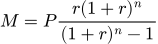
Mortgage Amortization Formula
A mortgage amortizes the loan balance through equal monthly payments over a fixed term. Each payment covers that month's interest, with the remainder reducing the principal. Early in the loan, most of the payment goes to interest.
M = P × r(1+r)ⁿ / ((1+r)ⁿ − 1)
Mortgage Amount from Payment
Rearranges the amortization formula to find the maximum mortgage you qualify for given a fixed monthly budget, interest rate, and term. Useful for setting a home-shopping price cap.
P = M × ((1+r)ⁿ − 1) / (r(1+r)ⁿ)
Mortgage Payoff Term
Back-solves for the months required to pay off a mortgage at a given payment and rate. Useful when modeling extra payments or prepayment strategies.
n = −ln(1 − Pr/M) / ln(1 + r)
How It Works
A mortgage amortizes the loan balance through equal monthly payments over a fixed term. Each payment covers that month's interest, with the remainder reducing the principal. Early in the loan, most of the payment goes to interest; later on, the principal share grows. Common terms are 15 and 30 years. A 15-year mortgage has higher monthly payments but significantly less total interest. The calculator also shows total interest paid over the life of the loan.
Example Problem
A $350,000 mortgage at 6.5% annual interest for 30 years. Calculate the monthly payment, total paid, and total interest.
- Identify the formula: M = P × r(1+r)ⁿ / ((1+r)ⁿ − 1).
- Convert the annual rate to a monthly decimal rate: r = 6.5 / 12 / 100 = 0.005417.
- Convert the term to months: n = 30 × 12 = 360 payments.
- Compute (1 + r)ⁿ = (1.005417)^360 ≈ 6.99179.
- Monthly payment: M = $350,000 × (0.005417 × 6.99179) / (6.99179 − 1) ≈ $2,212.24.
- Total interest: ($2,212.24 × 360) − $350,000 ≈ $446,406 — more than the original loan.
The same loan at 15 years would cost $3,049/month but only $198,843 in total interest — saving $247,563 but requiring $837/month more in cash flow.
When to Use Each Variable
- Solve for Monthly Payment — when you know the loan amount, interest rate, and term, e.g., budgeting for a home purchase.
- Solve for Mortgage Amount — when you know your budget and want to find how much you can borrow.
- Solve for Term — when you want to know how long it takes to pay off a loan at a given payment amount.
Key Concepts
Mortgage amortization splits each fixed payment into an interest portion and a principal portion. Early payments are interest-heavy because the outstanding balance is large; over time the principal share grows. The total interest paid over the life of a loan is often comparable to or greater than the original loan amount, especially for 30-year terms at moderate rates. The principal-and-interest (P&I) payment is only part of the full housing cost — taxes, insurance, and PMI add hundreds more per month.
Applications
- Home buying: determining the monthly payment you can afford before house hunting
- Refinancing: comparing total interest costs between your current loan and a new rate or term
- Financial planning: projecting how extra principal payments shorten the loan and reduce total interest
- Real estate investing: calculating cash flow by comparing mortgage payments to rental income
- Affordability testing: sizing a maximum loan against the 28/36 housing-to-income rule
- Buydowns and points: estimating the monthly-payment impact of rate buy-downs at closing
Common Mistakes
- Forgetting to divide the annual interest rate by 12 — using the annual rate directly produces wildly incorrect monthly payments
- Ignoring escrow costs — the P&I payment is not the full housing cost; property taxes, insurance, and PMI add significantly
- Comparing only monthly payments between 15- and 30-year loans — the 30-year loan may seem cheaper monthly but costs far more in total interest
- Skipping the PMI calculation — loans above 80% LTV typically carry $80–$300/month in mortgage insurance until the balance reaches 80%
- Assuming the rate is fixed on an ARM — adjustable-rate mortgages reset after an initial period, often changing the payment dramatically
Frequently Asked Questions
What determines your monthly mortgage payment?
Four factors set the P&I portion of a mortgage payment: the loan amount (principal), annual interest rate, loan term in years, and whether the rate is fixed or adjustable. Property taxes, homeowners insurance, and PMI (if LTV is above 80%) are typically escrowed on top, adding $300–$800/month on a typical home. Together these make up PITI — the full monthly housing cost.
Is a 15-year or 30-year mortgage better?
It depends on cash flow and goals. A 15-year mortgage saves tens of thousands in interest and builds equity faster, but the monthly payment is 30–50% higher. On a $300,000 loan at 6%, the 30-year payment is $1,799/month with $347,515 total interest, while the 15-year is $2,532/month with $155,683 total interest. Choose 15 years if you can comfortably afford the higher payment and want to pay off the house sooner; choose 30 years if you need the lower payment for other financial goals or have a clear plan to make extra principal payments.
What is included in a monthly mortgage payment (PITI)?
The basic payment covers principal and interest (P&I). Most lenders escrow property taxes (T) and homeowners insurance (I), combining all four into PITI. If your down payment is less than 20%, PMI is added. HOA dues, flood insurance, and supplemental taxes are separate line items on top of PITI.
How much mortgage can I afford?
A common rule of thumb is the 28/36 rule: total housing costs (PITI + HOA) should not exceed 28% of gross monthly income, and total debt payments (including car loans, student loans, and credit cards) should not exceed 36%. On $6,000/month gross income, that caps PITI around $1,680. Lenders may approve more, but staying under these thresholds leaves room for savings and emergencies.
How do extra principal payments affect a 30-year mortgage?
Every extra dollar toward principal shrinks the balance and eliminates future interest. Adding $200/month to a $300,000 mortgage at 6.5% cuts 6 years off the term and saves about $104,000 in interest. Most US mortgages allow extra principal payments without penalty — always label the payment 'apply to principal' to prevent the lender from treating it as an early regular payment.
Should I buy mortgage points to lower my rate?
One discount point costs 1% of the loan amount and typically cuts the rate by 0.25%. On a $350,000 loan, one point costs $3,500 and might save about $55/month — a break-even of roughly 64 months (5.3 years). Buying points makes sense if you plan to hold the mortgage past the break-even point; if you'll refinance or sell before then, skip the points.
What is the difference between APR and interest rate?
The interest rate is the pure cost of borrowing the principal. APR adds lender fees, origination charges, discount points, and mortgage insurance, expressed as an annualized rate. Compare APR between offers for an apples-to-apples cost comparison — two loans with the same rate but different fees will have different APRs.
Reference:
Brealey, R., Myers, S., & Allen, F. Principles of Corporate Finance. McGraw-Hill Education.
Mortgage Payment Formula
Mortgages use the standard amortization formula to calculate a fixed monthly payment that fully pays off the loan by the end of the term:
M = P × r(1+r)n / ((1+r)n − 1)
Where:
- M — monthly principal & interest payment, in dollars ($)
- P — mortgage principal (loan amount), in dollars ($)
- r — monthly interest rate (annual rate ÷ 12 ÷ 100), as a decimal
- n — total number of monthly payments (years × 12)
This formula calculates principal and interest (P&I) only. The full monthly housing cost — sometimes called PITI — also includes property taxes, homeowners insurance, and, for loans above 80% LTV, private mortgage insurance (PMI).
Worked Examples
First-Time Buyer
Can a $95,000 household afford a $300,000 starter home at 7%?
A first-time buyer earning $95,000/year ($7,917/month gross) is considering a $300,000 mortgage at 7% for 30 years. Is it within the 28% housing-cost guideline?
- Monthly rate: 7 / 12 / 100 = 0.005833; n = 360
- (1.005833)^360 ≈ 8.11649
- M = $300,000 × (0.005833 × 8.11649) / (8.11649 − 1) ≈ $1,995.91
- Adding ~$400 for taxes and insurance: ≈ $2,396/month
P&I ≈ $1,996/month
The 28% rule caps housing at $2,217/month. At $2,396 PITI the buyer is slightly over — they should look at $280,000 or wait for lower rates.
Refinancing
Does refinancing from 7.5% to 5.75% on a $425,000 balance make sense?
A homeowner has $425,000 remaining on a 30-year mortgage at 7.5%. They are considering a refinance into a new 30-year loan at 5.75% with $5,000 in closing costs. What is the monthly savings and break-even point?
- Current: r = 0.00625, n = 360, M ≈ $2,970/month
- New: r = 0.0047917, M ≈ $2,481/month
- Monthly savings ≈ $489
- Break-even: $5,000 / $489 ≈ 10.2 months
A rule of thumb: refinancing is worth considering if the rate drops 0.75% or more and you plan to stay in the home past the break-even point. Here the payoff is under a year — a clear win.
Investment Property
Does a rental duplex's income cover a $500,000 mortgage at 8%?
An investor borrows $500,000 at 8% on a 25-year amortization to buy a duplex that rents for $4,500/month gross. What is the mortgage payment and is the income enough to cover it plus expenses?
- r = 8 / 1200 = 0.006667; n = 300
- (1.006667)^300 ≈ 7.34025
- M = $500,000 × (0.006667 × 7.34025) / (7.34025 − 1)
- M ≈ $3,858/month P&I
- Rent $4,500 − P&I $3,858 = $642 cushion before taxes, insurance, vacancy, and maintenance
Investors typically target a debt coverage ratio (DCR) of 1.25 or higher. Here, DCR ≈ $4,500 / $3,858 = 1.17 — below the safety threshold. A larger down payment or a cheaper property would be needed to make this cash-flow positive after operating costs.
Related Calculators
- Mortgage Extra Payment Calculator — full amortization schedule with extra payments and early-payoff savings
- Loan Calculator — general loan amortization
- Mortgage Points Calculator — calculate the cost of discount points
- Loan to Value Calculator — determine your LTV ratio
- Interest Rate Calculator — compare simple and compound interest scenarios
- Debt Coverage Ratio Calculator — check if rental income covers your mortgage payment
Related Sites
- Dollars Per Hour — Weekly paycheck calculator with overtime
- OptionsMath — Options trading profit and loss calculators
- Percent Off Calculator — Discount and sale price calculator
- CameraDOF — Depth of field calculator for photographers
- Medical Equations — Hemodynamic, pulmonary, and dosing calculators
- InfantChart — Baby and child growth percentile charts