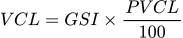
Vacancy and Credit Loss Equation
Vacancy and credit loss estimates how much income a property loses from empty units and tenants who don't pay.
VCL = GSI x PVCL / 100
How It Works
Vacancy and credit loss estimates how much income a property loses from empty units and tenants who don't pay. It is expressed as a percentage of gross scheduled income. Industry-standard VCL rates typically range from 5% to 10%.
Example Problem
A 20-unit building has gross scheduled income of $240,000/year. The market vacancy rate is 8%.
- Identify the known values: GSI = $240,000 and vacancy rate = 8%
- Write the vacancy and credit loss formula: VCL = GSI x Rate / 100
- Substitute the values: VCL = $240,000 x 8 / 100
- Calculate the vacancy loss: VCL = $19,200 per year
- Determine gross operating income: GOI = $240,000 - $19,200 = $220,800
- Interpret: each 1% increase in vacancy costs $2,400/year for this building
Each 1% increase in vacancy costs $2,400/year.
When to Use Each Variable
- Solve for Vacancy and Credit Loss ($) — when you know the gross scheduled income and vacancy rate and need to calculate the dollar amount of lost income.
- Solve for Gross Scheduled Income ($) — when you know the vacancy loss amount and rate and need to back-calculate the required gross income.
- Solve for Vacancy Rate (%) — when you have actual vacancy loss and gross income data and need to determine the effective vacancy rate.
Key Concepts
Vacancy and credit loss (VCL) bridges the gap between gross scheduled income (GSI) and effective gross income (EGI). GSI assumes 100% occupancy at market rent. VCL accounts for two income leakages: physical vacancy (empty units) and credit loss (tenants who occupy but fail to pay). The formula VCL = GSI x rate/100 converts the percentage to a dollar amount. Subtracting VCL from GSI gives the realistic income used in property valuation and NOI calculations.
Applications
- Property valuation: estimating effective gross income for the income capitalization approach used by appraisers
- Investment analysis: projecting realistic rental income for pro forma financial models and IRR calculations
- Lending underwriting: banks use VCL to stress-test loan applications by ensuring debt service coverage under realistic occupancy
- Property management: tracking actual vs. market vacancy rates to evaluate marketing effectiveness and tenant retention strategies
Common Mistakes
- Using the national average vacancy rate instead of local market data — vacancy varies dramatically by submarket, property type, and class
- Ignoring credit loss entirely — even fully occupied buildings lose 1-2% of income to bad debt, especially in lower-income housing
- Applying vacancy to net rent instead of gross scheduled income — VCL should be calculated on the full potential rent, not the discounted amount
- Confusing economic vacancy (income loss) with physical vacancy (empty units) — a unit rented below market rate has economic vacancy even though it is occupied
Frequently Asked Questions
What vacancy rate should I use when analyzing a rental property?
Use local market data from your county or metro area. Strong urban markets run 3-5%, suburban areas 5-7%, and oversupplied or rural markets can exceed 10%. Never rely on the national average — it hides dramatic local variation.
What is credit loss in real estate investing?
Credit loss accounts for tenants who occupy a unit but fail to pay rent. It typically runs 1-2% of GSI. Thorough tenant screening and requiring security deposits can reduce credit losses significantly.
How does vacancy affect property value?
Vacancy reduces NOI, which directly lowers property value. At a 6% cap rate, each $1,000 in lost income reduces value by about $16,667. Even small vacancy improvements translate to meaningful value gains.
Is there a difference between physical vacancy and economic vacancy?
Yes. Physical vacancy means units are empty. Economic vacancy includes physical vacancy plus income lost from concessions, below-market rents, and bad debt. Economic vacancy is always higher than physical vacancy.
How do seasonal patterns affect vacancy and credit loss?
Student housing near universities sees predictable summer vacancy spikes. Resort properties have off-season gaps. Use a 12-month rolling average rather than a snapshot to estimate VCL for seasonal properties.
What vacancy rate do lenders use when underwriting loans?
Most lenders use the greater of 5% or the actual market vacancy rate, whichever is higher. Some conservative lenders stress-test at 10% to ensure the loan performs under adverse conditions.
How has remote work changed commercial office vacancy rates?
Post-2020 office vacancy rates have risen to 15-20% in many metros, far above the historical 8-10%. Investors now apply higher VCL assumptions for office properties, especially older Class B and C buildings in suburban markets.
Reference:
Gallinelli, Frank. 2004. What Every Real Estate Investor Needs to Know About Cash Flow. McGraw-Hill.
Vacancy and Credit Loss Formula
The vacancy and credit loss formula converts a vacancy percentage into a dollar amount of lost income:
VCL = GSI × PVCL / 100
Where:
- VCL — vacancy and credit loss, the dollar amount of lost income
- GSI — gross scheduled income, total rent at 100% occupancy in dollars
- PVCL — percent vacancy and credit loss, the combined vacancy and bad debt rate
Subtracting VCL from GSI gives gross operating income (GOI), which is the realistic income used in property valuation, loan underwriting, and NOI calculations.
Worked Examples
Multi-Family
How much income does a 30-unit apartment building lose to vacancy?
A 30-unit building charges $1,400/month per unit, giving a GSI of $504,000/year. The neighborhood averages 6% vacancy and 1.5% credit loss.
- GSI = 30 × $1,400 × 12 = $504,000
- Combined rate = 6% + 1.5% = 7.5%
- VCL = $504,000 × 7.5 / 100
VCL = $37,800 per year
At $37,800 lost, the effective GOI is $466,200. Reducing vacancy by just 1% saves $5,040/year.
Student Housing
What vacancy rate explains a student housing property's income gap?
A student housing complex near campus has $360,000 GSI but only collects $313,200 in actual income. What is the effective vacancy and credit loss rate?
- VCL = $360,000 − $313,200 = $46,800
- Rate = VCL / GSI × 100
- Rate = $46,800 / $360,000 × 100
Rate = 13%
A 13% rate is high but typical for student housing with summer vacancy. Offering 12-month leases instead of academic-year leases can bring this down significantly.
Commercial Office
How do you budget for post-COVID office vacancy?
A suburban office building has $800,000 GSI. The investor projects 18% vacancy post-COVID (up from the historical 8%) plus 2% credit loss.
- Combined rate = 18% + 2% = 20%
- VCL = $800,000 × 20 / 100
VCL = $160,000 per year
At $160,000 in losses, the GOI drops to $640,000 — a $96,000 reduction from the historical 8% baseline. This may push the break-even ratio above lender thresholds.
Related Calculators
- Gross Operating Income Calculator — compute income after vacancy losses
- Net Operating Income Calculator — determine property profitability
- Break Even Ratio Calculator — assess income cushion against obligations
- Capitalization Rate Calculator — estimate property value from NOI and cap rate
- Gross Rent Multiplier Calculator — quick property valuation from gross rent
Related Sites
- Dollars Per Hour — Weekly paycheck calculator with overtime
- OptionsMath — Options trading profit and loss calculators
- Percent Off Calculator — Discount and sale price calculator
- CameraDOF — Depth of field calculator for photographers
- Medical Equations — Hemodynamic, pulmonary, and dosing calculators
- InfantChart — Baby and child growth percentile charts