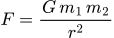
Newton’s Law of Universal Gravitation
Every two objects attract each other with a force proportional to the product of their masses and inversely proportional to the square of the distance between them. G = 6.6743 × 10⁻¹¹ N·m²/kg².
F = G × m₁ × m₂ / r²
Kepler’s Third Law
Relates the orbital period of a satellite to its orbital radius and the mass of the central body. Larger orbits have longer periods.
T = √(4π²r³ / GM)
Gravitational Acceleration
The acceleration due to gravity at a distance r from a planet’s center. On Earth’s surface, this gives the familiar 9.81 m/s².
a = GM / r²
Escape Velocity
The minimum speed needed to escape a planet’s gravitational field without further propulsion. Earth’s escape velocity is about 11.2 km/s.
vₑ = √(2GM / R)
How It Works
Newton’s Law of Universal Gravitation states that every two objects attract each other with a force proportional to the product of their masses and inversely proportional to the square of the distance between them (F = Gm₁m₂/r²). The gravitational constant G = 6.6743 × 10⁻¹¹ N·m²/kg². This calculator also covers Kepler’s Third Law (orbital period), gravitational acceleration, and escape velocity — all derived from the same underlying gravitational law.
Example Problem
What is the gravitational force between Earth (5.97 × 10²⁴ kg) and a 70 kg person standing on the surface (r = 6.371 × 10⁶ m)?
- Identify the knowns. Earth's mass m₁ = 5.97 × 10²⁴ kg, the person's mass m₂ = 70 kg, the center-to-surface distance r = 6.371 × 10⁶ m, and the gravitational constant G = 6.6743 × 10⁻¹¹ N·m²/kg².
- Identify what we're solving for. We want the gravitational force F between Earth and the person — the same force we colloquially call "weight" on Earth's surface.
- Write Newton's Law of Universal Gravitation: F = G × m₁ × m₂ / r². Force scales with the product of masses and falls off with the square of the distance between their centers.
- Substitute the known values: F = (6.6743 × 10⁻¹¹) × (5.97 × 10²⁴) × 70 / (6.371 × 10⁶)².
- Simplify the numerator and denominator separately. Numerator: 6.6743 × 10⁻¹¹ × 5.97 × 10²⁴ × 70 ≈ 2.788 × 10¹⁶ N·m². Denominator: (6.371 × 10⁶)² ≈ 4.059 × 10¹³ m².
- Divide to get the force: F = 2.788 × 10¹⁶ / 4.059 × 10¹³ ≈ **686 N (about 154 lbf)** — equivalent to a surface gravity of g ≈ 9.81 m/s², the familiar weight of a 70 kg person on Earth.
When to Use Each Variable
- Solve for Gravitational Force — when you know both masses and the distance between them, e.g., calculating the gravitational pull between Earth and a satellite.
- Solve for Distance — when you know the force and both masses, e.g., finding the orbital altitude where a specific gravitational force acts.
- Solve for Mass — when you know the force, the other mass, and the distance, e.g., estimating a planet's mass from satellite orbital data.
- Solve for Orbital Period — when you know the orbital radius and central body mass, e.g., calculating how long a satellite takes to complete one orbit.
- Solve for Orbital Radius — when you know the desired period and central body mass, e.g., finding the altitude for a geostationary orbit.
- Solve for Gravitational Acceleration — when you know a planet's mass and radius, e.g., finding the surface gravity on Mars or the Moon.
- Solve for Escape Velocity — when you know a planet's mass and radius, e.g., determining the minimum launch speed to leave Earth's gravitational field.
Key Concepts
Newton's Law of Universal Gravitation states that every pair of objects attracts each other with a force proportional to the product of their masses and inversely proportional to the square of the distance between their centers. The gravitational constant G = 6.6743 × 10⁻¹¹ N·m²/kg² is the same everywhere in the universe. Kepler's Third Law, gravitational acceleration, and escape velocity are all derived from this fundamental law.
Applications
- Aerospace engineering: calculating satellite orbits, launch trajectories, and escape velocities
- Astronomy: estimating planetary masses from the orbits of their moons or satellites
- Geophysics: measuring local variations in gravitational acceleration for mineral and oil exploration
- Space mission planning: determining transfer orbit parameters and gravitational slingshot maneuvers
Common Mistakes
- Confusing G (universal gravitational constant) with g (local gravitational acceleration) — G is constant everywhere, g varies with location
- Using the distance between surfaces instead of centers of mass — Newton's law requires the center-to-center distance
- Forgetting to convert radius to meters — mixing kilometers and meters gives results off by factors of 10³ or 10⁶
- Assuming g = 9.81 m/s² at all altitudes — gravitational acceleration decreases with the square of the distance from Earth's center
Frequently Asked Questions
What is the gravitational constant G?
G is a fundamental constant (6.6743 × 10⁻¹¹ N·m²/kg²) that sets the strength of gravity. Unlike g (9.81 m/s² on Earth), G is the same everywhere in the universe.
What is Earth's escape velocity?
Earth's escape velocity is about 11.2 km/s (roughly 25,000 mph). Any object launched at this speed or faster will not fall back to Earth, ignoring air resistance.
How does gravity change with altitude?
Gravitational acceleration decreases with the square of the distance from a planet's center. At the altitude of the ISS (~400 km), g is about 8.7 m/s² — roughly 89% of the surface value.
What is the difference between mass and weight?
Mass is the amount of matter in an object and is the same anywhere — measured in kilograms. Weight is the gravitational force on that mass: W = m × g. A 70 kg person weighs about 686 N on Earth, 260 N on Mars, and 113 N on the Moon — same mass, different weight.
How is gravitational acceleration related to Newton's law of gravitation?
Setting F = ma equal to F = G·M·m/r² and dividing by the small mass m gives a = G·M/r². The acceleration of a falling object near a large body depends only on the larger body's mass and the distance from its center — not on the falling object's own mass. That's why all objects fall at the same rate in vacuum.
Does Kepler's third law work for all orbits?
T² = (4π²/GM) × r³ is exact for circular orbits and a very good approximation for low-eccentricity ellipses. For elliptical orbits, r becomes the semi-major axis a, and the formula remains exact: T² ∝ a³. It applies to any small body orbiting a much more massive one (planet around a star, moon around a planet, satellite around Earth).
Why is the inverse-square law so important for gravity?
The 1/r² scaling means gravitational influence weakens quickly with distance but never fully reaches zero — every star pulls on every other star across the universe. It also makes orbits stable (closed ellipses) only under inverse-square laws; almost any other power law produces orbits that don't close on themselves, as proven by Bertrand's theorem.
Reference: Lindeburg, Michael R. 1992. Engineer In Training Reference Manual. Professional Publication, Inc. 8th Edition.
Worked Examples
Aerospace Engineering
What launch speed does a probe need to escape the Moon's gravity?
A lunar return vehicle ascending from the surface has to outrun the Moon's gravity before its engines cut off. The Moon has M = 7.342 × 10²² kg and a mean radius R = 1.7374 × 10⁶ m. What is the surface escape velocity v_e = √(2GM/R)?
- Knowns: M = 7.342 × 10²² kg, R = 1.7374 × 10⁶ m, G = 6.6743 × 10⁻¹¹ N·m²/kg²
- v_e = √(2 × G × M / R)
- 2 × G × M = 2 × 6.6743 × 10⁻¹¹ × 7.342 × 10²² ≈ 9.798 × 10¹²
- v_e = √(9.798 × 10¹² / 1.7374 × 10⁶) = √(5.640 × 10⁶)
v_e ≈ 2,375 m/s (~2.38 km/s)
That is about 22% of Earth's 11.19 km/s — the reason Apollo's ascent stage was a fraction of the size of the Saturn V first stage. Atmospheric drag adds nothing on the Moon, so this is also the practical Δv minimum to leave the surface (orbital insertion needs more).
Astrophysics
How long does it take the International Space Station to orbit Earth once?
The ISS flies at a mean altitude of about 408 km, giving an orbital radius r = 6,371,000 + 408,000 = 6,779,000 m around an Earth of mass M = 5.972 × 10²⁴ kg. Use Kepler's third law T = √(4π² × r³ / (G × M)) to predict the orbital period.
- Knowns: r = 6.779 × 10⁶ m, M = 5.972 × 10²⁴ kg, G = 6.6743 × 10⁻¹¹ N·m²/kg²
- r³ ≈ 3.115 × 10²⁰ m³
- T = √(4π² × r³ / (G × M))
- T = √(39.478 × 3.115 × 10²⁰ / (6.6743 × 10⁻¹¹ × 5.972 × 10²⁴))
- T = √(1.230 × 10²² / 3.984 × 10¹⁴) = √(3.087 × 10⁷)
T ≈ 5,556 s (≈ 92.6 minutes)
Real ISS orbital period averages 92.7 min — the 0.1 min discrepancy comes from atmospheric drag at 400 km nudging the orbit and from periodic reboost burns that re-raise the altitude. About 15.5 orbits per day.
Planetary Science
What is the surface gravity on Mars?
Mars has mass M = 6.4171 × 10²³ kg and a volumetric mean radius R = 3.3895 × 10⁶ m. Surface gravity from Newton's law of universal gravitation is g = G × M / R². How strong is gravity for a rover or astronaut at the surface?
- Knowns: M = 6.4171 × 10²³ kg, R = 3.3895 × 10⁶ m, G = 6.6743 × 10⁻¹¹ N·m²/kg²
- G × M = 6.6743 × 10⁻¹¹ × 6.4171 × 10²³ ≈ 4.281 × 10¹³
- R² = (3.3895 × 10⁶)² ≈ 1.149 × 10¹³
- g = G × M / R² = 4.281 × 10¹³ / 1.149 × 10¹³
g ≈ 3.73 m/s² (≈ 0.38 of Earth's g)
A 70 kg astronaut on Mars weighs about 70 × 3.73 ≈ 261 N — roughly the weight of a 27 kg person on Earth. NASA's Perseverance rover (1,025 kg) effectively weighs about 3,820 N on Mars, which is why its skycrane landing system could lower it on cables rather than wrestling Earth weight.
Gravity Formulas
The gravity calculator covers four related equations, all derived from Newton's universal law of gravitation:
F = G × m₁ × m₂ / r²Newton's law of universal gravitation
T = √(4π² × r³ / (G × M))Kepler's third law (orbital period)
a = G × M / r²Gravitational acceleration at distance r
vₑ = √(2 × G × M / R)Escape velocity from radius R
Where:
- F — gravitational force between the two bodies (N)
- G — gravitational constant = 6.6743 × 10⁻¹¹ N·m²/kg² (same everywhere in the universe)
- m₁, m₂ — masses of the two interacting bodies (kg)
- M — mass of the central body (kg)
- r — center-to-center distance between bodies, or orbital radius (m)
- R — radius from which escape velocity is measured (m); usually the planet's surface radius
- a — gravitational acceleration (m/s²); ≈ 9.81 at Earth's surface
- T — orbital period (s)
- vₑ — escape velocity (m/s); ≈ 11.2 km/s for Earth
All four equations follow from F = G·m₁·m₂/r². The acceleration form comes from dividing through by the small mass. Kepler's law and escape velocity come from setting gravitational force equal to the centripetal force (mv²/r) or to the kinetic energy needed to climb out of the potential well. Note that r is always measured from the center of mass of the larger body, not its surface.
Reference: Lindeburg, Michael R. 1992. Engineer In Training Reference Manual. Professional Publication, Inc. 8th Edition.
Related Calculators
- Gravitational Force Calculator — Newton's law F = Gm₁m₂/r² as a dedicated single-equation page
- Kepler's Third Law Calculator — orbital period T² = 4π²r³/GM solved for T, r, or M
- Gravitational Acceleration Calculator — surface gravity g = GM/r² for any planet, moon, or star
- Escape Velocity Calculator — minimum launch speed vₑ = √(2GM/R) to leave a gravitational well
- Weight Equation Calculator — calculate weight from mass and gravitational acceleration
- Circular Motion Calculator — analyze orbital and centripetal motion
Related Sites
- Temperature Tool — Temperature unit converter
- Z-Score Calculator — Z-score, percentile, and probability calculator
- InfantChart — Baby and child growth percentile charts
- Dollars Per Hour — Weekly paycheck calculator with overtime
- OptionsMath — Options trading profit and loss calculators
- Medical Equations — Hemodynamic, pulmonary, and dosing calculators