Escape Velocity Calculator
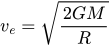
Escape velocity equals the square root of 2 times G times mass divided by radius
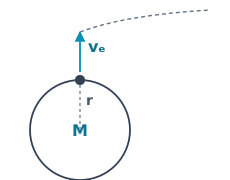
Escape velocity is the minimum speed a projectile must have at a planet's surface to coast away to infinity against gravity without further propulsion. It comes from setting kinetic energy equal to gravitational potential energy: ½mvₑ² = GMm/R, which solves to vₑ = √(2GM/R). G = 6.6743 × 10⁻¹¹ N·m²/kg² is the universal gravitational constant, M is the planet's mass, and R is the planet's radius. This calculator inverts the equation to solve for the escape velocity, the central mass, or the launch radius given the other two quantities — useful for any rocky or gas body in the solar system.
Calculate Earth's escape velocity. Earth's mass is M = 5.972 × 10²⁴ kg and its mean radius is R = 6.371 × 10⁶ m.
Escape velocity is independent of the launching object's mass — a feather and a rocket both need the same vₑ to escape. It is also independent of launch direction, as long as the path doesn't re-enter the atmosphere; rocket engineers usually launch eastward to exploit Earth's rotational speed of ~465 m/s at the equator. Achieving escape velocity doesn't mean escaping immediately — at exactly vₑ the object decelerates asymptotically and reaches infinity with zero residual speed. Real rocket missions need extra delta-v to overcome atmospheric drag and to reach useful interplanetary trajectories. The deeper a body's gravitational well, the harder it is to leave: Earth needs 11.2 km/s, the Moon only 2.4 km/s, Jupiter 59.5 km/s, and the Sun a staggering 617.5 km/s.
Apply vₑ = √(2 × G × M / R), where G = 6.6743 × 10⁻¹¹ N·m²/kg² is the universal gravitational constant, M is the central body's mass in kilograms, and R is its radius (or the launch distance from its center) in meters. Result vₑ comes out in meters per second.
vₑ = √(2GM/R). The derivation sets the launching object's kinetic energy ½mvₑ² equal to the gravitational potential energy GMm/R needed to climb out of the gravity well to infinity. The launching mass m cancels, leaving vₑ independent of the projectile.
About 11,186 m/s or 11.19 km/s — roughly 25,020 mph. That's the minimum speed needed at Earth's surface to coast to infinity ignoring air drag. Real rockets need more to overcome atmospheric losses and to reach useful destinations.
No. The formula vₑ = √(2GM/R) shows escape velocity depends only on the central body's mass M and the launch radius R — not on the projectile's own mass. A feather and a rocket both need the same vₑ to escape (though rockets need fuel to reach it).
Moon: 2.38 km/s. Mars: 5.03 km/s. Jupiter (from its 1-bar cloud tops): 59.5 km/s. The Sun's escape velocity at its surface is about 617.5 km/s — the steepest gravitational well in our solar system.
No. Orbital velocity at radius r is v = √(GM/r), which equals vₑ / √2 — about 71% of escape velocity. At Earth's surface (or ISS altitude), orbital velocity is about 7.9 km/s while escape velocity is 11.2 km/s. Orbital velocity keeps you circling; escape velocity lets you leave entirely.
References:
Lindeburg, Michael R. 1992. Engineer In Training Reference Manual. Professional Publication, Inc. 8th Edition.
Gravitational constant G: NIST CODATA. https://physics.nist.gov/cgi-bin/cuu/Value?bg
Lunar Mission Design
The Moon has a mass of M ≈ 7.342 × 10²² kg and a surface radius of R ≈ 1.7374 × 10⁶ m. A lunar lander on its way home only has to reach escape velocity from the Moon — Earth's gravity does the rest.
vₑ ≈ 2,375 m/s (≈ 2.38 km/s)
Less than a quarter of Earth's 11.2 km/s. That's why a small ascent stage with a single engine can leave the lunar surface — the energy budget scales with v², so 2.4 km/s requires roughly (2.4/11.2)² ≈ 4.5% of the energy per kilogram.
Planetary Science
Mars has M ≈ 6.4171 × 10²³ kg and R ≈ 3.3895 × 10⁶ m. A sample-return mission like Mars Sample Return needs to leave Mars at this speed (plus a margin for atmospheric drag and burn losses).
vₑ ≈ 5,026 m/s (≈ 5.03 km/s)
Roughly half of Earth's escape velocity but more than twice the Moon's. Mars' thin atmosphere also creates aerobraking losses, so real Mars Ascent Vehicles target ≈ 4.0 km/s burnout from the surface — orbital insertion supplies the rest.
Astronomy
Compute the heliocentric escape velocity at 1 AU. M_sun ≈ 1.989 × 10³⁰ kg and R = 1 AU = 1.496 × 10¹¹ m. This is the speed a spacecraft must reach relative to the Sun (not Earth) to leave the Solar System on a parabolic trajectory.
vₑ ≈ 42,123 m/s (≈ 42.1 km/s)
Earth already moves at ≈ 29.78 km/s in its solar orbit, so a prograde launch only needs 42.1 − 29.78 ≈ 12.3 km/s extra (plus Earth-escape and gravity-loss budget). This is exactly why Voyager and New Horizons launched in Earth's orbital direction.
Escape velocity comes from setting kinetic energy equal to the gravitational binding energy at the launch radius — the minimum speed at which an unpropelled projectile can coast to infinity against a planet's gravity.
Where:
The formula ignores atmospheric drag and assumes a non-rotating frame. Real rockets need to add a margin for gravity losses and aerodynamic drag, and they benefit from a prograde launch that adds the planet's surface rotation speed to vₑ. Escape velocity is direction-independent and does not depend on the escaping object's mass.
Mass, mean radius, and escape velocity for the Sun, Moon, and the inner planets out to Jupiter and Saturn. Click any row to load that body's mass and radius into the calculator and solve for its escape velocity. For the full solar-system list, see the planetary data reference.
| Body | Mass (kg) | Mean radius (km) | Escape velocity (km/s) | Source |
|---|---|---|---|---|
| Sun | 1.99×10³⁰ | 696,000 | 617.5 | NASA Planetary Fact Sheet |
| Mercury | 3.3×10²³ | 2,440 | 4.25 | NASA Planetary Fact Sheet |
| Venus | 4.87×10²⁴ | 6,052 | 10.36 | NASA Planetary Fact Sheet |
| Earth | 5.97×10²⁴ | 6,371 | 11.19 | NASA Planetary Fact Sheet |
| Moon | 7.34×10²² | 1,737 | 2.38 | NASA Planetary Fact Sheet |
| Mars | 6.42×10²³ | 3,390 | 5.03 | NASA Planetary Fact Sheet |
| Jupiter | 1.9×10²⁷ | 69,911 | 59.5 | NASA Planetary Fact Sheet |
| Saturn | 5.68×10²⁶ | 58,232 | 35.5 | NASA Planetary Fact Sheet |
The escape velocity shown is NASA's published value, which is referenced to each body's equatorial radius. Recomputing vₑ = √(2 × G × M / R) from the listed mass and mean radius differs by roughly 1–2% for the oblate, fast-spinning gas and ice giants (Jupiter and Saturn), whose equatorial radius is noticeably larger than their mean radius. For the small rocky bodies the two agree to within rounding.