Gravitational Acceleration Calculator
Acceleration equals G times mass divided by radius squared
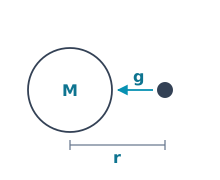
Gravitational acceleration is the acceleration any free-falling object experiences at distance r from a massive body of mass M: g = GM / r², where G = 6.6743 × 10⁻¹¹ N·m²/kg² is the universal gravitational constant. The formula comes directly from Newton's law of gravitation divided by the test mass — that's why all objects fall with the same g regardless of their own mass (Galileo's principle of equivalence). This calculator solves the equation for any one of three unknowns — acceleration, radius, or central mass — given the other two.
Calculate Earth's surface gravitational acceleration. Earth's mass is M = 5.972 × 10²⁴ kg and its mean radius is r = 6.371 × 10⁶ m.
Gravitational acceleration g depends only on the source mass M and the distance r — never on the falling object's own mass. The inverse-square fall-off is steep: at 400 km altitude (ISS), g drops to ≈ 8.7 m/s², about 89% of surface value, which is why astronauts inside the ISS experience apparent weightlessness as the station continuously free-falls around Earth. Other planets give very different values: the Moon's surface gravity is 1.62 m/s² (about 1/6 of Earth's), Mars 3.71 m/s², Jupiter 24.79 m/s², and the Sun a crushing 274 m/s². Use this calculator to find g on any body or to invert the formula and estimate a planet's mass from its measured surface gravity.
Apply the formula g = G × M / r², where G = 6.6743 × 10⁻¹¹ N·m²/kg² is the universal gravitational constant, M is the mass of the central body in kilograms, and r is the distance from that body's center in meters. The result g comes out in m/s².
g = G × M / r², where G is the universal gravitational constant, M is the mass of the body creating the gravity, and r is the distance from its center. This is the local gravitational acceleration felt at any point r away from a mass M.
Substituting Earth's mass (5.972 × 10²⁴ kg) and mean radius (6.371 × 10⁶ m) into g = GM/r² gives approximately 9.82 m/s². The standard reference value 9.80665 m/s² is a defined average that accounts for Earth's oblateness, rotation, and local density variations.
No. The formula g = GM/r² shows g depends only on the central body's mass M and the distance r — not on the falling object. This is why a feather and a hammer fall at the same rate in vacuum on the Moon, a result demonstrated by Apollo 15 astronauts in 1971.
It falls off as the inverse square of the distance from the planet's center. At the ISS's 400 km altitude (r ≈ 6,771 km), g ≈ 8.7 m/s² — about 89% of the surface value. At geostationary altitude (~36,000 km), g drops to about 0.22 m/s².
Moon: 1.62 m/s² (about 1/6 of Earth's). Mars: 3.71 m/s². Venus: 8.87 m/s². Jupiter (cloud tops): 24.79 m/s². Sun: 274 m/s². Use this calculator with each body's mass and radius to verify these values.
References:
Lindeburg, Michael R. 1992. Engineer In Training Reference Manual. Professional Publication, Inc. 8th Edition.
Gravitational constant G: NIST CODATA. https://physics.nist.gov/cgi-bin/cuu/Value?bg
Standard acceleration of gravity: NIST CODATA. https://physics.nist.gov/cgi-bin/cuu/Value?gn
Planetary Science
Mars has a mass of 6.4171 × 10²³ kg and a mean radius of 3.3895 × 10⁶ m. Surface gravity controls how heavy a kilogram weighs there — and how much thrust a Mars rover or human habitat needs to plan for.
g ≈ 3.727 m/s²
About 38% of Earth's 9.81 m/s². A 70 kg astronaut would weigh ≈ 261 N (≈ 59 lbf) on Mars vs 687 N on Earth — close to NASA's published Mars surface gravity of 3.71 m/s² (the small gap is the planet's equatorial bulge and rotation).
Gas Giant Astronomy
Jupiter has M ≈ 1.898 × 10²⁷ kg and an equatorial radius R ≈ 7.1492 × 10⁷ m at the 1-bar cloud tops (Jupiter has no real "surface"). This is the gravitational pull a probe like Galileo experiences as it enters the atmosphere.
g ≈ 24.79 m/s²
Roughly 2.53× Earth's gravity. Combined with extreme winds (≈ 150 m/s) and crushing pressure below the cloud deck, this is why Galileo's entry probe survived only ~58 minutes before being destroyed at the 23-bar level.
Satellite Orbits
Geostationary satellites orbit at r ≈ 4.2164 × 10⁷ m from Earth's center (≈ 35,786 km altitude). For station-keeping calculations and reaction-wheel sizing, engineers need to know the local g at that distance.
g ≈ 0.2241 m/s²
About 1/44 of surface gravity. That's still strong enough to make GEO a useful Lagrange-free anchor for communications: gravity exactly balances the centripetal demand v²/r at the geosynchronous orbital speed (≈ 3.07 km/s).
Gravitational acceleration is the local g a small test mass feels at distance r from a body of mass M. It comes from dividing Newton's law of universal gravitation by the test mass, so g depends only on the source body and the distance to it — not on what is being attracted.
Where:
The inverse-square falloff means that doubling the distance quarters g. The formula models the source body as a point mass (or, equivalently, a spherically symmetric mass distribution outside its surface). It does not include centrifugal effects from rotation, latitude variations, or local density anomalies — published surface gravities for Earth (9.81 m/s²) and other planets average these in.
NASA-published surface gravity for the Sun, Moon, and the inner planets, alongside each body's mass and mean radius. Click a row to load that body's mass and radius into the calculator and solve for its surface gravity with g = G × M / r². For the complete list of all solar-system bodies with escape velocity, see the planetary data reference.
| Body | Mass (kg) | Mean radius (km) | Surface gravity (m/s²) | Source |
|---|---|---|---|---|
| Sun | 1.99×10³⁰ | 696,000 | 274 | NASA Planetary Fact Sheet |
| Mercury | 3.3×10²³ | 2,440 | 3.7 | NASA Planetary Fact Sheet |
| Venus | 4.87×10²⁴ | 6,052 | 8.87 | NASA Planetary Fact Sheet |
| Earth | 5.97×10²⁴ | 6,371 | 9.807 | NASA Planetary Fact Sheet |
| Moon | 7.34×10²² | 1,737 | 1.62 | NASA Planetary Fact Sheet |
| Mars | 6.42×10²³ | 3,390 | 3.71 | NASA Planetary Fact Sheet |
| Jupiter | 1.9×10²⁷ | 69,911 | 24.79 | NASA Planetary Fact Sheet |
| Saturn | 5.68×10²⁶ | 58,232 | 10.44 | NASA Planetary Fact Sheet |
The listed surface gravity is NASA's published effective value, which includes the contribution of rotation and uses the equatorial radius. Computing g = G × M / r² directly from the listed mass and mean radius differs by a few percent for the fast-rotating gas and ice giants (Saturn's mean-radius g is about 11 m/s² vs the published 10.44 m/s²), and matches closely for the slowly-rotating rocky bodies.
