Kepler's Third Law Calculator
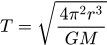
Period equals the square root of 4 pi squared times radius cubed divided by G times mass
Kepler's Third Law of Planetary Motion states that the square of an orbital period is proportional to the cube of the orbital radius: T² = (4π² / GM) × r³, where G = 6.6743 × 10⁻¹¹ N·m²/kg² is the universal gravitational constant and M is the mass of the central body the satellite orbits. This calculator rearranges the equation to solve for the period T, the orbital radius r, or the central mass M given the other two quantities. It works for any two-body orbit — planets around the Sun, moons around a planet, or satellites around Earth.
Calculate the orbital period of a satellite in low Earth orbit at a radius of 6.771 × 10⁶ m (about 400 km altitude, the ISS orbit). Earth's mass is M = 5.972 × 10²⁴ kg.
Kepler's Third Law is a direct consequence of Newton's gravitational law combined with the requirement that gravity supplies the centripetal force of a circular orbit. The proportionality constant 4π²/GM is fixed for any given central body, so all satellites of that body — regardless of mass — follow the same T² ∝ r³ curve. This is why every Sun-orbiting planet's period in years squared equals its semi-major axis in AU cubed: Earth's relation 1² = 1³ defines those units. The law applies in the limit where the orbiting body's mass is much smaller than the central mass; for comparable masses, the full two-body formula uses the sum M₁ + M₂.
Apply T = √(4π² r³ / GM), where r is the orbital radius from the center of the central body, M is the central body's mass, and G is the universal gravitational constant (6.6743 × 10⁻¹¹ N·m²/kg²). Make sure r is in meters and M is in kilograms before computing; the result T will be in seconds.
T² = (4π² / GM) × r³, which rearranges to T = √(4π² r³ / GM) for period, r = ∛(GMT² / 4π²) for radius, and M = 4π² r³ / (GT²) for mass. T is the orbital period, r the orbital radius, M the central mass, and G = 6.6743 × 10⁻¹¹ N·m²/kg².
It says the square of any orbiting body's period is proportional to the cube of its orbital radius. For Sun-orbiting bodies measured in years and AU, this simplifies to T² = r³ exactly. The proportionality constant is fixed by the central body's mass — so any two satellites of the same body satisfy T₁²/r₁³ = T₂²/r₂³.
Yes. Rearranging gives M = 4π² r³ / (GT²) — measure a satellite's orbital period T and radius r, then solve for the central body's mass. This is how astronomers weigh distant stars, planets, and even galaxies using their companions' orbital data.
Yes — for elliptical orbits the same relation holds when r is replaced by the semi-major axis a (half the longest diameter of the ellipse). T² = (4π² / GM) × a³. The circular form is just the special case where eccentricity is zero.
It falls out of equating gravity (∝ 1/r²) to the centripetal force needed for circular motion (∝ r/T²). Setting GM/r² = 4π²r/T² and solving gives T² = (4π²/GM)r³ directly — the squares and cubes are forced by the gravitational inverse-square law.
References:
Lindeburg, Michael R. 1992. Engineer In Training Reference Manual. Professional Publication, Inc. 8th Edition.
NASA, Orbits and Kepler's Laws. https://science.nasa.gov/resource/orbits-and-keplers-laws/
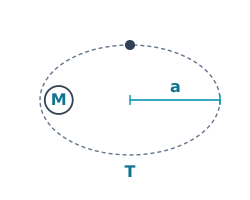
Kepler's third law applies to any closed orbit. This calculator uses the circular-orbit simplification: a body of mass m moves at constant speed along a circle of radius r centered on a much larger central mass M. The period T is the time to complete one revolution.
M — central mass (kg, dominant body) · m — orbiting body mass (cancels out of T) · r — orbital radius (center-to-center distance) · v — tangential orbital velocity · T — period (one full revolution) · G = 6.6743 × 10⁻¹¹ N·m²/kg².
Satellite Navigation
GPS satellites orbit Earth (M = 5.972 × 10²⁴ kg) at r ≈ 2.6561 × 10⁷ m from Earth's center (≈ 20,200 km altitude). The constellation is designed so each satellite repeats its ground track every sidereal day — verify by computing T.
T ≈ 43,089 s ≈ 11.97 h
Almost exactly half a sidereal day (11h 58m), so each satellite traces the same ground track twice per day. The constellation has 24+ satellites in 6 orbital planes, giving the four-satellite minimum needed for a position fix from almost anywhere on Earth's surface.
Kepler Verification
Earth orbits the Sun (M = 1.989 × 10³⁰ kg) at r = 1.496 × 10¹¹ m (one astronomical unit). Plug into Kepler's third law and confirm the calendar year matches.
T ≈ 3.156 × 10⁷ s ≈ 365.28 days
Within 0.02% of the sidereal year (365.256 days). The tiny gap comes from Earth's eccentricity (we used the mean a = 1 AU, but the law actually requires the semi-major axis) and rounding G and the Sun's mass. This is the same calculation Kepler did empirically — without G.
Exoplanet Astronomy
HD 209458 b is a gas giant orbiting at r ≈ 7.103 × 10⁹ m (≈ 0.04747 AU) around its host star of mass ≈ 1.148 M_sun ≈ 2.283 × 10³⁰ kg. It was the first exoplanet observed to transit its star — calculate the expected transit period.
T ≈ 304,700 s ≈ 3.53 days
Matches the measured transit period of 3.524 days. Hot Jupiters orbiting that close are tidally locked, with day-side temperatures above 1,200 K. The radial-velocity wobble of HD 209458 was first reported in 1999, then confirmed by transit photometry months later.
These are the central-body masses M for the calculator — the mass of the dominant body the satellite orbits. Supply the semi-major axis (a) and/or the period (T) yourself; the orbiting body's own mass does not enter Kepler's third law. Click a row to load that body's mass into M while keeping your current orbital-radius and period inputs. For the full sortable list of bodies with radius, surface gravity, and escape velocity, see the planetary data reference.
| Body | Mass (kg) | Type | Source |
|---|---|---|---|
| Sun | 1.99×10³⁰ | Star | NASA Planetary Fact Sheet |
| Mercury | 3.3×10²³ | Rocky planet | NASA Planetary Fact Sheet |
| Venus | 4.87×10²⁴ | Rocky planet | NASA Planetary Fact Sheet |
| Earth | 5.97×10²⁴ | Rocky planet | NASA Planetary Fact Sheet |
| Moon | 7.34×10²² | Moon | NASA Planetary Fact Sheet |
| Mars | 6.42×10²³ | Rocky planet | NASA Planetary Fact Sheet |
| Jupiter | 1.9×10²⁷ | Gas giant | NASA Planetary Fact Sheet |
| Saturn | 5.68×10²⁶ | Gas giant | NASA Planetary Fact Sheet |
Masses are from the NASA Planetary Fact Sheet. Use the central body the satellite actually orbits — a low Earth orbit uses Earth's mass, a heliocentric orbit uses the Sun's.
Kepler's third law relates the orbital period of a satellite to its semi-major axis and the mass of the central body it orbits. The Newtonian form below is derived by balancing gravity against centripetal acceleration for a circular orbit.
Where:
The period grows as r^(3/2): quadrupling the radius gives roughly 8× the period. The mass of the orbiting satellite does not appear — a 1 kg sensor and a 400-ton space station at the same altitude share the same period. The law applies to any central-force orbit and is the cleanest way to get T from r and M, or M from observed T and r (the standard method for weighing planets and stars).