Gravitational Force Calculator
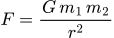
Force equals G times mass 1 times mass 2 divided by distance squared
Newton's Law of Universal Gravitation says every pair of objects pulls on each other with a force F = G × m₁ × m₂ / r², where m₁ and m₂ are their masses, r is the center-to-center distance, and G = 6.6743 × 10⁻¹¹ N·m²/kg² is the universal gravitational constant. This calculator solves the equation for any one of three unknowns — force, distance, or one of the masses — given the other three quantities. Inputs accept kg/g/lb for mass, m/km/ft/mi for distance, and N/lbf/dyne for force; the calculator converts to SI internally before computing.
Calculate the gravitational force between Earth (m₁ = 5.972 × 10²⁴ kg) and a 70 kg person standing on its surface (r = 6.371 × 10⁶ m).
Gravitational force scales linearly with each mass and falls off as the inverse square of the distance, so doubling the distance cuts the force to one-quarter. The gravitational constant G is one of the most precisely measured universal constants and appears unchanged in every gravitational equation derived from Newton's law (Kepler's third law, surface gravity, escape velocity). The force always acts along the line connecting the two centers of mass — never along the surfaces — so r in the formula is the center-to-center distance, not surface-to-surface separation.
Multiply the two masses together and the gravitational constant G (6.6743 × 10⁻¹¹ N·m²/kg²), then divide by the square of the distance between their centers: F = G × m₁ × m₂ / r². Make sure the masses are in kilograms and the distance is in meters before applying the formula.
F = G × m₁ × m₂ / r², where G is the gravitational constant (6.6743 × 10⁻¹¹ N·m²/kg²), m₁ and m₂ are the two masses in kilograms, and r is the distance between their centers in meters. The result F is in newtons.
G = 6.6743 × 10⁻¹¹ N·m²/kg² is the universal gravitational constant — a fixed value that quantifies how strongly any two masses attract each other. Unlike Earth's surface gravity g (≈ 9.81 m/s²), G is identical anywhere in the universe and appears in every gravitational equation.
Because G is extremely small (≈ 6.7 × 10⁻¹¹). Two 1 kg masses one meter apart pull on each other with only ~6.7 × 10⁻¹¹ N — about a hundred-billionth of a newton. Gravitational force only becomes appreciable when at least one of the masses is planetary in scale.
It falls off as the inverse square of the distance. Doubling the separation cuts the force to one-quarter; tripling it cuts the force to one-ninth. This is why orbits weaken rapidly with altitude and why the gravitational influence of distant stars on Earth is negligible.
Yes — both masses appear in the formula and contribute equally. Earth pulls on you with the same force you pull on Earth (Newton's third law). The reason you accelerate noticeably and Earth doesn't is the enormous difference in mass, not in force.
References:
Lindeburg, Michael R. 1992. Engineer In Training Reference Manual. Professional Publication, Inc. 8th Edition.
Gravitational constant G: NIST CODATA. https://physics.nist.gov/cgi-bin/cuu/Value?bg
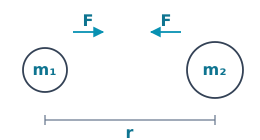
Newton's law of universal gravitation says every pair of masses attracts every other pair along the line connecting their centers, with force that scales as the product of the masses and falls off with the square of the separation distance.
m₁, m₂ — the two masses (kg) · r — center-to-center distance (m) · F — gravitational force on each mass; equal in magnitude, opposite in direction (Newton's third law) · G = 6.6743 × 10⁻¹¹ N·m²/kg² — the universal gravitational constant.
Astronomy
Earth (m₁ = 5.972 × 10²⁴ kg) and the Moon (m₂ = 7.342 × 10²² kg) sit at a mean center-to-center distance of r = 3.844 × 10⁸ m. The mutual gravity sets ocean tides, locks the Moon's rotation, and keeps it in its orbit.
F ≈ 1.98 × 10²⁰ N
The same force acts on both bodies (Newton's third law). Combined with the Moon's orbital speed of ≈ 1,022 m/s, this is exactly what's needed to hold the Moon in its near-circular path — a hands-on verification of Kepler's laws.
Classroom Physics
In 1798 Henry Cavendish measured G by suspending a 0.73 kg lead ball at distance 0.23 m from a 158 kg fixed lead sphere on a torsion fiber. The deflection let him recover G — the first measurement of the gravitational force between laboratory objects.
F ≈ 1.45 × 10⁻⁷ N (145 nN)
Roughly the weight of a single grain of fine sand. Cavendish's apparatus had to detect deflections of just a few millimeters on a torsion fiber tuned to such tiny restoring forces — one of the most remarkable measurements in physics history.
Solar System Dynamics
The Sun (m₁ = 1.989 × 10³⁰ kg) holds Earth (m₂ = 5.972 × 10²⁴ kg) in orbit at r = 1.496 × 10¹¹ m (1 astronomical unit). This is the centripetal force that makes Earth complete one orbit per year.
F ≈ 3.54 × 10²² N
About 178× the Earth-Moon force. Earth's tangential orbital speed of 29.78 km/s converts this gravitational pull into the centripetal acceleration v²/r ≈ 5.93 × 10⁻³ m/s² — the curvature of our annual orbit.
Newton's law of universal gravitation says every pair of point masses attracts each other along the line connecting their centers, with a force proportional to the product of the masses and inversely proportional to the square of the separation.
Where:
The equation treats both bodies as point masses (or as spherically symmetric mass distributions, which behave the same way from outside their surfaces). The inverse-square distance dependence means doubling r reduces the force to a quarter and halving r multiplies it by four. F vanishes only as r → ∞ — gravity has unlimited range.
Masses of the Sun, planets, and Moon for plugging into F = G × m₁ × m₂ / r². Click a body to load its mass as Object 1 (m₁); your other mass and distance are preserved. For the full sortable table with radius, surface gravity, and escape velocity, see the planetary data reference.
| Body | Mass (kg) | Type | Source |
|---|---|---|---|
| Sun | 1.99×10³⁰ | Star | NASA Planetary Fact Sheet |
| Mercury | 3.3×10²³ | Rocky planet | NASA Planetary Fact Sheet |
| Venus | 4.87×10²⁴ | Rocky planet | NASA Planetary Fact Sheet |
| Earth | 5.97×10²⁴ | Rocky planet | NASA Planetary Fact Sheet |
| Moon | 7.34×10²² | Moon | NASA Planetary Fact Sheet |
| Mars | 6.42×10²³ | Rocky planet | NASA Planetary Fact Sheet |
| Jupiter | 1.9×10²⁷ | Gas giant | NASA Planetary Fact Sheet |
| Saturn | 5.68×10²⁶ | Gas giant | NASA Planetary Fact Sheet |
Source: NASA Planetary Fact Sheet. Masses are the published values for each body; the calculator treats each as a point mass at the center-to-center distance you enter.