Centripetal Acceleration Calculator
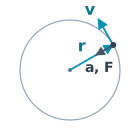
Centripetal acceleration equals velocity squared divided by radius
Centripetal acceleration is the inward acceleration of an object moving along a curved path: a = v² / r. It points toward the center of curvature and is what keeps the object on the circle even when speed is constant. Enter any two of acceleration, velocity, or radius and the calculator algebraically solves for the third, converting between m/s², ft/s², g, and other units automatically.
A car travels at 20 m/s around a circular track with a radius of 50 m. What is the centripetal acceleration the driver experiences?
Centripetal acceleration depends only on speed and radius — it does not depend on the mass of the object. Mass enters when computing the centripetal force F = ma.
Any object moving in a circle is continuously changing direction, which is itself a form of acceleration even when the speed is constant. The centripetal (center-seeking) component of acceleration always points along the radius toward the center of the circle, perpendicular to the velocity. By Newton's second law, this acceleration requires a centripetal force F = ma directed inward — supplied by friction (a car on a curve), gravity (a satellite in orbit), tension (a swinging mass), or the normal force (a roller-coaster loop).
Use a = v² / r, where v is the tangential speed and r is the radius of the circular path. Square the speed, divide by the radius — the result is the inward acceleration in m/s².
a = v² / r. Equivalently, since v = ωr, the formula can also be written a = ω² r, where ω is the angular velocity in rad/s.
Centripetal acceleration is real: it points inward and is what curves the path of a moving object. Centrifugal force is fictitious — it appears only in a rotating reference frame because the frame itself is accelerating. The inertia you feel pulling you outward in a turning car is your body's tendency to move in a straight line, not a real outward force.
No. The formula a = v² / r contains no mass term. Mass only enters when you compute the centripetal force F = ma = mv²/r needed to maintain the motion.
For a car at 20 m/s (≈ 45 mph) on a 50 m radius curve, a = (20)²/50 = 8 m/s² ≈ 0.82 g — close to the lateral grip limit of typical street tires. Sharper curves or higher speeds quickly exceed the friction limit and the car begins to skid.
Reference:
Tipler, Paul A. 1995. Physics For Scientists and Engineers. Worth Publishers. 3rd ed.
Automotive
Close to the lateral-grip limit of typical street tires (≈ 0.85 g) — sharper curves at this speed would slip.
Aerospace
Matches typical low-Earth-orbit orbital speed at ISS altitude (~400 km above sea level).
Amusement Park
4 g is near the upper edge of acceptable instantaneous g-loading for amusement rides; tighter loops or higher speeds rapidly approach blackout territory.
