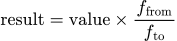
result equals value times from-factor divided by to-factor
Acceleration Conversion =
Solution in Other Units
Unit
Value
Meter / Second² (m/s²)
1
Centimeter / Second² (cm/s²)
100
Millimeter / Second² (mm/s²)
1000
Foot / Second² (ft/s²)
3.2808399
Inch / Second² (in/s²)
39.370079
Centimeter / Day² (cm/d²)
7.4649600e+11
Centimeter / Hour² (cm/h²)
1.2960000e+9
Centimeter / Minute² (cm/min²)
360000
Foot / Day² (ft/d²)
2.4491339e+1
Foot / Hour² (ft/h²)
42519685
Foot / Minute² (ft/min²)
11811.024
Kilometer / Day² (km/d²)
7464960
Kilometer / Hour² (km/h²)
12960
Kilometer / Minute² (km/min²)
3.6
Kilometer / Second² (km/s²)
0.001
Knot / Second (kn/s)
1.9438445
Meter / Day² (m/d²)
7.4649600e+9
Meter / Hour² (m/h²)
1296
Meter / Minute² (m/min²)
3600
Mile / Day² (mi/d²)
4638511.1
Mile / Hour² (mi/h²)
8052.9706
Mile / Minute² (mi/min²)
2.2369363
Mile / Second² (mi/s²)
0.00062137119
Yard / Second² (yd/s²)
1.0936133
Share:
Acceleration Conversion
Each acceleration unit is defined relative to m/s². The converter multiplies by the source factor and divides by the target factor for precise results.
result = value × (from factor / to factor)
How It Works
This converter transforms an acceleration value from one unit into every other supported acceleration unit using precise conversion factors. Each unit is defined relative to m/s², so the converter multiplies by the source factor and divides by the target factor.
Example Problem
Convert 9.81 m/s² (standard gravity) to ft/s².
The conversion factor from m/s² to ft/s² is approximately 3.28084.
9.81 × 3.28084 = 32.17 ft/s²
Key Concepts
Acceleration describes how quickly velocity changes over time. The SI base unit is m/s squared, but engineers and scientists also use g-force (multiples of standard gravity, 9.80665 m/s squared), ft/s squared, and Gal (1 cm/s squared, used in geophysics). All conversions are linear because acceleration units share the same dimensional structure.
Applications
Automotive engineering: converting crash-test deceleration from g-force to m/s squared for structural analysis
Aerospace: expressing launch acceleration in g-force for crew safety assessments
Geophysics: converting seismometer readings in Gal to m/s squared for earthquake magnitude studies
Biomechanics: translating accelerometer data between metric and imperial units for sports science research
Common Mistakes
Confusing g (gravitational acceleration, 9.81 m/s squared) with G (the gravitational constant, 6.674e-11 N m squared/kg squared) — they differ by many orders of magnitude
Forgetting that 1 Gal = 1 cm/s squared, not 1 m/s squared — a factor-of-100 error when converting seismic data
Mixing up acceleration and velocity units — m/s squared is acceleration, while m/s is velocity
Frequently Asked Questions
What is acceleration?
Acceleration is the rate of change of velocity over time. The SI unit is meters per second squared (m/s²).
How do you convert m/s² to ft/s²?
Multiply by approximately 3.281. For example, 9.81 m/s² (gravity) is about 32.17 ft/s².
What is standard gravity in m/s²?
Standard gravitational acceleration is exactly 9.80665 m/s², commonly rounded to 9.81 m/s².
Related Calculators
Time Converter — convert between time units used in acceleration calculations.