Centripetal Force Calculator
Centripetal force equals mass times velocity squared divided by radius
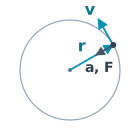
Centripetal force is the inward force required to keep an object of mass m moving in a circle of radius r at speed v: F = m v² / r. It's the net force directed toward the center, not a separate kind of force — it can be supplied by friction (a car on a curve), gravity (a satellite in orbit), tension (a swinging mass), or the normal force (a roller-coaster loop). Enter any three of force, mass, velocity, or radius and the calculator algebraically solves for the fourth, converting units automatically.
A 1,000 kg car rounds a circular curve of radius 50 m at 20 m/s. What centripetal force must friction supply to keep it on the road?
If friction can't supply enough force, the car slides outward along a tangent to the curve — Newton's first law in action.
Centripetal force is a net force, not a new fundamental force. Any combination of gravity, normal force, friction, or tension can supply it as long as the net is directed toward the center. By Newton's second law, F = ma, so centripetal force equals mass times centripetal acceleration: F = m × (v²/r) = m v² / r. The faster the object or the tighter the radius, the more force is needed — speed enters quadratically, so doubling speed quadruples the required force at the same radius.
Use F = m v² / r, where m is the mass, v is the tangential speed, and r is the radius of the circular path. The result is the inward (centripetal) force directed toward the center of the circle.
F = m v² / r. Equivalently, since centripetal acceleration is a = v² / r, you can write F = m a — Newton's second law applied to circular motion.
Friction between the tires and the road. If the curve is banked, a horizontal component of the normal force also contributes. When friction is insufficient (slick roads, excessive speed), the car cannot follow the curve and skids tangentially outward.
No. Centripetal force is real, inward, and required by Newton's laws to keep an object on a circle. Centrifugal force is an apparent (fictitious) outward force that appears only when you analyze motion from inside a rotating reference frame — it isn't a real interaction.
Gravity. For a satellite in a circular orbit, the gravitational force F = G M m / r² equals the required centripetal force m v² / r. Solving gives the orbital speed v = √(G M / r) — only about 7.5 km/s at low Earth orbit.
On a banked curve, a horizontal component of the normal force points toward the center of the curve and contributes to the centripetal force. At the design speed v_d, all of the centripetal force comes from this normal-force component and zero friction is needed: tan(θ) = v_d² / (g × r). Banking is what allows highway interchanges and velodromes to be taken at speed in slick conditions.
Centripetal acceleration is a = v² / r. One g equals 9.81 m/s², so 1 g of lateral grip at 30 m/s requires a curve radius of v² / a = 900 / 9.81 ≈ 92 m. Performance cars achieve roughly 1 g on dry pavement; Formula-1 cars reach 4–5 g through high-speed corners thanks to downforce.
At the top of the loop, gravity pulls the water down while the bucket continues on its circular path. If the bucket moves fast enough that the required centripetal force m v² / r exceeds the weight m g (so v² ≥ g r), the bucket pushes down on the water and the bucket-water system stays on the circle. Below that speed the water falls out and the constraint of circular motion is no longer satisfied.
Reference:
Tipler, Paul A. 1995. Physics For Scientists and Engineers. Worth Publishers. 3rd ed.
Astronautics
The International Space Station orbits at v ≈ 7,660 m/s on a radius of about 6.771 × 10⁶ m (≈ 400 km altitude). Compute the centripetal force gravity must supply to keep its 420 t mass on that circular path.
F ≈ 3.64 × 10⁶ N (≈ 3.64 MN)
Earth's gravity is the only real force acting — it doubles as the centripetal force. Dividing by the ISS mass gives a ≈ 8.67 m/s² (about 0.88 g), which matches g = GM/r² at 6.771 × 10⁶ m — confirming the orbit is self-consistent.
Motorsport
Formula 1 cars routinely pull more than 4 g in fast corners thanks to aerodynamic downforce. Consider a 740 kg car (driver + fuel) negotiating a sweeper at 70 m/s (≈ 250 km/h) on a 90 m radius arc.
F ≈ 40,289 N (≈ 5.55 × car weight)
Dividing by mg = 740 × 9.81 ≈ 7,259 N gives roughly 5.55 g of lateral acceleration — only possible because downforce squashes the tires against the track far harder than gravity alone.
Amusement Park Engineering
In a classic Gravitron / Rotor cylinder, riders stand against the wall while it spins; the wall's normal force is the centripetal force. Size the drum so a 70 kg adult feels a comfortable but firm 5 kN inward push at a wall speed of 12 m/s.
r ≈ 2.02 m
5 kN on a 70 kg rider is about 7.3 g — well above the ~3 g typical Rotor target. Real rides keep wall speed near 8 m/s for the same 2 m radius, giving the more comfortable ~3 g design point.
The centripetal force formula gives the net inward force required to keep an object moving along a circular path at constant speed:
Where:
F is a net force, not a separate kind of force — it can be supplied by friction, tension, gravity, the normal force, or any combination that produces a net inward result. Because v enters quadratically, doubling the speed quadruples the required force at the same radius. The formula assumes uniform circular motion (constant speed); for changing speeds you need to add tangential acceleration separately.
