Orbital Period Calculator
Orbital period equals two pi times radius divided by orbital velocity
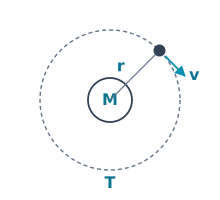
Orbital period is the time it takes one full revolution around a circular path: T = 2πr / v. Geometrically, you're traveling the circumference (2πr) at constant orbital speed v, so the period is just distance over speed. Enter any two of period, orbital radius, or orbital velocity and the calculator rearranges algebraically to solve for the third, converting units automatically.
A satellite orbits 7,000 km from the center of Earth at an orbital speed of 7,500 m/s. What is the orbital period?
This is close to the actual period of the International Space Station (≈ 92 min at 6,778 km mean radius). For higher orbits the period grows because the orbital speed drops.
The relation T = 2πr / v is purely kinematic — it follows from circular geometry, not from gravity. For gravitationally bound circular orbits there is an additional dynamic constraint: gravity must supply the centripetal force, giving v = √(GM/r). Substituting into the kinematic period yields Kepler's third law T² = 4π²r³ / (GM), the relation Newton used to confirm universal gravitation. This calculator uses only the kinematic form — it works for any circular trajectory regardless of what supplies the centripetal force.
Use T = 2πr / v, where r is the orbital radius (distance from the center of the parent body) and v is the orbital speed. Multiply 2π by r to get the circumference of the orbit, then divide by speed.
T = 2πr / v. For a gravitationally bound orbit you can also use Kepler's third law T = 2π√(r³ / GM) — both give the same answer when the orbital speed satisfies v = √(GM / r).
The ISS orbits at about 6,778 km mean radius (≈ 400 km altitude above Earth's surface) at 7,660 m/s. T = 2π(6,778,000) / 7,660 ≈ 5,560 s ≈ 92.6 minutes — about 15.5 orbits per day.
For the kinematic form T = 2πr / v, no — only on radius and speed. But the orbital speed itself depends on the central body's mass (v = √(GM/r) for a circular gravitational orbit), so indirectly orbital period varies with the gravity of the parent body.
Two compounding effects: the orbital circumference (2πr) is larger, and the required orbital speed v = √(GM/r) is smaller. Both push the period up — that's why geostationary satellites at 42,164 km radius take 24 hours per orbit while ISS at 6,778 km takes only 92 minutes.
Reference:
Tipler, Paul A. 1995. Physics For Scientists and Engineers. Worth Publishers. 3rd ed.
Aerospace
Comparable to the ISS (≈ 92 min at 400 km altitude). Higher orbits take longer.
Geostationary
Geostationary satellites match Earth's rotation rate, so they appear stationary over a fixed ground point.
Astronomy
Recovers the astronomical unit — Earth's mean orbital radius around the Sun.
