Hooke's Law Calculator
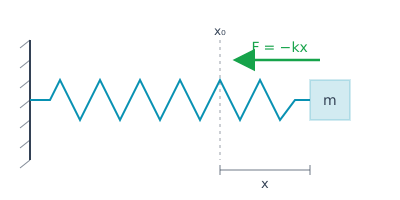
Force equals negative spring constant times displacement from equilibrium
Hooke’s Law states that the restoring force of a spring is proportional to its displacement from equilibrium. The spring constant k measures stiffness — a higher k means a stiffer spring. You can solve for force, distance, equilibrium position, or spring constant.
F = −k(x − x₀)
The elastic potential energy stored in a spring equals one-half times the spring constant times the displacement squared. This energy is released as kinetic energy when the spring returns to its natural length.
U = ½kx²
Hooke’s Law states that the force needed to stretch or compress a spring is proportional to the displacement: F = −k(x − x₀). The spring constant k measures stiffness — a higher k means a stiffer spring. The stored potential energy is U = ½kx². This law applies to any elastic material within its proportional limit, including rubber bands, metal beams, and biological tissues.
A spring with spring constant k = 200 N/m is stretched 0.15 m from its natural length. What restoring force does the spring exert, and how much elastic energy is stored?
Hooke's Law states that the restoring force of an elastic material is proportional to its displacement from equilibrium: F = -k(x - x₀). The spring constant k (in N/m) measures stiffness — higher k means more force is needed for the same displacement. The elastic potential energy stored in a spring is U = ½kx². Hooke's Law applies only within the elastic limit; beyond that point, permanent deformation occurs.
Hooke's law: Fₓ = −k × (x − x₀). Force scales linearly with how far the spring is displaced from its natural length, with stiffness k as the slope and the minus sign indicating the restoring direction.
Rearrange Hooke's law: k = |Fₓ| / |x − x₀|. Apply a known force, measure the resulting deflection from the spring's free length, and divide. The standard load-deflection test in mechanical QA uses this exact relationship.
It's the stiffness of the spring, measured in newtons per meter (N/m). A k of 500 N/m means the spring exerts 500 N of restoring force for every meter it is stretched or compressed from its natural length.
The sign indicates direction: the restoring force always points opposite to the displacement, pulling the spring back toward equilibrium. When you stretch the spring (positive x), the force points in the negative direction, and vice versa.
Beyond the material's elastic limit. Once a spring or any elastic material yields plastically, deformation becomes permanent and force no longer scales linearly with displacement. For steel springs the limit is the proportional yield stress; for coil springs it's often the solid-height point where coils touch.
The energy U = ½kx² equals the area under the force-vs-displacement line. It represents the work done to stretch or compress the spring, and it's released back as kinetic energy when the spring returns to its natural length — the principle behind catapults, suspension bounce, and clockwork mechanisms.
Yes — Hooke's law and "the spring force equation" refer to the same relationship Fₓ = −k(x − x₀). Some textbooks drop the equilibrium term and write F = −kx when x₀ is taken as the origin.
Reference:
Tipler, Paul A. 1995. Physics For Scientists and Engineers. Worth Publishers. 3rd ed.
Automotive Engineering
A coil spring in a vehicle's suspension has a spring rate k = 35,000 N/m. During a hard bump it compresses by 8 cm from its preload position.
F = 2,800 N restoring force
Real automotive springs become progressively stiffer near full compression — Hooke's law applies only inside the linear (elastic) range.
Sports Equipment
A recurve bow modelled as a linear spring has k = 600 N/m. The archer draws the string 0.65 m back from rest.
U ≈ 126.75 J of elastic potential energy
When released, most of this energy transfers into arrow kinetic energy — heavier draw weights launch arrows faster for the same draw length.
Manufacturing QA
A QA fixture applies a measured force of 250 N to a coil spring and records 15 mm of deflection from its free length.
k ≈ 16,667 N/m (≈ 16.7 kN/m)
Industry spec sheets often list spring rates as N/mm or lb/in — divide N/m by 1000 for N/mm, or by 175.13 for lb/in.
Hooke's law describes the restoring force of a linear spring as proportional to its displacement from equilibrium:
Where:
The companion equation gives the elastic potential energy stored in the spring when displaced by x from equilibrium:
Hooke's law is exact only within a material's elastic (proportional) limit. Beyond that point the spring or material yields plastically and the linear relationship breaks down. For coil springs, that limit is typically the point where coils touch (solid height) or where the wire begins to permanently deform.
A linear spring obeys Hooke's law within its elastic limit: the restoring force is proportional to the displacement from equilibrium. The diagram below shows the spring in three states — natural length at equilibrium x₀, stretched by Δx, and the resulting restoring force F pulling the mass back.
k — spring constant (N/m, slope of the F-vs-x line) · x₀ — equilibrium (natural) position · x — displacement from equilibrium (positive when stretched, negative when compressed) · F — restoring force, always pointing toward equilibrium (the negative sign in F = −kx) · U = ½kx² — elastic potential energy stored in the stretched/compressed spring.
