Output Voltage (Vout)
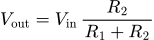
The standard voltage divider formula. Given a supply voltage Vin and two series resistors R₁ and R₂, the voltage measured across R₂ is the supply scaled by the ratio R₂ / (R₁ + R₂). The output is purely passive — no transistor or op-amp gain — and is the building block of bias networks, level shifters, and ADC scaling.
Vout = Vin × R₂ / (R₁ + R₂)
Input Voltage (Vin)
Rearrange when you know the target output and the divider resistors, and want to know what supply voltage is required. Useful when designing around a known reference (3.3 V, 5 V) or working backwards from a measurement on a divider whose source is unknown.
Vin = Vout × (R₁ + R₂) / R₂
Top Resistor (R₁)
Solve for the top resistor when you have picked R₂ (often constrained by load impedance or available values) and need the matching upper-leg resistor to hit a target Vout. The classic 5 V → 3.3 V level shifter is solved this way.
R₁ = R₂ × (Vin − Vout) / Vout
Bottom Resistor (R₂)
Solve for the bottom resistor when R₁ is fixed. Common when you have a fixed series sense resistor or a calibrated upper leg and need the lower-leg value to set the divider ratio.
R₂ = R₁ × Vout / (Vin − Vout)
How It Works
A voltage divider is two resistors in series across a voltage source. The same current I = Vin / (R₁ + R₂) flows through both resistors (Kirchhoff's current law on a single loop). By Ohm's law each resistor drops a voltage proportional to its resistance, so the voltage across R₂ is Vout = I × R₂ = Vin × R₂ / (R₁ + R₂). Kirchhoff's voltage law confirms the math: the drops across R₁ and R₂ sum to Vin. Use the Solve For selector above to rearrange the formula for whichever quantity you need.
Example Problem
A 9 V battery feeds a divider with R₁ = 1 kΩ and R₂ = 2 kΩ. What is the output voltage at the tap between R₁ and R₂, and how much power does each resistor dissipate?
- Identify the known values: Vin = 9 V, R₁ = 1,000 Ω, R₂ = 2,000 Ω.
- Compute the total series resistance: R₁ + R₂ = 1,000 + 2,000 = 3,000 Ω.
- Compute the loop current: I = Vin / (R₁ + R₂) = 9 / 3,000 = 0.003 A = 3 mA.
- Compute the output voltage: Vout = Vin × R₂ / (R₁ + R₂) = 9 × 2,000 / 3,000 = 6 V.
- Compute the power in R₁: P_R1 = I² × R₁ = (0.003)² × 1,000 = 0.009 W = 9 mW.
- Compute the power in R₂: P_R2 = I² × R₂ = (0.003)² × 2,000 = 0.018 W = 18 mW. Total dissipation in the divider is 27 mW.
Both resistors easily handle this dissipation — even a 1/8 W (125 mW) resistor has 5× headroom. For higher voltages or lower divider impedances, always check that the actual dissipation is well below the resistor's rated power.
When to Use Each Variable
- Solve for Vout — when you know the supply voltage and both resistors, e.g., predicting the ADC pin voltage for a battery monitor or sensor.
- Solve for Vin — when you have measured the divider output and the resistor values, e.g., back-calculating an unknown supply or verifying a power-rail estimate.
- Solve for R₁ — when R₂ is fixed by load or available stock and you need the matching top resistor to hit a target Vout, e.g., scaling 5 V down to 3.3 V with R₂ = 10 kΩ.
- Solve for R₂ — when R₁ is fixed (perhaps as a calibrated sense resistor or current-limit) and you need the bottom resistor that produces the desired output ratio.
Key Concepts
An ideal voltage divider assumes no current is drawn from the Vout tap. In reality every load — an ADC pin, a transistor base, the next op-amp stage — pulls some current and forms a Thévenin equivalent (Vth = Vout, Rth = R₁ ∥ R₂). The output 'sags' when the load impedance is comparable to R₁ ∥ R₂. Rule of thumb: keep the load impedance at least 10× larger than R₂ (or R₁ ∥ R₂) so the divider behavior dominates. For high-impedance ADCs (≥ 1 MΩ input) this is easy with kΩ-scale dividers; for op-amp inverting stages with low input impedance, a buffer or rethought topology is usually better than a stiffer divider.
Applications
- Battery voltage monitoring — scale a 12 V or 24 V battery down to the 3.3 V or 5 V ADC range on a microcontroller.
- Logic level shifting — convert a 5 V signal to a 3.3 V input on a modern MCU (one-way; for bidirectional use a level translator).
- Transistor bias networks — set the base voltage of a BJT (or gate of a MOSFET) to put the device in its active region.
- Reference voltage generation — derive a fractional reference (e.g., Vcc/2) for the non-inverting input of an op-amp comparator.
- Potentiometers and sensor scaling — a pot is a continuously variable two-resistor divider; thermistors and photoresistors form half of a divider for analog sensing.
- High-voltage measurement probes — a 100:1 divider lets a 10 V instrument safely read 1,000 V.
Common Mistakes
- Forgetting load impedance — a divider feeding a low-impedance load no longer follows the no-load formula. Always check that the load is ≥ 10× the Thévenin resistance R₁ ∥ R₂.
- Ignoring power dissipation — for low-impedance dividers (Ω-scale) on high voltages, the I²R loss can far exceed standard 1/8 W or 1/4 W resistor ratings.
- Choosing tiny resistance values to 'stiffen' the divider — this wastes battery life and pushes power dissipation up. Pick the largest R that still keeps the load impedance condition met.
- Confusing R₁ and R₂ — Vout is across R₂ (the bottom resistor between the tap and ground). Swapping them flips the ratio.
- Using a divider for power delivery — a divider is a voltage reference, not a power supply. Use a voltage regulator if the load draws meaningful current.
Frequently Asked Questions
What is the voltage divider formula?
The voltage divider formula is Vout = Vin × R₂ / (R₁ + R₂). It gives the voltage measured between R₁ and R₂ when two resistors are connected in series across a supply, with the output tap between them. The same series current flows through both resistors, so the output is the supply scaled by the ratio R₂ / (R₁ + R₂).
How do you calculate voltage divider output?
Add the two resistors to get the total: R₁ + R₂. Divide R₂ by that total to get the ratio. Multiply by Vin to get Vout. Example: a 9 V supply, R₁ = 1 kΩ, R₂ = 2 kΩ gives 2/(1+2) = 0.667, so Vout = 0.667 × 9 = 6 V.
What is the formula Vout = Vin · R2/(R1+R2)?
It is the voltage divider rule — the ratio of the output voltage Vout to the input voltage Vin equals the ratio of R₂ to the total series resistance R₁ + R₂. It comes directly from Ohm's law plus Kirchhoff's voltage law: the same loop current I = Vin/(R₁+R₂) flows through both resistors, and Vout is the drop across R₂, so Vout = I × R₂.
How do you choose voltage divider resistors?
Pick the ratio R₂/(R₁+R₂) to match your target Vout/Vin. Then choose the absolute values so the divider's Thévenin impedance R₁ ∥ R₂ is at least 10× smaller than your load impedance (so the load does not pull Vout down) but large enough that the standing current Vin/(R₁+R₂) does not waste power. For most microcontroller applications, kΩ to tens of kΩ is a good sweet spot.
Why does my voltage divider sag under load?
Real loads draw current. The Thévenin equivalent of the divider has output impedance R₁ ∥ R₂, so any current drawn through the load drops voltage across that source impedance. If the load impedance is not much larger than R₁ ∥ R₂, Vout falls noticeably. Fix it by lowering the divider impedance (smaller R₁ and R₂), buffering with an op-amp follower, or using a voltage regulator instead.
How do you protect a microcontroller pin with a divider?
Use the divider to scale the unsafe voltage down to within the MCU's input range, then verify that under any reasonable fault the pin voltage stays below the absolute-maximum spec (usually Vcc + 0.3 V). For example a 12 V battery feeding a 3.3 V MCU might use R₁ = 30 kΩ, R₂ = 10 kΩ to give Vout = 3.0 V. Add a small clamp diode to Vcc and a series resistor for extra safety in high-transient environments.
Can a voltage divider supply power to a load?
Only for extremely light loads (microamps). A divider is a voltage reference, not a power supply. The output impedance equals R₁ ∥ R₂, so even modest current draw causes the output to sag. For real load currents use a linear voltage regulator (LDO), a switching regulator, or a buffer stage.
What happens if R₁ or R₂ is zero?
If R₁ = 0, the top resistor is a short and Vout = Vin (no division). If R₂ = 0, the bottom resistor is a short to ground and Vout = 0. If both are zero, the supply is shorted to ground — undefined math (NaN) and a real-world short circuit. The calculator returns 0 V, Vin, or no result respectively, and these edge cases highlight why neither resistor should be omitted in practice.
Reference:
Horowitz, Paul and Hill, Winfield. 2015. The Art of Electronics, 3rd ed. Cambridge University Press. §1.2 — The voltage divider.
Voltage Divider Formula
The voltage divider rule scales an input voltage Vin by the ratio of the bottom resistor to the total series resistance:
Vout = Vin × R₂ / (R₁ + R₂)
Where:
- Vin — input (supply) voltage, in volts (V)
- Vout — output voltage at the tap between R₁ and R₂, in volts (V)
- R₁ — top resistor (between Vin and the tap), in ohms (Ω)
- R₂ — bottom resistor (between the tap and ground), in ohms (Ω)
The same loop current I = Vin / (R₁ + R₂) flows through both resistors. Each resistor dissipates I²·R watts of power, so the full divider draws Vin² / (R₁ + R₂) watts from the supply even at no load.
Voltage Divider Schematic
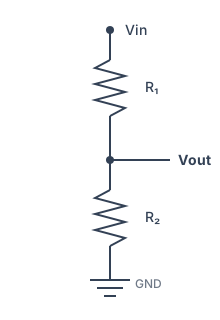
Vin enters at the top, current flows down through R₁ then R₂ to ground, and Vout is measured at the tap between the two resistors.
Worked Examples
Microcontroller Interfacing
How do you shift a 5 V signal down to 3.3 V for a modern MCU?
An older 5 V logic output needs to drive a 3.3 V input on a modern microcontroller. Pick R₂ = 10 kΩ and solve for R₁.
- Target ratio: Vout / Vin = 3.3 / 5 = 0.66.
- R₁ = R₂ × (Vin − Vout) / Vout = 10,000 × (5 − 3.3) / 3.3.
- R₁ = 10,000 × 1.7 / 3.3 ≈ 5,152 Ω.
R₁ ≈ 5,150 Ω (use a 5.1 kΩ standard E96 resistor)
This one-way level shifter only works for slow signals (the source impedance and any wire capacitance form an RC low-pass). For high-speed bidirectional shifting, use a proper level translator like the TXB0108.
Battery Monitoring
How do you read a 12 V lead-acid battery on a 3.3 V ADC?
An MCU with a 3.3 V reference must measure a battery that ranges from 10 V to 14 V. Design a divider so 12 V maps to roughly 3.0 V (leaving headroom for the upper end).
- Choose R₁ = 30 kΩ, R₂ = 10 kΩ (kΩ-scale keeps the ADC's >1 MΩ input from loading the divider).
- Vout at 12 V: 12 × 10,000 / (30,000 + 10,000) = 12 / 4 = 3.0 V.
- Loop current: 12 / 40,000 = 0.3 mA. Power: 12 × 0.0003 = 3.6 mW total — negligible.
Vout = 3.0 V at 12 V battery, 3.5 V at 14 V (safely under 3.3 V if your ADC supports overrange; otherwise tweak the ratio).
Add a 100 nF capacitor from Vout to ground to filter noise. For solar/EV systems where transients are common, add a clamp diode to Vcc on the ADC pin.
High-Voltage Measurement
How do you build a 100:1 probe for a high-voltage measurement?
A 1,000 V power supply needs to be safely measured by a 10 V-range instrument. Use a divider with R₂ = 1 kΩ and solve for R₁.
- Target ratio: Vout / Vin = 10 / 1000 = 1/100.
- R₁ = R₂ × (Vin − Vout) / Vout = 1,000 × (1,000 − 10) / 10.
- R₁ = 1,000 × 99 = 99,000 Ω = 99 kΩ.
R₁ = 99 kΩ. The probe divides 1,000 V down to 10 V.
At 1,000 V the loop current is 1000 / 100,000 = 10 mA, and R₁ dissipates I² × R₁ = (0.01)² × 99,000 = 9.9 W. Use a high-voltage-rated 10 W resistor (or a string of 5× 1/4 W in series) and respect the working-voltage rating, not just the wattage.
Reference: Horowitz, Paul and Hill, Winfield. 2015. The Art of Electronics, 3rd ed. Cambridge University Press. §1.2 — The voltage divider.
Related Calculators
- Ohm's Law Calculator — voltage, current, resistance, and power
- Power Calculator — electrical power from voltage and current
- AC Circuit Calculator — inductive and capacitive reactance
- Capacitor Design Calculator — capacitance, charge, voltage, stored energy
- Resistance Unit Converter — ohms, kilohms, megohms
Related Sites
- Medical Equations — Hemodynamic, pulmonary, and dosing calculators
- Dollars Per Hour — Weekly paycheck calculator with overtime
- Compare 2 Loans — Side-by-side loan comparison calculator
- InfantChart — Baby and child growth percentile charts
- Temperature Tool — Temperature unit converter
- LoanChop — Loan prepayment calculator