
Calculate Torus Volume from Major and Minor Radii
Use this form when both radii of a torus (donut shape) are known. The factor π² (not just π) reflects that the volume comes from sweeping a circular cross-section around a circular path.
V = 2π² R r²
Calculate Torus Surface Area
Use this form for the total external surface area of the donut — wrapping, plating, coating estimates for ring-shaped objects.
S = 4π² R r
Calculate Torus Major Radius from Volume and Minor
Use this rearrangement when the volume and minor radius (tube radius) are known and you need the major radius (distance from center of torus to center of tube).
R = V / (2π² r²)
Calculate Torus Minor Radius from Volume and Major
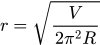
Use this rearrangement when the volume and major radius are known and you need the minor radius (tube cross-section radius).
r = √(V / (2π² R))
How It Works
This torus calculator solves V = 2π² R r² for volume and S = 4π² R r for surface area, where R is the major radius (center of torus to center of tube) and r is the minor radius (the radius of the circular tube cross-section). Both formulas come from Pappus's theorem applied to a circle rotated around an external axis. Pick the unknown with the solve-for toggle, enter the remaining values, and the calculator displays the volume, surface area, outer radius (R + r), and inner radius (R − r) together.
Example Problem
A donut-shaped tube has a major radius of 4 m (center of donut to center of tube) and a tube radius of 1 m. Compute its volume, surface area, and outer/inner radii.
- Knowns: R = 4 m, r = 1 m
- Volume: V = 2π² R r² = 2π² · 4 · 1 = 8π² ≈ 78.957 m³
- Surface area: S = 4π² R r = 4π² · 4 · 1 = 16π² ≈ 157.914 m²
- Outer radius: R + r = 5 m
- Inner radius (donut hole): R − r = 3 m
- Sanity check (inverse): from V = 8π², r = 1, R = V/(2π²r²) = 8π² / 2π² = 4 m, recovering the major radius.
This is a 'ring torus' because R > r. When R = r the torus becomes a 'horn torus' (no hole); when R < r it self-intersects.
When to Use Each Variable
- Solve for Volume — when both radii are known — donut, tire-shape tank, ring-shaped vacuum chamber.
- Solve for Surface Area — when you need the total outer surface — plating, coating, or wrapping a torus.
- Solve for Major Radius — when the volume and tube radius are fixed and you need the overall ring radius.
- Solve for Minor Radius — when the volume and ring radius are fixed and you need the tube cross-section radius.
Key Concepts
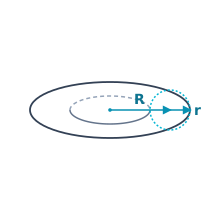
A torus (donut shape) is generated by rotating a circle of radius r around an axis that lies in the same plane as the circle but doesn't intersect it. The distance from the center of the rotation axis to the center of the rotating circle is R, the major radius. The radius of the rotating circle itself is r, the minor radius. By Pappus's theorem, the volume swept out is the area of the rotating circle (πr²) times the distance the centroid travels (2πR), giving V = 2π²Rr². Likewise the surface area is the circumference of the rotating circle (2πr) times the centroid path (2πR), giving S = 4π²Rr.
Applications
- Plumbing and tanks: torus-shaped expansion tanks, accumulator vessels, and process loop volumes
- Tires and inner tubes: estimate volume and surface area for design and pressure calculations
- Physics: tokamak fusion reactor chambers, where toroidal geometry is essential
- Manufacturing: O-ring material volume, donut-shaped seals, and toroidal magnetic cores
Common Mistakes
- Forgetting that the formula has π² (not π) — a torus volume isn't just 'circle area times circumference'; both factors carry a π
- Confusing major radius R (center of torus to tube center) with outer radius (R + r) or inner radius (R − r)
- Treating a torus volume as a cylinder bent into a ring — equal area cross-section times path length is correct only if you use the centroid path 2πR, not the inner or outer rim
- Allowing R < r — that produces a self-intersecting shape, not a proper torus
Frequently Asked Questions
How do you calculate the volume of a torus?
Use V = 2π² R r², where R is the major radius (center of torus to tube center) and r is the minor radius (tube cross-section). For R = 4 m and r = 1 m, V = 8π² ≈ 78.957 m³.
What is the formula for the surface area of a torus?
S = 4π² R r. Same parameter dependencies as volume but with one less factor of r. For R = 4 m and r = 1 m, S = 16π² ≈ 157.914 m².
What's the difference between major and minor radius?
The major radius R is the distance from the center of the torus (center of the donut hole) to the center of the tube. The minor radius r is the radius of the circular tube cross-section itself. The outer edge of the donut is at R + r; the inner edge of the hole is at R − r.
How do you find the major radius given the volume?
Rearrange V = 2π² R r² to R = V / (2π² r²). For V = 8π² m³ and r = 1 m, R = 8π² / (2π²) = 4 m.
What is a 'ring torus' vs a 'horn torus' vs a 'spindle torus'?
Ring torus: R > r (has a donut hole). Horn torus: R = r (no hole, just one point of contact at the center). Spindle torus: R < r (self-intersects). This calculator assumes a ring torus.
Where does the 2π² come from?
By Pappus's centroid theorem, the volume of a solid of revolution is the area of the rotating shape times the distance the centroid travels. For a torus: area = πr², centroid path = 2πR, so V = πr² · 2πR = 2π²Rr².
What is the outer diameter of a torus?
The outer diameter (across the whole donut) is 2(R + r). The inner diameter (across the hole) is 2(R − r).
Can I model a tire with this calculator?
Yes, approximately. A typical car tire has a major radius (rim center to tread center) and a minor radius (sidewall to sidewall, divided by 2). Real tires aren't perfect tori because the cross-section is more rectangular than circular, but the torus formula gives a decent estimate of internal air volume.
Reference:
Weisstein, Eric W. "Torus." MathWorld — A Wolfram Web Resource. https://mathworld.wolfram.com/Torus.html
Worked Examples
Inner Tube
What is the volume of a bicycle inner tube?
A bicycle inner tube has a major radius of 0.33 m (rim radius) and a minor radius of 0.025 m (tube cross-section). Estimate the air volume.
- Knowns: R = 0.33 m, r = 0.025 m
- Formula: V = 2π² R r²
- V = 2π² · 0.33 · 0.000625 ≈ 0.004072 m³
- Convert: 0.004072 m³ × 1000 = 4.07 liters
Volume ≈ 4.07 L
Real bicycle tubes have rectangular-ish cross-sections; the torus formula gives a useful estimate but the actual air volume depends on inflated geometry.
Decorative Donut
How much glaze does a 4 m × 1 m torus need?
An architectural torus ring has R = 4 m and r = 1 m. Compute the total surface area to estimate glaze coverage.
- Knowns: R = 4 m, r = 1 m
- Formula: S = 4π² R r
- S = 4π² · 4 · 1 = 16π² ≈ 157.9 m²
Surface area ≈ 157.9 m² (≈ 1,700 ft²)
This is the same canonical example used in the Example Problem section. Try doubling r to see how surface area scales linearly with the minor radius.
Inverse Solve
What major radius does a 100 L torus need with 0.05 m tube radius?
Design a torus tank with 100 L (0.1 m³) volume and a fixed tube radius of 0.05 m. Find the major radius needed.
- Knowns: V = 0.1 m³, r = 0.05 m
- Formula: R = V / (2π² r²)
- R = 0.1 / (2π² · 0.0025) ≈ 2.026 m
Major radius ≈ 2.03 m
Outer diameter would be 2(R + r) ≈ 4.16 m. Make sure your installation space accommodates the full outer envelope, not just R.
Torus Formulas
A torus (donut shape) is defined by two radii: the major radius R (center of torus to center of tube) and the minor radius r (radius of the circular tube cross-section).
Volume equals two pi squared R r squaredSurface area equals four pi squared R rMajor radius equals V over two pi squared r squaredMinor radius equals the square root of V over two pi squared R


Where:
- V — enclosed volume (m³, L, gal, ft³)
- S — total external surface area
- R — major radius: center of torus to center of tube cross-section
- r — minor radius: radius of the circular tube cross-section
- R + r — outer radius (outer edge of the donut)
- R − r — inner radius (radius of the donut hole; valid only when R > r)
Related Calculators
- Sphere Calculator — compute volume and surface area for a sphere
- Cylinder Calculator — compute volume, surface area, radius, and height for a cylinder
- Circle Calculator — the 2D cross-section that generates the torus
- Geometric Formulas Calculator — explore volume formulas for many shapes
- Volume Converter — switch between m³, L, gallons, ft³
Related Sites
- Temperature Tool — Temperature unit converter
- Z-Score Calculator — Z-score, percentile, and probability calculator
- OptionsMath — Options trading profit and loss calculators
- Medical Equations — Hemodynamic, pulmonary, and dosing calculators
- Dollars Per Hour — Weekly paycheck calculator with overtime
- Percent Off Calculator — Discount and sale price calculator