
Calculate Regular Tetrahedron Volume
Use this form when the edge length a is known and you want the volume of the regular tetrahedron. Equivalent to V = (√2/12)·a³ ≈ 0.117851·a³.
V = a³ / (6√2)
Calculate Regular Tetrahedron Total Surface Area
Use this form for the entire exterior — all four equilateral-triangle faces combined. Each face has area (√3/4)·a², and a regular tetrahedron has four of them.
S = √3 · a²
Calculate Regular Tetrahedron Height
Use this form for the perpendicular distance from any vertex straight down to the opposite face. About 0.8165 of the edge length.
h = a · √(2/3) = a · √6 / 3
Calculate Regular Tetrahedron Edge from Volume
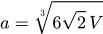
Use this rearrangement when a target volume is known and you need the edge length — the inverse of V = a³/(6√2).
a = ∛(6√2 · V)
How It Works
This regular tetrahedron calculator solves V = a³/(6√2) for volume, S = √3·a² for total surface area, and h = a·√6/3 for the vertex-to-face height — all from a single edge length a. The inverse solve recovers a from a target volume via a = ∛(6√2·V). Inradius r = a/(2√6), circumradius R = a·√6/4, and the fixed dihedral angle θ = arccos(1/3) ≈ 70.53° are always shown as supplementary outputs.
Example Problem
A regular tetrahedron has an edge length of 4 m. Compute its volume, surface area, height, inradius, and circumradius.
- Knowns: a = 4 m (all six edges are equal in a regular tetrahedron)
- Volume: V = a³ / (6√2) = 64 / (6√2) = 16√2 / 3 ≈ 7.5425 m³
- Surface area: S = √3 · a² = 16√3 ≈ 27.7128 m²
- Height: h = a · √6 / 3 = 4√6 / 3 ≈ 3.2660 m (vertex to opposite face)
- Inradius: r = a / (2√6) ≈ 0.8165 m (inscribed sphere)
- Circumradius: R = a · √6 / 4 ≈ 2.4495 m — note R = 3r exactly
- Sanity check (inverse): from V = 7.5425, a = ∛(6√2·V) = ∛(64) = 4 m, recovering the original edge.
The dihedral angle (between two adjacent faces) is the same for any regular tetrahedron: θ = arccos(1/3) ≈ 70.5288°. Edge a is the only free parameter — all other measurements scale from it.
When to Use Each Variable
- Solve for Volume — when the edge length is known and you need the enclosed volume — common for tetrahedral packaging, dice, or molecular geometry estimates.
- Solve for Surface Area — when you need the total area of all four triangular faces — material coverage, coating, or polyhedral net layouts.
- Solve for Height — when you need the vertex-to-face perpendicular distance — useful for tetrahedral truss geometry and CAD layout.
- Solve for Edge — when a target volume is known and you need to size the tetrahedron — typical inverse problem for packaging design.
Key Concepts
The regular tetrahedron is the first of the five Platonic solids — a polyhedron with four congruent equilateral-triangle faces, four vertices, and six edges, all of equal length a. It is the simplest non-degenerate 3D shape and the only polyhedron whose dual is itself. Because every edge has the same length, a single parameter a fully determines the geometry: V scales as a³, S scales as a², and h scales as a. The dihedral angle between adjacent faces is the constant arccos(1/3) ≈ 70.5288°, and the ratio R/r between circumradius and inradius is exactly 3.
Applications
- Tabletop gaming: the four-sided d4 die used in role-playing systems — a regular tetrahedron with the result on the face touching the table (or on the top edge in some variants)
- Chemistry: tetrahedral molecular geometry — methane (CH₄), silicon dioxide tetrahedra in silicate minerals, and the sp³-hybridized carbon in organic compounds all show ~109.47° H-C-H angles
- Crystallography: the diamond cubic lattice is built from corner-sharing tetrahedra; same shape underlies silicon and germanium semiconductors
- Architecture and engineering: tetrahedral trusses (Buckminster Fuller's space frames) are among the strongest lightweight load-bearing structures
- Education: foundational solid for introducing Platonic solids, dihedral angles, and the dual of a polyhedron
Common Mistakes
- Confusing the regular tetrahedron with an Egyptian-style square pyramid — the Egyptian pyramid has a square base and four triangular faces (five faces total), while a regular tetrahedron has four triangular faces total
- Using the perpendicular height h in the surface-area formula — S = √3·a² uses the edge a directly, not the height
- Forgetting that all six edges are equal — in a regular tetrahedron, base edges and slant edges are the same length
- Computing surface area as 4·(1/2·a·h) — that uses the tetrahedron's vertex-to-face height. The correct per-face height is the equilateral-triangle altitude (√3/2)·a, so each face's area is (√3/4)·a², not (1/2)·a·h
- Assuming the dihedral angle is 90° — it is arccos(1/3) ≈ 70.53°, noticeably acute
Frequently Asked Questions
How do you calculate the volume of a regular tetrahedron?
Use V = a³ / (6√2), where a is the edge length and all six edges are equal. Equivalently V = (√2/12)·a³ ≈ 0.117851·a³. For a = 4 m, V = 64/(6√2) = 16√2/3 ≈ 7.5425 m³.
What is the formula for the surface area of a regular tetrahedron?
S = √3 · a². The regular tetrahedron has four congruent equilateral-triangle faces, each with area (√3/4)·a², so the total is 4·(√3/4)·a² = √3·a². For a = 4 m, S = 16√3 ≈ 27.7128 m².
Is a tetrahedron a Platonic solid?
Yes — the regular tetrahedron is the first of the five Platonic solids (tetrahedron, cube, octahedron, dodecahedron, icosahedron). A Platonic solid is a convex polyhedron whose faces are congruent regular polygons meeting the same way at every vertex. With four equilateral triangles and three triangles meeting at each vertex, the regular tetrahedron qualifies.
How is a tetrahedron used as a d4 die?
A standard tabletop d4 (four-sided die) is a regular tetrahedron with the digits 1-4 printed near each vertex. Because a tetrahedron has no 'top' face when it lands (one face is always touching the table), most modern d4s show the result by reading the number along the bottom edges of the three visible faces — the same number repeats at each vertex of the bottom face.
Why is methane (CH₄) tetrahedral?
Carbon in methane has four bonding pairs of electrons, and electron-pair repulsion (VSEPR theory) drives them to maximize angular separation. The geometry that maximizes angles between four points on a sphere is a regular tetrahedron, giving H-C-H bond angles of arccos(-1/3) ≈ 109.47°. This is why methane and most sp³-hybridized carbons are tetrahedral.
What is the dihedral angle of a regular tetrahedron?
The dihedral angle (between two adjacent faces along a shared edge) is arccos(1/3) ≈ 70.5288°. It is constant for every regular tetrahedron — independent of edge length — and is one of the defining identities of the shape. Note the bond angle in methane (109.47°) is a different angle: that one is between vertex-to-center vectors, not between faces.
Is the Great Pyramid of Giza a regular tetrahedron?
No — the Great Pyramid is a square-based pyramid (five faces: one square base plus four triangular sides), not a regular tetrahedron (four triangular faces total). The two shapes are easily confused because both have triangular sloping faces, but a regular tetrahedron has no square base. Use the pyramid calculator for Egyptian-style pyramids.
How do you find the edge length given a target volume?
Rearrange V = a³/(6√2) to a = ∛(6√2·V). For V = 7.5425 m³, a = ∛(6√2 · 7.5425) = ∛64 = 4 m. The cube root means edge length scales as V^(1/3) — doubling volume increases edge length by only about 26%.
Reference:
Weisstein, Eric W. "Regular Tetrahedron." MathWorld — A Wolfram Web Resource. https://mathworld.wolfram.com/RegularTetrahedron.html
Worked Examples
Tabletop Gaming
What is the volume of a 20 mm d4 die?
A standard tabletop d4 is a regular tetrahedron, typically about 20 mm on an edge. Compute its volume and surface area to estimate the resin needed for casting.
- Knowns: a = 20 mm = 0.02 m
- Volume: V = a³ / (6√2) = (0.02)³ / (6√2) ≈ 9.43 × 10⁻⁷ m³ ≈ 0.943 mL
- Surface area: S = √3 · a² = √3 · (0.02)² ≈ 6.93 × 10⁻⁴ m² ≈ 6.93 cm²
- Height: h = a · √6 / 3 = 0.02 · √6 / 3 ≈ 16.33 mm
Volume ≈ 0.943 mL (about 1 mL of casting resin per d4)
A d4 is a regular tetrahedron with the digits 1-4 printed near each vertex. The number that appears at all three visible vertex corners of the bottom (resting) face is the rolled value.
Molecular Geometry
What size tetrahedron describes a methane (CH₄) molecule?
Methane has four hydrogen atoms arranged at the vertices of a regular tetrahedron around the central carbon. The C-H bond length is about 109 pm (1.09 Å), so the H-H edge of that tetrahedron is about 178 pm.
- Knowns: H-H edge a ≈ 178 pm = 1.78 × 10⁻¹⁰ m
- Volume: V = a³ / (6√2) ≈ 6.64 × 10⁻³¹ m³
- Surface area: S = √3 · a² ≈ 5.49 × 10⁻²⁰ m²
- Vertex-to-face height: h = a · √6 / 3 ≈ 145 pm
Edge a ≈ 178 pm, volume ≈ 6.6 × 10⁻³¹ m³
The H-C-H bond angle (109.47°) is arccos(-1/3) — different from the tetrahedron's dihedral angle of arccos(1/3) ≈ 70.53°. The bond angle measures vertex-center-vertex; the dihedral measures face-face.
Scientific Lattice
How big is the Si-Si tetrahedron in a silicon diamond lattice?
Silicon's diamond-cubic crystal is built from corner-sharing regular tetrahedra. Each Si atom is bonded to four neighbors with Si-Si bond length 235 pm — the edge of the tetrahedron formed by any one Si and its four neighbors is about 384 pm.
- Knowns: edge a = 384 pm = 3.84 × 10⁻¹⁰ m
- Volume: V = a³ / (6√2) ≈ 6.67 × 10⁻³⁰ m³
- Surface area: S = √3 · a² ≈ 2.55 × 10⁻¹⁹ m²
- Circumradius: R = a · √6 / 4 ≈ 235 pm — matches the Si-Si bond length, as expected (center-to-vertex)
Each Si-Si tetrahedron has volume ≈ 6.7 × 10⁻³⁰ m³
Diamond and silicon share this tetrahedral framework — the same geometry underlies semiconductor electronics. Germanium and gray tin use the same lattice with different bond lengths.
Regular Tetrahedron Formulas
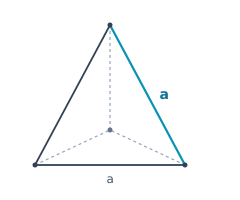
A regular tetrahedron is fully defined by a single parameter: the edge length a. All four faces are congruent equilateral triangles with side a, and all six edges share that same length. Volume, surface area, height, inradius, and circumradius all follow from a.
Volume equals a cubed divided by six root twoSurface area equals root three times a squaredHeight equals a times the square root of two-thirdsEdge equals the cube root of six root two times V


Where:
- a — edge length (every edge of a regular tetrahedron has the same length)
- V — enclosed volume (m³, L, cm³, ft³)
- S — total surface area of all four equilateral-triangle faces (m², cm², in²)
- h — vertex-to-opposite-face perpendicular height ≈ 0.8165·a
- r — inradius (radius of the inscribed sphere) = a / (2√6) ≈ 0.2041·a
- R — circumradius (radius of the circumscribed sphere) = a·√6/4 ≈ 0.6124·a
- θ — dihedral angle between adjacent faces = arccos(1/3) ≈ 70.5288° (constant)
Identity worth noting: for a regular tetrahedron, R = 3r exactly. The circumscribed sphere has three times the radius of the inscribed sphere — a clean result that follows from the symmetry.
Related Calculators
- Cube Calculator — the second Platonic solid — six square faces, eight vertices, twelve edges
- Sphere Calculator — the limiting shape as the number of Platonic-solid faces tends to infinity; volume and surface area from radius
- Pyramid Calculator (Square Base) — an Egyptian-style square-based pyramid — five faces total (one square + four triangles), not the same as a regular tetrahedron
- Triangle Calculator — the 2D equilateral triangle face of the tetrahedron — area, perimeter, and angles
- Geometric Formulas Calculator — explore volume and area formulas for many shapes side by side
- Volume Converter — switch tetrahedron volume between m³, L, gallons, ft³, and more
Related Sites
- Temperature Tool — Temperature unit converter
- Z-Score Calculator — Z-score, percentile, and probability calculator
- OptionsMath — Options trading profit and loss calculators
- Medical Equations — Hemodynamic, pulmonary, and dosing calculators
- Dollars Per Hour — Weekly paycheck calculator with overtime
- Percent Off Calculator — Discount and sale price calculator