Square Pyramid Frustum Calculator (Truncated Square Pyramid)
Volume equals h divided by three times the quantity a squared plus a times b plus b squared
Use this form when both square edge lengths and the perpendicular height of a truncated square pyramid are known. The volume reduces to a square prism (a = b) at one extreme and to a full square pyramid (b = 0) at the other.
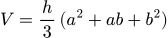
V = (h / 3)(a² + a b + b²)
Use this form when you need the entire exterior — both square ends plus the four trapezoidal sides. Common for closed plinths, capped planter boxes, and finished architectural blocks.
S = 2 (a + b) ℓ + a² + b²
Use this form when only the four slanted trapezoidal faces matter — wrap material for a lampshade frame, paint coverage on the sides of a planter, or sheet metal for an open-top hopper.
S_lat = 2 (a + b) ℓ
Use this rearrangement when a target volume and both edge lengths are fixed and you need the perpendicular height. Common when sizing a planter or stepped-pyramid course to a specified capacity for given square dimensions.
h = 3V / (a² + a b + b²)
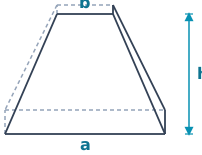
This square pyramid frustum calculator (truncated square pyramid) treats the shape as a pyramid with the apex sliced off parallel to the base — the same Egyptian-pyramid-like silhouette you see on Mayan and Aztec stepped pyramids, architectural plinths, and tapered planter boxes. Three numbers fix the geometry: the bottom square side a, the top square side b, and the perpendicular height h. The two sides do not need a specific ordering — the slant uses the half-difference (a − b)/2 squared, so b > a (a wider-on-top planter shape) works the same way. From those the calculator solves V = (h / 3)(a² + a b + b²) for volume, S = 2(a + b)ℓ + a² + b² for total surface area, and S_lat = 2(a + b)ℓ for the lateral area, where ℓ = √(h² + ((a − b) / 2)²) is the slant height of each trapezoidal face. Pick the unknown with the solve-for toggle, enter the remaining three values in any supported length or volume unit, and the calculator converts to SI internally before reporting every related quantity — volume, both surface areas, slant height, slant edge, both edges, and the perpendicular height.
A small stepped-pyramid block has a bottom edge a = 6 m, a top edge b = 2 m, and a height h = 4 m. What is its volume, slant height, lateral surface area, total surface area, and corner-to-corner slant edge?
When b = 0 the frustum collapses into a full square pyramid — V = 48, ℓ = 5, S_lat = 60, S = 96 — matching the regular pyramid formulas exactly. When a = b the frustum is a square prism with ℓ = h and four rectangular sides.
A square pyramid frustum is what you get when you slice a regular square pyramid with a plane parallel to its base and remove the small pyramid on top — the same silhouette you see on Mayan and Aztec stepped pyramids, ziggurats, and architectural plinths. Three numbers determine the geometry: the bottom edge a, the top edge b, and the perpendicular height h. There are two distinct slant measurements: the face slant height ℓ = √(h² + ((a − b) / 2)²) — the perpendicular distance from a face midpoint up to the top edge midpoint, used in the lateral-area formula — and the slant edge e = √(h² + (a − b)² / 2) — the actual length of the corner-to-corner edge. The volume V = (h / 3)(a² + a b + b²) is a specialization of the general frustum formula V = (h / 3)(A_bottom + √(A_bottom · A_top) + A_top): for two squares with sides a and b the geometric mean √(A_bottom · A_top) = √(a² · b²) = a b, so the bracketed sum collapses to a² + a b + b². The volume interpolates smoothly between two familiar cases: when b → 0 it becomes (1/3) a² h (a full square pyramid); when b → a it becomes a² h (a square prism).
Use V = (h / 3)(a² + a b + b²), where a is the bottom square side, b is the top square side, and h is the perpendicular height. The two sides can be in either order. For example, a = 6 m, b = 2 m, h = 4 m gives V = (4/3) · 52 = 208/3 ≈ 69.3 m³.
For a square pyramid frustum: V = (h / 3)(a² + a b + b²), S_lat = 2(a + b)ℓ, and S = S_lat + a² + b², where ℓ = √(h² + ((a − b) / 2)²) is the slant height of each trapezoidal face. The volume formula is a special case of the general prismatoid rule V = (h / 6)(A_bottom + 4 A_middle + A_top), or equivalently V = (h / 3)(A_bottom + √(A_bottom · A_top) + A_top).
Slant height ℓ = √(h² + ((a − b) / 2)²) is the perpendicular distance from the midpoint of a bottom edge up the trapezoidal face to the midpoint of the corresponding top edge. Slant edge e = √(h² + (a − b)² / 2) is the actual length of a corner-to-corner edge connecting a bottom vertex to the corresponding top vertex. Lateral surface area uses ℓ, not e.
Rearrange the volume formula: h = 3V / (a² + a b + b²). For V = 69.3 m³, a = 6 m, b = 2 m: h = 3 · 69.3 / 52 ≈ 4 m. This recovers the original height to within rounding.
No — the Great Pyramid is a complete square pyramid (b = 0 at the apex), not a frustum. The Mayan and Aztec stepped pyramids (Chichén Itzá's El Castillo, Teotihuacán's Pyramid of the Sun) are closer to frusta — each course is a truncated layer with a flat top, and the temple sits on the topmost frustum. Ziggurats from Mesopotamia follow the same stepped-frustum pattern.
Architectural plinths, monumental stepped pyramids (Mayan, Aztec, ziggurat), tapered planter boxes, lampshade frames with square section, transition sections in HVAC and hoppers, packaging and shipping crates with tapered profiles, and finials on columns. Any time you need a stable shape with a square base that narrows to a smaller square top, the answer is a square pyramid frustum.
Both are specializations of V = (h / 3)(A_bottom + √(A_bottom · A_top) + A_top). For a cone the bases are circles (A = π r²), so √(A_b · A_t) = π R r and V = (π h / 3)(R² + R r + r²). For a square frustum the bases are squares (A = side²), so √(A_b · A_t) = a b and V = (h / 3)(a² + a b + b²). The structural pattern is identical.
When b = 0 the frustum is a complete square pyramid. The formulas collapse: V = (h / 3) a², ℓ = √(h² + (a / 2)²), S_lat = 2 a ℓ, S = S_lat + a². The square-pyramid-frustum calculator and the square-pyramid calculator agree exactly in that limit.
Reference:
Weisstein, Eric W. "Pyramidal Frustum." MathWorld — A Wolfram Web Resource. https://mathworld.wolfram.com/PyramidalFrustum.html
Stepped Pyramid Course
A single course of a stepped pyramid has a bottom edge a = 6 m, top edge b = 2 m, and height h = 4 m (the canonical Wolfram case). Use V = (h / 3)(a² + a b + b²) for the volume of that course.
Course volume ≈ 69.3 m³
Real stepped pyramids stack many such frusta — total volume is the sum of all course volumes, each computed individually with its own a, b, and h.
Tapered Planter
A garden planter has a bottom edge a = 30 cm, top edge b = 50 cm (wider at the top), and depth h = 40 cm. The capacity is V = (h / 3)(a² + a b + b²).
Planter capacity ≈ 65 L (about 17 US gallons of potting mix)
The frustum formula is symmetric in a and b — whether the wider square is at the top or the bottom doesn't change the volume, only the orientation. Subtract roughly 5–10% for drainage layer and root mass.
Square Hopper
A square-section hopper has bin edge a = 0.8 m and discharge edge b = 0.2 m. The target capacity is 200 L (0.2 m³). Solve h = 3V / (a² + a b + b²).
Hopper height ≈ 0.71 m (≈ 28 in)
Real hoppers also factor in the discharge angle — the slant ℓ — for material-flow purposes. Granular material flows reliably only when the trapezoidal-face angle exceeds the material's angle of repose.
All truncated-square-pyramid properties follow from three dimensions: the bottom edge a, the top edge b, and the perpendicular height h. From those, both slant measurements, the volume, and both surface areas all derive:
Where: