Cone Frustum Calculator (Truncated Cone)
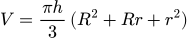
Volume equals pi h divided by three times the quantity capital R squared plus capital R times r plus r squared
Use this form when both base radii and the perpendicular height of a truncated cone are known. The volume reduces to a cylinder (R = r) at one extreme and to a full cone (r = 0) at the other.
V = (π h / 3)(R² + R r + r²)
Use this form when you need the entire exterior — both circular ends plus the slanted side. Common for closed buckets, lampshade end caps, and material takeoffs on hoppers with a top flange.
S = π (R + r) ℓ + π R² + π r²
Use this form when only the slanted side matters — the wrap on a lampshade, the sheet metal needed to roll a hopper, or the paint coverage on the curved face of a bucket.
L = π (R + r) ℓ
Use this rearrangement when a target volume and both radii are fixed and you need the perpendicular height. Common when sizing a bucket or hopper to a specified capacity for given rim dimensions.
h = 3V / (π (R² + R r + r²))
This cone frustum calculator (truncated cone) uses V = (π h / 3)(R² + R r + r²) plus the surface-area pair S = π (R + r) ℓ + π R² + π r² and L = π (R + r) ℓ, where ℓ = √(h² + (R − r)²) is the slant height. Pick the unknown with the solve-for toggle, enter the remaining three values in any supported length or volume unit, and the calculator converts to SI internally before computing every related quantity — volume, both surface areas, slant height, both radii, and the perpendicular height — so a single page covers buckets, lampshades, conical hoppers, drinking cups, and frusta in geometry homework.
A small bucket has a bottom radius R = 3 m, a top radius r = 1 m, and a height h = 4 m. What is its volume, slant height, lateral surface area, and total surface area?
When r = 0 the frustum collapses into a full cone — and V = 12π, ℓ = 5, L = 15π, S = 24π, matching the cone formulas exactly. When R = r the frustum is a cylinder with ℓ = h.
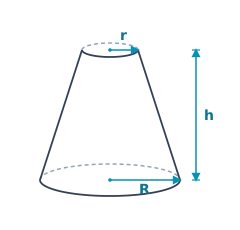
A cone frustum — sometimes just called a truncated cone — is what you get when you slice a right circular cone with a plane parallel to its base and remove the small cone on top. Three numbers determine the geometry: the bottom radius R, the top radius r, and the perpendicular height h. The slant height ℓ = √(h² + (R − r)²) plays the same role here that it does for a cone — it scales the lateral surface and is the actual length of the slanted edge in cross section. The volume formula V = (π h / 3)(R² + R r + r²) interpolates smoothly between two familiar cases: when r → 0 it becomes (1/3) π R² h (a full cone); when r → R it becomes π R² h (a cylinder). The mixed term R r is what makes the average of the two end-area approximations work exactly.
Use V = (π h / 3)(R² + R r + r²), where R is the bottom radius, r is the top radius, and h is the perpendicular height. For example, R = 3 m, r = 1 m, h = 4 m gives V = (4π/3) · 13 = 52π/3 ≈ 54.5 m³.
Slant height ℓ = √(h² + (R − r)²). It is the actual length of the slanted edge in cross section, not the perpendicular height. For R = 3, r = 1, h = 4 this gives ℓ = √20 = 2√5 ≈ 4.47.
Lateral surface area L = π (R + r) ℓ counts only the slanted side. Total surface area S = L + π R² + π r² adds both circular ends. Use lateral area for a lampshade wrap or open bucket; use total surface area for a closed container.
Set the bottom radius R to your discharge-spout radius, the top radius r to your bin radius, and the height h to the vertical transition. The calculator returns the hopper volume and the slant height needed for the sheet-metal pattern.
Rearrange the volume formula to h = 3V / (π (R² + R r + r²)). For V = 54.5 m³, R = 3 m, r = 1 m: h = 3 · 54.5 / (π · 13) ≈ 4 m.
Yes — set r = 0 and the formulas collapse to the cone formulas: V = (1/3) π R² h, ℓ = √(R² + h²), L = π R ℓ, S = L + π R². The frustum calculator and the cone calculator agree exactly in that limit.
Measure the inside diameter at the bottom and top, divide each by 2 to get R and r, measure the inside depth h, and plug into V = (π h / 3)(R² + R r + r²). The same formula works for a pail, planter, drinking glass, or lampshade silhouette.
The lateral surface unrolls into an annular sector — a ring-shaped slice of a circle with inner arc length 2π r and outer arc length 2π R, separated radially by the slant height ℓ. Sheet-metal shops use this pattern to roll buckets, hoppers, and lampshade frames.
Reference:
Weisstein, Eric W. "Conical Frustum." MathWorld — A Wolfram Web Resource. https://mathworld.wolfram.com/ConicalFrustum.html
Bucket Capacity
A small bucket has a bottom radius R = 3 m, top radius r = 1 m, and a height h = 4 m (the canonical Wolfram case). Use V = (π h / 3)(R² + R r + r²) for the capacity.
Volume ≈ 54.5 m³ ≈ 54,454 liters
Real buckets have wall thickness — for working volume measure interior diameters and depth, not exterior.
Lampshade Wrap
A pendant lampshade has a bottom (skirt) radius R = 25 cm, top (collar) radius r = 12 cm, and height h = 30 cm. The fabric needed is the lateral surface area L = π(R + r)ℓ.
Lateral surface area ≈ 3,801 cm² (~0.38 m²)
When rolled flat, the shade unwraps into a circular sector with arc lengths 2πR and 2πr separated by ℓ — that's the pattern the shop cuts. Add a small seam-allowance on the cut edge.
Grain Hopper
A conical-transition hopper has bin radius R = 0.6 m at the top of the transition and discharge radius r = 0.1 m at the bottom. The target capacity is 500 L (0.5 m³). Solve h = 3V / (π(R² + R r + r²)).
Hopper height ≈ 1.11 m (≈ 43.7 in)
Note that R and r in the volume formula are interchangeable — flipping which end is wider doesn't change the volume, only the orientation. Real hoppers also factor in the discharge angle (slope of the slant) for material-flow purposes.
All cone-frustum properties follow from three dimensions: the bottom radius R, the top radius r, and the perpendicular height h. From those, slant height, volume, and both surface areas all derive:
Where: