How It Works
Moisture content measures the fraction of water in a solid waste sample, which directly affects compaction, decomposition rate, and leachate generation. The landfill water balance equation estimates how much precipitation percolates through the cover soil by subtracting runoff, storage, and evapotranspiration. Together these calculations help engineers size leachate collection systems and design cover layers that limit infiltration while supporting vegetation. A waste sample weighs 4 kg wet and 2.8 kg after drying. What is the moisture content? Typical municipal solid waste has moisture content of 15–40%, depending on climate and composition. Moisture content affects waste density, compaction efficiency, and the rate of biological decomposition in landfills. Higher moisture generally accelerates decomposition but increases leachate generation, which must be collected and treated.
Example Problem
A waste sample weighs 4 kg wet and 2.8 kg after drying. What is the moisture content?
- Identify the knowns. Wet weight W = 4 kg (sample as received) and dry weight D = 2.8 kg (sample after oven-drying to constant mass).
- Identify what we're solving for. We want the moisture content M as a percentage of the wet weight, the convention used in solid waste characterization.
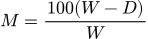
- Write the formula in symbols: M = 100 × (W − D) / W.
- Substitute the known values: M = 100 × (4 − 2.8) / 4 = 100 × 1.2 / 4.
- Simplify the arithmetic: M = 100 × 0.30.
- State the result with units: **M = 30%** — typical for municipal solid waste and an input to landfill compaction and leachate estimates.
Moisture content affects waste density, compaction efficiency, and the rate of biological decomposition in landfills. Higher moisture generally accelerates decomposition but increases leachate generation, which must be collected and treated.
When to Use Each Variable
- Solve for Moisture Content — when you know wet and dry weights of a waste sample, e.g., characterizing incoming waste for landfill compaction planning.
- Solve for Wet Weight — when you know dry weight and moisture content, e.g., estimating total weight for hauling and tipping fee calculations.
- Solve for Percolation — when you know precipitation, runoff, storage, and evapotranspiration, e.g., sizing a leachate collection system for a new landfill.
- Solve for Evapotranspiration — when you know the other water balance components, e.g., evaluating cover soil vegetation performance.
Key Concepts
Solid waste management relies on two key calculations: moisture content and the landfill water balance. Moisture content (percentage of water in a waste sample) affects compaction, decomposition rate, and leachate generation. The water balance equation estimates percolation through the landfill cover by accounting for precipitation, runoff, soil moisture storage, and evapotranspiration. Together these help engineers design leachate collection systems and select appropriate cover materials.
Applications
- Landfill design: sizing leachate collection and treatment systems based on expected percolation rates
- Waste characterization: measuring moisture content to predict decomposition rates and gas generation
- Cover system design: selecting soil types and vegetation to maximize evapotranspiration and minimize infiltration
- Regulatory compliance: documenting moisture and percolation data for environmental permits and monitoring reports
Common Mistakes
- Using wet weight in the denominator for moisture content but dry weight in the water balance — consistency in definitions is critical
- Ignoring seasonal variation in evapotranspiration — ET is near zero in winter but can exceed precipitation in summer
- Assuming uniform moisture throughout the waste — waste composition varies widely, making representative sampling essential
- Neglecting the runoff coefficient for different cover soil types — bare clay versus vegetated topsoil have very different runoff characteristics
Frequently Asked Questions
Why is moisture content important in solid waste management?
Moisture content affects waste density, compaction efficiency, and the rate of biological decomposition in landfills. Higher moisture generally accelerates decomposition but increases leachate generation, which must be collected and treated.
What is the landfill water balance equation?
The water balance subtracts runoff, soil storage, and evapotranspiration from precipitation to estimate percolation: C = P(1−R) − S − E. The result tells engineers how much water will reach the waste and become leachate.
What moisture content is typical for municipal solid waste?
Freshly collected MSW typically has 15–40% moisture by weight. Food waste can exceed 70%, while construction debris may be below 5%. These differences significantly affect landfill design.
How is the runoff coefficient R chosen for a landfill cover?
R depends on cover-soil slope, vegetation, and antecedent moisture. Bare, steep clay caps can run 0.5–0.7; well-vegetated 3:1 slopes are often 0.1–0.3. Local SCS/NRCS curve numbers or field rainfall-simulator tests anchor the choice for permit calculations.
What is leachate and how does percolation relate to it?
Leachate is the contaminant-laden liquid generated when water percolates through buried waste and picks up dissolved and suspended solids. The percolation value C from the water-balance equation is the upper bound on long-term leachate generation rate per unit area.
Why use wet weight in the moisture formula instead of dry weight?
Solid-waste characterization traditionally reports moisture as a fraction of total (wet) mass — the form in which the waste is generated, hauled, and tipped. Soil science uses a dry-mass basis for the same ratio. Always confirm which convention is in use before comparing field values.
How does evapotranspiration limit landfill percolation?
Vegetated cover soils return water to the atmosphere by transpiration through plants and direct evaporation from the surface. Healthy turf or deep-rooted vegetation can return more than half of annual precipitation, sharply reducing percolation and leachate volume.
Worked Examples
Materials Recovery Facility
What is the moisture content of a 100 kg MSW sample that dries to 70 kg?
A materials recovery facility (MRF) operator takes a representative 100 kg sample of incoming municipal solid waste (MSW) and dries it in a 105 °C oven until constant weight. The dried sample weighs 70 kg. What is the as-received moisture content?
- Knowns: W = 100 kg (wet), D = 70 kg (dry)
- M = 100 × (W − D) / W
- M = 100 × (100 − 70) / 100
- M = 100 × 30 / 100
M = 30% moisture
Typical mixed MSW runs 15–40% moisture depending on food-waste and yard-waste fraction. Moisture content is a key input for landfill gas modeling and waste-to-energy heat value calculations.
Sanitary Landfill — Leachate Generation
How much leachate percolates through a landfill cover with 1,000 mm/yr rainfall?
A sanitary landfill in a temperate region receives 1,000 mm/yr of precipitation. The vegetated cover soil has a runoff coefficient of 0.15, the root-zone storage retains 100 mm/yr, and evapotranspiration removes 600 mm/yr. What is the annual deep percolation rate through the cap into the waste mass?
- Knowns: P = 1,000 mm, R = 0.15, S = 100 mm, E = 600 mm
- C = P × (1 − R) − S − E
- C = 1,000 × (1 − 0.15) − 100 − 600
- C = 850 − 700
C = 150 mm/yr percolation
Deep percolation drives leachate generation and is what landfill liners and leachate collection systems are sized to handle. Regulators typically require the cap to be designed so C trends toward zero within a few years of closure.
Compost Operations
What is the wet weight of 500 kg of finished compost at 40% moisture?
A composting facility ships finished product with a target 40% moisture content for proper microbial activity. If a delivery contains 500 kg of bone-dry compost solids, what is the wet shipping weight at the specified moisture level?
- Knowns: D = 500 kg (dry), M = 40%
- W = D / (1 − M/100)
- W = 500 / (1 − 0.40)
- W = 500 / 0.60
W ≈ 833.3 kg shipped
Wet-basis moisture is the convention in waste management because it matches what's actually weighed at the scale. Dry-basis moisture (D/W vs (W−D)/W) is used more commonly in soil science.
Solid Waste Formulas
Two equations cover the most common solid-waste calculations: characterizing a waste sample's moisture and balancing water flows through a landfill cover.
M = 100 × (W − D) / WMoisture content (wet-mass basis, %)
C = P × (1 − R) − S − ELandfill water balance (percolation through cover)
Where:
- M — moisture content as a percent of wet weight
- W — wet (as-received) sample weight, any consistent mass unit
- D — dry sample weight after oven-drying to constant mass
- C — deep percolation through the cover (mm/yr or in/yr)
- P — total precipitation onto the cover surface (mm/yr)
- R — runoff coefficient (dimensionless, 0–1); fraction of P that runs off as surface flow
- S — net change in soil-moisture storage in the cover root zone (mm/yr)
- E — evapotranspiration: water returned to atmosphere by evaporation and plant transpiration (mm/yr)
Moisture content drives compaction, decomposition rate, and the calorific value used in waste-to-energy planning. The water-balance equation drives leachate-system sizing: percolation C sets the long-term volume of leachate the collection system must handle. Designing a closed-landfill cap is essentially the work of pushing C toward zero by maximizing R, S, and E.
Related Calculators
- Permeameter Calculator — measure cover soil permeability for landfill liner design
- Trommel Screen Calculator — size screens for solid waste separation
- Rainwater Collection Calculator — assess precipitation patterns relevant to landfill hydrology
- Density Calculator — calculate waste density for compaction and volume estimates
- Volume Unit Converter — convert landfill capacity between cubic yards, cubic meters, and gallons
Related Sites
- CameraDOF — Depth of field calculator for photographers
- Medical Equations — Hemodynamic, pulmonary, and dosing calculators
- Hourly Salaries — Hourly wage to annual salary converter
- RN Calc — Nursing dosage and calculation tools
- InfantChart — Baby and child growth percentile charts
- Z-Score Calculator — Z-score, percentile, and probability calculator