Trommel Screen Critical Speed
A trommel screen is a rotating drum with holes that separates materials by size. The critical speed is the rotation rate at which centrifugal force pins material to the drum wall.
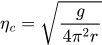
ηc = √(g / 4π²r)
How It Works
A trommel screen is a rotating drum with holes that separates materials by size. The critical speed is the rotation rate at which centrifugal force pins material to the drum wall, stopping the tumbling action needed for effective screening. Operators typically run trommels at 25–35% of critical speed.
Example Problem
A trommel drum has a radius of 0.75 m and operates under standard gravity (9.81 m/s²). What is the critical speed?
- Identify the known values: g = 9.81 m/s², r = 0.75 m.
- We are solving for critical speed ηc using the formula ηc = √(g / 4π²r).
- Calculate 4π²: 4 × π² = 4 × 9.8696 = 39.478.
- Calculate the denominator: 4π² × r = 39.478 × 0.75 = 29.609.
- Divide gravity by the denominator: 9.81 / 29.609 = 0.3313.
- Take the square root: ηc = √0.3313 = 0.576 Hz (34.5 RPM). Operating at 30% gives about 10 RPM.
Operating at 30% critical speed gives about 10 RPM.
When to Use Each Variable
- Solve for Critical Speed (ηc) — when you know the drum radius and gravity and need to find the maximum rotation speed before material stops tumbling.
- Solve for Radius — when you have a target critical speed and need to determine the drum size required.
- Solve for Gravity — when testing on a different planet or in a centrifuge and need to find the effective gravitational acceleration from measured speed and radius.
Key Concepts
A trommel screen separates materials by size using a rotating perforated drum. The critical speed is where centrifugal force equals gravity at the drum wall — above this speed, material pins to the wall and stops tumbling through the screen openings. The formula ηc = √(g / 4π²r) comes from setting centripetal acceleration equal to gravitational acceleration. Operators run at 25–35% of critical speed to maximize screening efficiency.
Applications
- Solid waste recycling: separating organics, glass, and plastics by size in municipal recycling facilities
- Compost production: screening finished compost to remove oversize material and produce uniform particle sizes
- Mining and mineral processing: classifying ore by particle size before further concentration steps
- Aggregate production: grading sand, gravel, and crushed stone to meet construction specifications
Common Mistakes
- Using diameter instead of radius in the formula — the equation uses the drum radius (center to wall), not the full diameter
- Running too close to critical speed — above 35% of critical, material begins to ride the wall and screening efficiency drops sharply
- Ignoring the effect of material moisture — wet, sticky materials need lower operating speeds and larger screen openings to prevent blinding
Frequently Asked Questions
How does a trommel screen separate materials by size?
Material is fed into one end of a slowly rotating perforated drum. As the drum turns, smaller particles fall through the screen openings while oversize material tumbles toward the discharge end. The drum angle (2–5° slope) and rotation speed control retention time and separation quality.
What factors affect trommel screening efficiency?
Key factors include rotation speed (as a percentage of critical speed), screen opening size, drum diameter and length, feed rate, material moisture content, and drum inclination angle. Wet or sticky materials reduce efficiency by blinding screen openings.
What is the critical speed of a trommel screen?
Critical speed is the rotational speed at which centrifugal force equals gravity at the drum surface. Above this speed, material sticks to the wall instead of tumbling. The formula ηc = √(g / 4π²r) calculates it from gravity and drum radius.
What percentage of critical speed should a trommel operate at?
Most trommels operate at 25–35% of critical speed. This provides enough tumbling action for material to contact the screen surface without centrifugal pinning. Lower percentages (20–25%) suit wet materials; higher percentages (30–35%) work for dry, free-flowing feeds.
What are the typical screen opening sizes for different applications?
Compost screening uses 10–25 mm openings. Municipal recycling trommels use 50–200 mm openings to separate paper and containers from fines. Mining trommels may use 5–50 mm openings depending on the ore classification required.
How does drum radius affect trommel performance?
Larger drum radii lower the critical speed, meaning the drum rotates more slowly for the same tumbling action. Larger drums also handle higher throughput and provide more screen area, but they cost more and require heavier support structures.
Can trommel screens handle wet or sticky materials?
Yes, but with modifications. Wet materials require larger screen openings (to prevent blinding), lower rotation speeds, and sometimes spray bars or brushes to keep openings clear. Some operations use heated drums or vibrating screens as alternatives for very sticky feeds.
Trommel Screen Critical Speed Formula
The critical speed is the rotation rate at which centrifugal force equals gravity at the drum wall, derived by setting centripetal acceleration equal to gravitational acceleration:
ηc = √(g / 4π²r)
Where:
- ηc — critical rotational speed (revolutions per second)
- g — gravitational acceleration (m/s² or cm/s²)
- r — drum radius, center to inner wall (m or cm)
Operating speed is typically 25–35% of critical speed. Below this range, material slides rather than tumbles; above it, centrifugal force pins material to the wall.
Worked Examples
Recycling
What is the critical speed for an MRF trommel screen?
A materials recovery facility (MRF) uses a trommel with 0.9 m drum radius under standard gravity (9.81 m/s²).
- η_c = √(9.81 / (4π² × 0.9))
- η_c = √(9.81 / 35.53)
- η_c = √(0.2761)
η_c = 0.526 Hz (31.5 RPM)
At 30% of critical speed, the operating speed would be about 9.5 RPM — a typical MRF trommel setting.
Mining
What drum radius is needed for a mining trommel at a target critical speed?
A gold mining operation needs a trommel with a critical speed of 0.4 Hz to classify ore. Standard gravity applies (9.81 m/s²).
- r = g / (4π² × η_c²)
- r = 9.81 / (39.478 × 0.16)
- r = 9.81 / 6.3165
r = 1.553 m
Large-diameter trommels in mining typically handle higher throughput but require more robust support structures.
Composting
What is the critical speed for a compost grading trommel?
A composting facility screens finished compost through a 0.6 m radius trommel to produce uniform product grades.
- η_c = √(9.81 / (39.478 × 0.6))
- η_c = √(9.81 / 23.687)
- η_c = √(0.4142)
η_c = 0.644 Hz (38.6 RPM)
Smaller-radius compost trommels have higher critical speeds. Wet compost requires lower operating percentages to prevent material sticking.
Related Calculators
- Solid Waste Calculator — analyze moisture content and landfill percolation
- Wastewater Screening Calculator — design bar racks and fine screens for wastewater
- Cyclone Calculator — separate particles from gas streams using centrifugal force
- Stokes Law Calculator — calculate particle settling velocity for screening efficiency
- Speed Unit Converter — convert drum rotation speed and feed rate units
Related Sites
- CameraDOF — Depth of field calculator for photographers
- Medical Equations — Hemodynamic, pulmonary, and dosing calculators
- Hourly Salaries — Hourly wage to annual salary converter
- RN Calc — Nursing dosage and calculation tools
- InfantChart — Baby and child growth percentile charts
- Z-Score Calculator — Z-score, percentile, and probability calculator