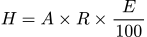
Rainwater Harvest Volume
The harvestable volume depends on three factors: catchment area, depth of rainfall, and collection efficiency. Metal roofs typically achieve 80–95% efficiency, asphalt shingles 75–85%, and green roofs just 20–40%.
H = A × R × E / 100
Catchment Area
Given a target harvest volume and known rainfall and efficiency, you can determine the minimum roof or paved surface area needed to collect that amount of water.
A = H / (R × E / 100)
Amount of Rain
If you know your catchment area and collection efficiency, this solves for the minimum rainfall depth needed to fill a given storage volume.
R = H / (A × E / 100)
Collection Efficiency
Collection efficiency accounts for losses from evaporation, splashing, gutter overflow, and first-flush diversion. Solve for efficiency to evaluate how well your system captures available rainfall.
E = 100H / (A × R)
How It Works
Rainwater harvesting captures precipitation from a roof or paved surface and stores it for later use. The harvestable volume depends on three factors: catchment area, depth of rainfall, and collection efficiency (which accounts for losses from evaporation, splashing, and first-flush diversion). Metal roofs typically achieve 80–95% efficiency, asphalt shingles 75–85%, and green roofs just 20–40%.
Example Problem
A metal roof has an area of 200 m², annual rainfall is 0.9 m, and the collection efficiency is 85%. How much water can be harvested per year?
- Identify the formula: H = A × R × (E / 100) — multiply catchment area by rainfall depth and scale by efficiency.
- Confirm consistent units: A = 200 m², R = 0.9 m, and E = 85 (percent, dimensionless).
- Substitute: H = 200 × 0.9 × (85 / 100).
- Simplify the efficiency fraction: 85 / 100 = 0.85.
- Multiply: H = 200 × 0.9 × 0.85 = 180 × 0.85.
- Compute the final harvest volume: H = 153 m³ (equivalent to about 153,000 liters or 40,400 US gallons).
That is enough to supply a household’s non-potable needs (toilets, laundry, irrigation) for much of the year.
When to Use Each Variable
- Solve for Harvest — when you know your roof area, local rainfall, and system efficiency and want to estimate annual yield.
- Solve for Area — when you have a target storage volume and want to know the minimum catchment area required.
- Solve for Rainfall — when you know the system size and want the minimum annual rainfall needed to meet demand.
- Solve for Efficiency — when you have measured harvest data and want to evaluate your system’s actual capture rate.
Key Concepts
Harvestable rainwater volume depends on three factors: catchment area, rainfall depth, and collection efficiency. Efficiency accounts for real-world losses including evaporation, splash, gutter overflow, and first-flush diversion. Metal roofs are most efficient (80-95%); green roofs absorb most rainfall (20-40% efficiency). Storage must be sized for seasonal rainfall patterns.
Applications
- Residential water conservation: sizing cisterns and rain barrels for garden irrigation and toilet flushing
- Green building design: meeting LEED water efficiency credits through rainwater harvesting systems
- Agricultural water supply: supplementing irrigation in arid regions with rooftop collection from farm buildings
- Emergency preparedness: designing backup water storage systems for communities with unreliable municipal supply
Common Mistakes
- Using total roof area instead of the horizontal projection — a steeply pitched roof has more surface area but the same horizontal catchment as a flat roof of the same footprint
- Ignoring first-flush diversion losses — the first 1-2 mm of rain washes contaminants off the roof and is typically diverted away from storage, reducing effective yield
- Sizing storage for average annual rainfall instead of monthly patterns — if 80% of rain falls in 4 months, you need enough storage to bridge the dry season
Frequently Asked Questions
How much rainwater can I harvest from my roof?
A rough rule is that 1 mm of rain on 1 m² of roof yields about 1 liter of water before losses. A typical 150 m² home receiving 800 mm of annual rainfall at 85% collection efficiency harvests roughly 102 m³ (≈ 27,000 US gallons) per year — enough for garden irrigation and toilet flushing in most two-person households.
What factors affect rainwater collection efficiency?
Efficiency depends on roof material, gutter design, first-flush diversion, and evaporation. Metal or tile roofs achieve 80–95% efficiency, asphalt shingles 75–85%, and green roofs only 20–40% because the substrate absorbs most rainfall. Well-maintained gutters, leaf guards, and a first-flush diverter can add 5–10 percentage points.
How do I size a rainwater storage tank?
Tank size should cover the longest expected dry period between rain events. A rule of thumb is 5,000 L (≈ 1,300 gal) of storage per 100 m² of catchment in temperate climates, or 10,000 L per 100 m² in arid climates. Run a monthly water balance — rainfall times area times efficiency versus demand — to fine-tune storage.
Can harvested rainwater be used for drinking?
Rainwater can be treated to potable standards with filtration, UV disinfection, and sometimes chlorination, but most residential systems use it for non-potable demands: irrigation, toilet flushing, and laundry. Local regulations vary — many U.S. jurisdictions require an NSF-certified treatment train before indoor potable use.
Should I use total roof area or horizontal footprint for A?
Use the horizontal footprint (the plan-view area). A steeply pitched roof has more surface area but receives the same rainfall as a flat roof with the same footprint, because rainfall is measured as vertical depth. Using sloped surface area over-estimates harvest by the secant of the pitch angle.
How does rainfall frequency matter if I only know the annual total?
Annual totals set the upper bound on harvest, but storage sizing depends on intensity and dry-spell length. A region that receives 800 mm spread evenly over 12 months needs much less storage than one that receives the same 800 mm in four monsoon months. Always check monthly rainfall patterns before picking a tank size.
What is a first-flush diverter and do I need one?
A first-flush diverter routes the first 1–2 mm of rain (which carries dust, bird droppings, and leaf debris off the roof) away from the storage tank. For any system feeding irrigation, laundry, or indoor plumbing, a first-flush diverter is strongly recommended — it improves water quality and typically reduces annual yield by only 1–3%.
Rainwater Harvest Formula
The harvestable rainwater volume from any roof or paved catchment surface is calculated using this simple linear relationship:
H = A × R × (E / 100)
Where:
- H — harvest volume collected, in cubic meters (m³) or liters (1 m³ = 1,000 L)
- A — catchment area (horizontal projection of the roof or paved surface), in square meters (m²)
- R — rainfall depth over the collection period, in meters (m)
- E — collection efficiency, as a percentage (0–100) that accounts for evaporation, splash, gutter overflow, and first-flush diversion
A convenient shortcut: 1 mm of rain on 1 m² of roof yields about 1 liter of water before efficiency losses. Multiply rainfall in mm by area in m², then by E/100, and you have the harvestable volume in liters.
Worked Examples
Residential — Home Rain Barrel System
How much water can a typical suburban home harvest from its roof in a year?
A single-family home has a 150 m² roof footprint in a region receiving 800 mm of annual rainfall. The metal roof plus well-maintained gutters deliver 85% collection efficiency.
- H = 150 × 0.8 × (85 / 100)
- H = 150 × 0.8 × 0.85
H = 102 m³ (≈ 27,000 US gallons)
That is enough to cover year-round garden watering, toilet flushing, and laundry in a two-person household. Storage sizing should follow the longest dry stretch, not average annual flow — often a 5,000 L cistern per 100 m² of catchment is a reasonable starting point.
Commercial — Warehouse Non-Potable Supply
How large a roof does a distribution warehouse need to cover 500 m³/yr of non-potable demand?
A logistics center wants to harvest enough rainwater to supply toilets, truck washing, and site irrigation (≈ 500 m³/yr). Local annual rainfall is 0.9 m and the standing-seam metal roof delivers 90% efficiency. Solve for catchment area A.
- A = H / (R × E/100)
- A = 500 / (0.9 × 0.90)
- A = 500 / 0.81
A ≈ 617 m² of roof
For a 10,000 m² distribution center that is only 6% of the roof — most commercial buildings already have more catchment than they need and end up storage-limited rather than roof-limited.
Agriculture — Supplemental Irrigation from Barn Roof
How much irrigation water can a 400 m² barn capture in a semi-arid climate?
A small farm in a semi-arid region receives only 0.35 m of annual rainfall. The corrugated steel barn roof has an area of 400 m² and the system uses a first-flush diverter, achieving 80% efficiency.
- H = 400 × 0.35 × 0.80
- H = 140 × 0.80
H = 112 m³ (≈ 112,000 L)
Even in dry climates, a modest barn can supplement a quarter-acre of drip-irrigated orchard or high-value market garden — especially when paired with a 50 m³ storage tank that buffers between storms.
Related Calculators
- Swimming Pool Calculator — manage pool water volume and turnover rates
- Solid Waste Calculator — assess rainfall percolation through landfill cover soil
- Permeameter Calculator — measure soil permeability for drainage design
- French Drain Calculator — design subsurface drainage for overflow management
- Gutter Design Calculator — size gutters that feed the collection system
- Volume Unit Converter — convert between gallons, liters, and cubic meters for tank sizing
Related Sites
- CameraDOF — Depth of field calculator for photographers
- Medical Equations — Hemodynamic, pulmonary, and dosing calculators
- Hourly Salaries — Hourly wage to annual salary converter
- RN Calc — Nursing dosage and calculation tools
- InfantChart — Baby and child growth percentile charts
- Z-Score Calculator — Z-score, percentile, and probability calculator