Rhombus Calculator
Area equals one half times diagonal p times diagonal q
Use this form when both diagonals are known. The diagonals of a rhombus are perpendicular bisectors of each other, so their product is twice the area.
A = (1/2) · p · q
Use this form when both diagonals are known and you need the common side length. Each side is the hypotenuse of a right triangle with legs p/2 and q/2.
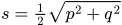
s = (1/2) · √(p² + q²)
Use this rearrangement when the area and the other diagonal are known.
p = 2A / q
Use this rearrangement when the area and the other diagonal are known.
q = 2A / p
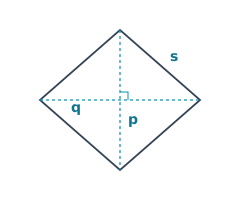
This rhombus calculator solves A = (1/2)·p·q for area, s = (1/2)·√(p² + q²) for the common side length, plus inverse solves for either diagonal. A rhombus has four equal sides, and its two diagonals meet at right angles and bisect each other — so the diagonals partition the shape into four congruent right triangles with legs p/2 and q/2. Pick the unknown with the solve-for toggle and enter the relevant inputs in any supported length or area unit.
A rhombus-shaped quilt patch has diagonals p = 6 in and q = 8 in. Compute its area, side length, and perimeter.
The example uses a 3-4-5 right triangle so the side and perimeter are integers. In general s = (1/2)·√(p² + q²) is irrational.
A rhombus is a parallelogram with all four sides equal in length. Its two diagonals p and q are perpendicular to each other and bisect each other at the center — these two properties together fully characterize a rhombus among parallelograms. Because the diagonals are perpendicular, they partition the rhombus into four congruent right triangles with legs p/2 and q/2, giving both the clean area formula A = (1/2)·p·q and the side formula s = (1/2)·√(p² + q²). A rhombus with equal diagonals (p = q) is a square; the more p and q differ, the flatter and more elongated the rhombus.
Multiply the two diagonals and divide by two: A = (1/2)·p·q. For diagonals p = 6 and q = 8, A = (1/2)·6·8 = 24 square units.
s = (1/2)·√(p² + q²). Each side is the hypotenuse of a right triangle with legs p/2 and q/2, so by the Pythagorean theorem s² = (p/2)² + (q/2)² = (p² + q²)/4.
P = 4s, because all four sides of a rhombus are equal in length. If you only know the diagonals, first compute s = (1/2)·√(p² + q²) and then multiply by 4.
A square is a special rhombus where all angles are also 90° — equivalently, a rhombus whose diagonals are equal in length (p = q). Every square is a rhombus, but a general rhombus has unequal diagonals and non-right angles.
A rhombus is a parallelogram with all four sides equal in length. A general parallelogram has only opposite sides equal. Equivalently, a rhombus is a parallelogram whose diagonals are perpendicular.
Because all four sides are equal, the diagonals partition the rhombus into four congruent triangles. The only way these triangles can fit together with shared sides is if the diagonals cross at 90° and bisect each other.
Yes — 'diamond' is the everyday name for a rhombus, usually one oriented with a vertical and a horizontal diagonal. The traffic-sign diamond is a rhombus that also happens to be a square (p = q).
Rearrange A = (1/2)·p·q to solve for the unknown diagonal: p = 2A/q, or q = 2A/p. For A = 24 and q = 8, p = 2·24/8 = 6.
Reference:
Weisstein, Eric W. "Rhombus." MathWorld — A Wolfram Web Resource. https://mathworld.wolfram.com/Rhombus.html
Quilt Patch
A rhombus quilt patch has diagonals p = 6 in and q = 8 in. Compute its area so you can estimate fabric usage.
Area = 24 in² per patch
Multiply by the number of patches in the quilt block for total fabric area; add a seam-allowance margin separately.
Tile Edge
A decorative rhombus floor tile has diagonals p = 10 cm and q = 24 cm. Find the common side length so you can order matching grout lines.
Side = 13 cm, perimeter = 52 cm per tile
The 5-12-13 right triangle (legs p/2 = 5 and q/2 = 12) makes the side an integer — most rhombus sides are irrational numbers.
Inverse Solve
A landscape feature must enclose 24 m² of area and one diagonal is fixed at q = 8 m. Find the other diagonal.
Diagonal p = 6 m
Real layouts also need the rhombus orientation and the corner angles, which depend on both diagonals — this calculator solves for the missing diagonal once area and the other diagonal are known.
A rhombus is determined by its two diagonals p and q. The diagonals are perpendicular and bisect each other, so the four sides have equal length s = (1/2)·√(p² + q²) and the perimeter is P = 4s.
Where: