Parallelogram Calculator
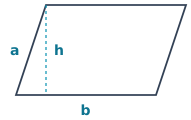
Area equals base times height
Use this form when the base and perpendicular height are known. The height is measured perpendicular to the base, not along the slant side.
A = b × h
Use this form when the two adjacent side lengths (a, b) are known. Opposite sides of a parallelogram are equal in length.
P = 2(a + b)
Use this rearrangement when the area and perpendicular height are known.
b = A / h
Use this rearrangement when the area and base are known and you need the perpendicular height.
h = A / b
This parallelogram calculator solves A = b·h for area and P = 2(a+b) for perimeter, plus inverse solves for base and height. The key distinction from a rectangle: the perpendicular height h is shorter than the slant side a unless the parallelogram is a rectangle. Pick the unknown with the solve-for toggle and enter the relevant inputs in any supported length or area unit.
A parallelogram-shaped garden bed has base 8 m, perpendicular height 4 m, and slant sides of 5 m. Compute area and perimeter.
The example uses a 3-4-5 right triangle to make the slant side an integer. In practice, the slant side and perpendicular height are independent measurements.
A parallelogram is a four-sided polygon with opposite sides parallel and equal in length. Two non-equal dimensions and one angle (or equivalently the perpendicular height) fully determine its geometry. The area formula A = b · h uses the perpendicular height, not the slant side — this is the most common source of error in parallelogram problems. A parallelogram with all angles equal to 90° is a rectangle; one with all sides equal is a rhombus; one with both properties is a square.
Multiply the base by the perpendicular height: A = b × h. For a parallelogram with b = 8 m and h = 4 m, A = 32 m².
P = 2(a + b), where a and b are the two adjacent side lengths. For a = 5 m and b = 8 m, P = 26 m.
The base × side formula gives the wrong answer because the parallelogram is 'tilted' — only the perpendicular height contributes to the enclosed area. Picture sliding a rectangle's top over by some amount: the area stays b·h because each horizontal slice has the same length b.
Divide: h = A / b. For A = 32 m² and b = 8 m, h = 4 m.
A parallelogram has opposite sides parallel and equal, but its angles are not necessarily 90°. A rectangle is a parallelogram where all four angles ARE 90°. Every rectangle is a parallelogram, but not every parallelogram is a rectangle.
The slant side a is the actual edge length. The perpendicular height h is the shortest distance between the two parallel base lines, measured at 90° to the base. h ≤ a, with equality only when the parallelogram is a rectangle.
Yes — a parallelogram with one right angle has all four right angles and is therefore a rectangle (or a square if all sides are also equal).
Square ⊂ rhombus ⊂ parallelogram. A rhombus is a parallelogram with all sides equal. A square is a rhombus with all angles equal to 90° — equivalently, a rectangle with all sides equal.
Reference:
Weisstein, Eric W. "Parallelogram." MathWorld — A Wolfram Web Resource. https://mathworld.wolfram.com/Parallelogram.html
Garden Bed
A parallelogram-shaped garden bed has base 8 m and perpendicular height 4 m. Compute its area to size the soil order.
Area = 32 m² (≈ 344 ft²)
The slant side length doesn't affect area; only the base and perpendicular height matter.
Parking Stripe
An angled parking stall has a base of 2.5 m and a slant side of 5.5 m (the actual edge length along the curb). Find the perimeter to estimate paint.
Perimeter = 16 m of striping
Angled parking stripes use the slant-side length, not the perpendicular height — paint follows the visible outline.
Inverse Solve
A landscape feature must enclose 50 m² and the available perpendicular height is fixed at 5 m. Find the base.
Base = 10 m
Real layouts also need the slant-side length, which depends on the parallelogram's angle — this calculator handles the perpendicular-height case.
A parallelogram is determined by its base b, perpendicular height h, and slant side a. Note that h is measured perpendicular to b, not along the slant.
Where:



