
Calculate Kite Area from Diagonals
Use this form when both diagonals are known. Because a kite's diagonals are perpendicular, their product is twice the area.
A = (1/2) · d₁ · d₂
Calculate Diagonal d₁ from Area and Diagonal d₂
Use this rearrangement when the area and the other diagonal are known and you need the missing diagonal.
d₁ = 2A / d₂
Calculate Diagonal d₂ from Area and Diagonal d₁
Use this rearrangement when the area and the other diagonal are known and you need the missing diagonal.
d₂ = 2A / d₁
How It Works
This kite calculator solves A = (1/2)·d₁·d₂ for the area of a kite quadrilateral with two pairs of adjacent equal sides, plus inverse solves for either diagonal. A kite's two diagonals cross at right angles, so the four triangles they create combine to give the simple half-product area formula. Pick the unknown with the solve-for toggle and enter the two known quantities in any supported length or area unit.
Example Problem
A traditional diamond kite has a long diagonal d₁ = 10 in (top tip to bottom tail) and a short diagonal d₂ = 6 in (left spar to right spar). Find the surface area of the kite.
- Knowns: d₁ = 10 in, d₂ = 6 in
- Formula: A = (1/2) · d₁ · d₂
- Substitute: A = (1/2) · 10 · 6
- Multiply the diagonals: 10 · 6 = 60
- Halve the product: A = 60 / 2 = 30 in²
- Sanity check (inverse): from A = 30 and d₂ = 6, d₁ = 2A/d₂ = 60/6 = 10 in, recovering the original diagonal.
The formula assumes the diagonals are perpendicular, which is always true for a kite. It does not require the diagonals to bisect each other — only the axis-of-symmetry diagonal does that in a general kite.
When to Use Each Variable
- Solve for Area — when both diagonals are known — paper kites, kite-shaped tiles, baseball home-plate area approximations.
- Solve for Diagonal d₁ — when the area and the other diagonal d₂ are known and you need the missing diagonal.
- Solve for Diagonal d₂ — when the area and the other diagonal d₁ are known and you need the missing diagonal.
Key Concepts
A kite is a quadrilateral with two pairs of consecutive (adjacent) equal sides. Its two diagonals are perpendicular, but only one of them — the axis of symmetry — bisects the other. A kite is the "dual" of an isosceles trapezoid: where the trapezoid has a pair of parallel sides, the kite has a pair of equal adjacent sides. A rhombus is a special-case kite in which both pairs of adjacent sides are not just equal within each pair but equal across pairs, so all four sides match. A square is a special-case kite (and a special-case rhombus) with equal perpendicular diagonals. Because the diagonals meet at a right angle, the four triangles they create combine to give the clean area formula A = (1/2)·d₁·d₂ — the same shape of formula as a rhombus.
Applications
- Paper kites and traditional diamond-kite frame design
- Baseball home plate, which is approximately kite-shaped (a pentagon with a kite-like silhouette)
- Geometry puzzles and tangram pieces that use kite quadrilaterals
- Architecture and tiling: kite-shaped tessellations and stained-glass panels
- Crystallography: kite-shaped faces appear on several mineral habits
Common Mistakes
- Confusing the diagonals with the sides — A = (1/2)·d₁·d₂ uses the diagonals, not the four side lengths
- Treating a kite as a rhombus and assuming all four sides are equal — in a general kite only the two pairs of adjacent sides are equal, not all four
- Forgetting the factor of 1/2 in A = (1/2)·d₁·d₂ and reporting twice the true area
- Assuming the diagonals bisect each other — only the axis-of-symmetry diagonal is bisected by the other, except in the special-case rhombus or square
- Mixing units between the two diagonals (e.g., d₁ in inches and d₂ in centimeters) without converting — keep both diagonals in the same length unit or let the calculator convert each input
Frequently Asked Questions
How do you calculate the area of a kite?
Multiply the two diagonals and divide by two: A = (1/2)·d₁·d₂. For diagonals d₁ = 10 and d₂ = 6, A = (1/2)·10·6 = 30 square units. The formula works because a kite's diagonals are perpendicular.
What is the formula for the area of a kite?
The area formula is A = (1/2)·d₁·d₂, where d₁ and d₂ are the full lengths of the two diagonals. It is the same shape of formula as for a rhombus, because in both cases the diagonals are perpendicular.
What is a kite in geometry?
A kite is a quadrilateral with two pairs of consecutive (adjacent) sides of equal length. Its two diagonals are perpendicular to each other, and one of them — the axis of symmetry — bisects the other.
How is a kite different from a rhombus?
A rhombus has all four sides equal in length, while a kite only requires the two pairs of adjacent sides to be equal within each pair (the two pairs can have different lengths). Every rhombus is therefore a kite, but most kites are not rhombi.
Can a kite be a square?
Yes — a square is a special-case kite (and a special-case rhombus) where all four sides are equal AND the two diagonals are equal in length. In that case d₁ = d₂ and the area formula reduces to A = (1/2)·d² = d²/2 in terms of the common diagonal length.
What are the diagonals of a kite?
A kite has two diagonals that cross at right angles. The longer one is the axis of symmetry — it connects the two vertices where unequal sides meet and is bisected by the other diagonal. The shorter diagonal connects the two vertices where equal sides meet.
How do you find a missing diagonal of a kite from the area?
Rearrange A = (1/2)·d₁·d₂ to solve for the unknown diagonal: d₁ = 2A/d₂, or d₂ = 2A/d₁. For A = 30 and d₂ = 6, d₁ = 2·30/6 = 10.
Are the diagonals of a kite perpendicular?
Yes — the two diagonals of any kite are perpendicular to each other. This is what makes the area formula A = (1/2)·d₁·d₂ work, the same way it does for a rhombus.
Reference:
Weisstein, Eric W. "Kite." MathWorld — A Wolfram Web Resource. https://mathworld.wolfram.com/Kite.html
Worked Examples
Paper Kite
What is the surface area of a diamond kite with 10 in × 6 in diagonals?
A traditional diamond kite has a vertical spar d₁ = 10 in (top tip to bottom tail) and a horizontal spar d₂ = 6 in. Compute its sail area.
- Knowns: d₁ = 10 in, d₂ = 6 in
- Formula: A = (1/2) · d₁ · d₂
- A = (1/2) · 10 · 6 = 30 in²
Area = 30 in² of sail material
Add a seam allowance separately when cutting the actual sail fabric — this is the geometric surface area only.
Stained Glass Panel
How big is a kite-shaped stained-glass panel with 30 cm × 18 cm diagonals?
A leaded stained-glass kite panel has a long diagonal d₁ = 30 cm and a short diagonal d₂ = 18 cm. Find the glass area you need to order.
- Knowns: d₁ = 30 cm, d₂ = 18 cm
- Formula: A = (1/2) · d₁ · d₂
- A = (1/2) · 30 · 18 = (1/2) · 540 = 270 cm²
- Convert to m² for the supplier: 270 cm² = 0.027 m²
Area = 270 cm² (about 0.027 m²) of glass
Order at least 10 percent extra glass to allow for breakage and trim losses during cutting and leading.
Inverse Solve
A 30 m² kite-shaped garden bed has d₂ = 6 m — what is the missing diagonal?
A kite-shaped garden bed must enclose 30 m² of area and one diagonal is fixed at d₂ = 6 m. Find the other diagonal d₁.
- Knowns: A = 30 m², d₂ = 6 m
- Formula: d₁ = 2A / d₂
- d₁ = (2 · 30) / 6 = 60 / 6 = 10 m
Diagonal d₁ = 10 m
The two diagonals fully determine the area of a kite, but they do not by themselves determine the four side lengths — those also depend on where d₂ crosses d₁ along the axis of symmetry.
Kite Formulas
A kite is determined by its two perpendicular diagonals d₁ and d₂. Because the diagonals cross at a right angle, the four triangles they create combine to give the simple half-product area formula. The same area formula applies to rhombi, which are a special case of kites.
Area equals one half times diagonal d sub 1 times diagonal d sub 2Diagonal d sub 1 equals two times area divided by diagonal d sub 2Diagonal d sub 2 equals two times area divided by diagonal d sub 1


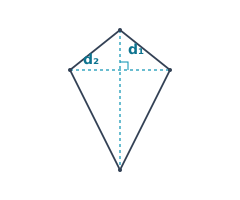
Where:
- A — area of the kite (m², ft², in²)
- d₁ — one diagonal of the kite (typically the longer one, the axis of symmetry)
- d₂ — the other diagonal of the kite, perpendicular to d₁
Related Calculators
- Rhombus Calculator — find area, side, and diagonals for a rhombus (a special-case kite with all four sides equal)
- Parallelogram Calculator — find area, perimeter, base, and height for any parallelogram
- Square Calculator — compute area, perimeter, and diagonal for a square (a kite with equal perpendicular diagonals)
- Triangle Calculator — find sides, angles, and area for any triangle
- Area Converter — switch between m², ft², acres, and other area units
Related Sites
- Temperature Tool — Temperature unit converter
- Z-Score Calculator — Z-score, percentile, and probability calculator
- OptionsMath — Options trading profit and loss calculators
- Medical Equations — Hemodynamic, pulmonary, and dosing calculators
- Dollars Per Hour — Weekly paycheck calculator with overtime
- Percent Off Calculator — Discount and sale price calculator