AJ Designer

Impulse-Momentum Theorem Calculator (J = Δp = m·Δv)
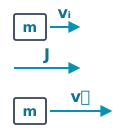
Impulse equals mass times change in velocity

Solution

Enter values to calculate
Share:

How It Works

The impulse-momentum theorem connects force, time, mass, and velocity change with one statement: J = Δp = m × Δv, where Δv = v_f − v_i is the change in velocity over the interval. Because impulse (J = F × Δt) equals the change in an object's momentum (Δp), this theorem is the bridge that turns a collision problem into a force-and-time problem and vice versa. The SI unit is the newton-second (N·s), dimensionally identical to kg·m/s. Enter any two of {impulse, mass, velocity change} and the calculator solves for the third.

Example Problem

A 0.145 kg baseball is pitched toward the batter at 40 m/s and hit back along the same line at 50 m/s. What impulse did the bat deliver?

  1. Set a sign convention: take the post-hit direction as positive.
  2. Compute the velocity change: Δv = v_f − v_i = 50 − (−40) = 90 m/s.
  3. Apply the theorem: J = Δp = m × Δv.
  4. Substitute: J = 0.145 kg × 90 m/s.
  5. Multiply: J = 13.05 N·s. That equals the bat-on-ball impulse during contact.

When to Use Each Variable

  • Solve for Impulse (J = Δp)when you know mass and velocity change and need the impulse delivered (collisions where you measured incoming and outgoing speeds).
  • Solve for Mass (m)when you know the impulse and the velocity change it produced and want to infer mass (forensic reconstruction).
  • Solve for Velocity Change (Δv)when you know the impulse delivered and the mass of the object and need the resulting Δv (rocket delta-v, recoil speed).

Key Concepts

The theorem follows directly from Newton's second law: F = m·a = m·(dv/dt), so F·dt = m·dv, and integrating gives ∫F dt = m·Δv. The left side is the impulse; the right side is the change in momentum. Because Δv is a signed vector, reversals matter — a baseball that rebounds delivers nearly twice the impulse of one that simply stops, even at the same speed. This is also why rocket delta-v budgets are computed in terms of total impulse divided by mass.

Applications

  • Vehicle crash testing: measured Δv and known mass give the impulse the structure absorbed.
  • Rocket delta-v calculations: total impulse / vehicle mass = Δv achievable per stage.
  • Forensic reconstruction: inferring vehicle mass from skid-mark Δv and known braking impulse.
  • Sports analytics: bat-ball, racket-ball, club-ball momentum transfer measured from pitch and exit speeds.
  • Recoil engineering: gun recoil Δv = projectile-momentum / firearm-mass.

Common Mistakes

  • Treating Δv as a magnitude when it's a vector. Always use Δv = v_f − v_i with a consistent sign convention; a reversal makes Δv = v_f − (−v_i) = v_f + |v_i|.
  • Confusing Δv with average velocity. The theorem uses the change in velocity, not the average.
  • Mixing units — pounds-force-seconds with kilograms and m/s. Set unit selectors before reading the result.
  • Forgetting that J and Δp share canonical units (N·s ≡ kg·m/s). Treat them as the same quantity expressed two ways.
  • Assuming the theorem only works in elastic collisions. It applies to every interaction — elastic, inelastic, or explosive.

Frequently Asked Questions

How do you calculate the impulse-momentum theorem?

Multiply mass by velocity change: J = Δp = m × Δv. For a 0.145 kg ball with Δv = 90 m/s, J = 0.145 × 90 = 13.05 N·s.

What is the formula for the impulse-momentum theorem?

J = Δp = m × Δv — impulse equals the change in momentum, which equals mass times the change in velocity. Equivalently, J = F × Δt for an average force F acting over time Δt.

What is the relationship between impulse and momentum?

Impulse is the change in momentum: J = Δp = p_final − p_initial. The two have identical units (N·s = kg·m/s) and any impulse applied to an object produces an equal change in its momentum.

Why does a baseball delivering more impulse hurt more on a catch?

The impulse equals m × Δv. A faster ball has a larger Δv when stopped, so a larger impulse must be absorbed by the glove and arm. Padding spreads that impulse over a longer Δt, reducing peak force F = J / Δt.

Can I apply the theorem to a stopping car?

Yes. Δv = 0 − v_initial = −v_initial, so |J| = m × |v_initial|. A 1,200 kg car stopping from 25 m/s requires 30,000 N·s of impulse — supplied by friction at the brake pads over the braking time.

Is the impulse-momentum theorem the same as Newton's second law?

It's the integral form of it. F = m·a is the instantaneous version; integrating both sides over a time interval gives ∫F dt = m·Δv, which is the impulse-momentum theorem.

Reference: Halliday, David, Robert Resnick, and Jearl Walker. Fundamentals of Physics. Wiley, 10th Edition. Chapter 9, Section 9-6.

Worked Examples

Sports Science

A 0.145 kg baseball reverses from 40 m/s to 50 m/s — what impulse did the bat deliver?

  • Δv = v_f − v_i = 50 − (−40) = 90 m/s
  • J = Δp = m × Δv
  • J = 0.145 kg × 90 m/s
  • J ≈ 13.05 N·s

Note the sign flip: a reversal nearly doubles Δv compared to a ball that simply stops at the bat.

Aerospace

A 4,000 kg rocket stage receives 40,000 N·s of impulse — what Δv does it achieve?

  • Δv = J / m
  • Δv = 40,000 N·s / 4,000 kg
  • Δv = 10 m/s

The classic delta-v budget calculation — total impulse divided by vehicle mass yields the velocity increment from a burn.

Forensic Reconstruction

A braking impulse of 30,000 N·s produces a Δv of 25 m/s — what is the vehicle mass?

  • m = J / Δv
  • m = 30,000 N·s / 25 m/s
  • m = 1,200 kg (about 2,646 lb)

Crash-scene impulse measurements pair with measured Δv to infer the involved vehicles' masses.

Related Calculators

Related Sites