AJ Designer

Impulse Calculator (J = F·Δt)
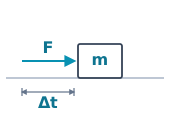
Impulse equals force times change in time

Solution

Enter values to calculate
Share:

How It Works

Impulse (J) is the product of a force and the time interval over which it acts: J = F × Δt. It quantifies how much a force can change an object's motion when applied over a finite duration. Impulse is a vector with the same direction as the force, and its SI unit — the newton-second (N·s) — is dimensionally identical to the momentum unit kg·m/s. Enter force and time in any supported unit and the calculator converts to SI internally before applying the formula.

Example Problem

A rocket engine produces a constant thrust of 5,000 N for 8 seconds during a stage burn. What impulse does the engine deliver?

  1. Identify the equation for impulse from force and time: J = F × Δt.
  2. Substitute the known values in SI units: J = 5,000 N × 8 s.
  3. Multiply: J = 40,000 N·s.
  4. Result: the engine delivers 40,000 N·s of impulse, which equals the change in the rocket's momentum from that burn.

When to Use Each Variable

  • Solve for Impulse (J)when you know the average force and the duration it acts (rocket burns, club strikes, sustained pushes).
  • Solve for Force (F)when you know the impulse delivered and the contact time, and want the average force during that interval (collision force from a glove catching a ball).
  • Solve for Time (Δt)when you know the impulse required and the force available, and need to find the burn or contact time (engine sizing, brake duration).

Key Concepts

Impulse and momentum share units (N·s ≡ kg·m/s) for a reason — the impulse-momentum theorem says J = Δp. That makes J = F × Δt a powerful tool: if you can extend the time over which a force acts, you can reduce the peak force needed to deliver the same impulse. Airbags, crumple zones, baseball mitts, and bungee cords all exploit this trade-off. The formula assumes constant (or time-averaged) force; for varying forces, impulse equals the integral of F(t) dt over the interval.

Applications

  • Rocket propulsion: total impulse (thrust × burn time) determines a stage's contribution to delta-v.
  • Sports equipment: bat-ball, club-ball, and racket-ball contact times set the impulse delivered.
  • Vehicle safety: airbags and crumple zones extend Δt to lower the peak force F during a collision.
  • Recoil analysis: gun recoil impulse equals projectile-mass × muzzle-velocity, used to size buffer springs.
  • Industrial impact: drop hammers, pile drivers, and stamping presses are characterized by impulse per cycle.

Common Mistakes

  • Forgetting that impulse is a vector — reversing direction during contact doubles the magnitude (e.g., a baseball bounced back, not just stopped).
  • Using peak force instead of average force. The formula J = F × Δt uses the time-averaged force over the contact interval.
  • Mixing units — entering force in pounds-force and time in milliseconds without converting. The unit selectors handle conversion automatically if both are set.
  • Confusing impulse with work. Impulse uses force × time; work uses force × distance. Same force can produce different work and impulse depending on how long and how far it acts.

Frequently Asked Questions

How do you calculate impulse from force and time?

Multiply the average force by the duration over which it acts: J = F × Δt. For a 100 N force applied for 0.5 s, J = 100 × 0.5 = 50 N·s.

What is the formula for impulse?

J = F × Δt — impulse equals force times the change in time. In SI units, force is in newtons, time in seconds, and impulse in newton-seconds (N·s).

Is impulse the same as momentum?

They share units (N·s ≡ kg·m/s) but are different quantities. Momentum (p = m·v) is a property of a moving object; impulse (J = F·Δt) is the change in momentum produced by a force acting over time. The impulse-momentum theorem states J = Δp.

Why do airbags reduce injury in a crash?

An airbag extends the time Δt over which the occupant's momentum changes. Since J is fixed by the change in momentum, increasing Δt reduces the average force F = J / Δt that the body experiences.

What are the units of impulse?

The SI unit is the newton-second (N·s), which is dimensionally identical to kg·m/s. Imperial systems use the pound-force-second (lbf·s) or the slug-foot-per-second.

Can impulse be negative?

Yes. Impulse is a vector. A braking force that decelerates an object delivers an impulse opposite to the motion, giving a negative scalar value when the original motion is taken as positive.

Reference: Lindeburg, Michael R. 1992. Engineer In Training Reference Manual. Professional Publication, Inc. 8th Edition.

Worked Examples

Aerospace

What impulse does a 5,000 N rocket motor deliver during an 8-second burn?

  • J = F × Δt
  • J = 5,000 N × 8 s
  • J = 40,000 N·s

That impulse equals the change in the rocket's momentum during the burn — the primary input to a stage's delta-v contribution.

Sports Science

A catcher's glove stops a 6 N·s pitch in 0.05 s — what average force on the hand?

  • F = J / Δt
  • F = 6 N·s / 0.05 s
  • F = 120 N (about 27 lbf)

Padding inside the glove extends Δt and lowers F — that's the same physics behind crumple zones and airbags.

Mechanical Engineering

A hydraulic ram needs to deliver 2,000 N·s of impulse at 4,000 N — how long must it push?

  • Δt = J / F
  • Δt = 2,000 N·s / 4,000 N
  • Δt = 0.5 s

Useful for sizing actuator stroke times when total impulse per cycle is the design target.

Related Calculators

Related Sites