Newton's Second Law Calculator
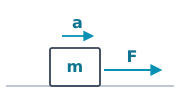
Net force equals mass times acceleration
Newton's second law states that the net force on an object equals its mass times its acceleration. If you know any two of these three variables, you can solve for the third. This law is the foundation of classical mechanics and applies to everything from conveyor belts to rocket launches.
F = m × a
Newton's Second Law (F = ma) relates the net force on an object to its mass and acceleration. If you know any two of these variables, you can solve for the third. The heavier an object or the faster you want it to speed up, the more force you need. Rearranging gives m = F/a (to find mass) or a = F/m (to find acceleration). Use the Solve For selector above to pick which variable to calculate.
A 2,000 kg elevator accelerates upward at 1.5 m/s². What net force is required?
A simpler example: a 10 kg object accelerates at 9.81 m/s². The force is 10 × 9.81 = 98.1 N — roughly the object's own weight on Earth.
Newton's Second Law establishes that the acceleration of an object is directly proportional to the net force acting on it and inversely proportional to its mass. The law applies to net force — the vector sum of all forces — not individual forces. It is valid for constant-mass systems at everyday speeds; at relativistic speeds or for variable-mass systems (like rockets), modified forms are required.
Identify any two of the three variables — force (F), mass (m), and acceleration (a). Enter them into the calculator and it solves for the third using F = m × a. For example, if a 5 kg object accelerates at 3 m/s², the net force is 5 × 3 = 15 N.
The formula is F = m × a, where F is the net force in newtons (N), m is mass in kilograms (kg), and a is acceleration in meters per second squared (m/s²). Rearranging gives m = F / a to find mass or a = F / m to find acceleration.
Newton's first law (inertia): an object at rest stays at rest unless acted on by a net force. Newton's second law: F = ma — net force equals mass times acceleration. Newton's third law: for every action there is an equal and opposite reaction. This calculator focuses on the second law.
At speeds approaching the speed of light, Newton's second law must be replaced by its relativistic form from Einstein's special relativity, where effective mass increases with speed. For everyday speeds (well below 300,000 km/s), F = ma is extremely accurate.
You sum all forces as vectors to find the net force, then apply F = ma. Only the net (resultant) force determines the acceleration. For example, if a 10 N push right and a 3 N friction force left act on an object, the net force is 7 N to the right.
Mass measures the amount of matter in an object (in kilograms) and stays the same everywhere. Weight is the gravitational force on that mass (in newtons) — it equals m × g, where g is gravitational acceleration. On the Moon, your weight is about one-sixth of Earth weight, but your mass is unchanged.
They use the same formula (F = ma). This page focuses on Newton's Second Law as a physics concept, covering all three laws, relativistic limits, and real-world applications. The force calculator page focuses on unit conversions and engineering applications of the force equation.
Reference:
Lindeburg, Michael R. 1992. Engineer In Training Reference Manual. Professional Publication, Inc. 8th Edition.
Newton's second law of motion defines the relationship between net force, mass, and acceleration:
Where:
The formula assumes a constant net force acting on a rigid body with constant mass. It applies to any scale from subatomic particles to spacecraft, as long as speeds are well below the speed of light (where relativistic effects take over).
Rocket Science
At liftoff, the rocket engines must produce enough net force to accelerate the entire vehicle mass at three times gravitational acceleration.
F = 1,471,500 N
The actual engine thrust must also overcome the rocket's weight (mg), so total required thrust is significantly higher than the net force alone.
Sports Biomechanics
During the explosive start phase, the sprinter's legs must generate enough horizontal force to achieve maximum acceleration from the blocks.
F = 595 N
This is the net horizontal force. The sprinter's legs also support their body weight, so the total ground reaction force is substantially greater.
Industrial Machinery
The conveyor motor must provide enough force to accelerate the loaded belt from rest to operating speed.
F = 80 N
Real-world motor sizing must also account for friction, incline angle, and the mass of the belt itself.
Reference: Lindeburg, Michael R. 1992. Engineer In Training Reference Manual. Professional Publication, Inc. 8th Edition.
