Kinetic Friction Calculator
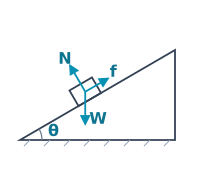
Kinetic friction force equals kinetic friction coefficient multiplied by normal force
Kinetic friction is the resistive force acting on an object that is already sliding across a surface. It equals the kinetic coefficient of friction times the normal force pressing the surfaces together.
f = μ_k × F_normal
The kinetic coefficient is a dimensionless ratio that depends on the material pair and surface conditions. Measure it experimentally by dividing the sliding friction force by the normal force.
μ_k = f / F_normal
Given the sliding friction force and the kinetic coefficient, recover the normal force pressing the surfaces together.
F_normal = f / μ_k
Kinetic friction is the force that resists sliding once two surfaces are already moving relative to each other. The equation f = μ_k × F_normal multiplies the kinetic coefficient (a dimensionless number that depends on the material pair) by the normal force pressing the surfaces together. Unlike static friction, which can vary up to a maximum, kinetic friction is approximately constant once sliding begins. The kinetic coefficient is typically lower than the static coefficient for the same surface pair — that's why a box becomes easier to push once it starts moving.
A 50 kg crate slides across a concrete floor (μ_k = 0.3). How much kinetic friction force resists its motion?
Kinetic friction acts on objects already in motion and is approximately independent of sliding speed for most dry contacts (Coulomb friction model). The kinetic coefficient μ_k is a dimensionless property of the material pair and surface conditions — not of either material alone. For most surface pairs, μ_k is lower than the static coefficient μ_s, which is why a moving object is easier to keep moving than to start moving.
Multiply the kinetic coefficient of friction by the normal force: f = μ_k × F_normal. For μ_k = 0.3 and F_normal = 100 N, f = 30 N.
The kinetic friction equation is f = μ_k × F_normal, where μ_k is the kinetic coefficient (dimensionless) and F_normal is the perpendicular force the surface exerts on the object.
Once sliding begins, the microscopic asperities between the surfaces no longer have time to interlock as deeply, so less force is required to keep the object moving than to start it moving. The ratio μ_k/μ_s is typically 0.7–0.9.
For most dry contacts at modest speeds, kinetic friction is approximately independent of speed (Coulomb model). At very high speeds, very low speeds, or for lubricated contacts, speed dependence becomes significant.
Measure the sliding friction force and divide by the normal force: μ_k = f / F_normal. Common values: rubber on dry concrete ~0.6, steel on steel ~0.4, ice on ice ~0.03.
For most dry contacts, kinetic friction is independent of the apparent contact area — it depends only on the normal force and the materials in contact. This is one of the classical Amontons–Coulomb laws of friction.
Reference:
Tipler, Paul A. 1995. Physics For Scientists and Engineers. Worth Publishers. 3rd ed.
