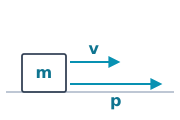
How It Works
Momentum (p) is the product of an object's mass and its velocity: p = m × v. It's a vector quantity pointing in the direction of motion, with SI units of kilogram-meters per second (kg·m/s), dimensionally identical to newton-seconds. Total momentum is conserved in any closed system with no external forces — that conservation law is what makes momentum the key tool for analyzing collisions, explosions, and recoil. Enter mass and velocity in any supported unit and the calculator converts to SI internally before applying the formula.
Example Problem
A 1,200 kg compact car is traveling at 25 m/s (about 56 mph). What is the car's momentum?
- Identify the equation: p = m × v.
- Substitute the values in SI units: p = 1,200 kg × 25 m/s.
- Multiply: p = 30,000 kg·m/s.
- Result: the car carries 30,000 kg·m/s of momentum — the impulse required to bring it to a stop.
When to Use Each Variable
- Solve for Momentum (p) — when you know mass and velocity and need the momentum directly (collision analysis, conservation problems).
- Solve for Mass (m) — when you know the momentum and velocity and need the mass (inferring an object's mass from a recoil measurement).
- Solve for Velocity (v) — when you know the momentum and mass and need the velocity (post-collision speed from conservation of momentum).
Key Concepts
Conservation of momentum says the total momentum of a closed system is constant: m1·v1 + m2·v2 = m1·v1' + m2·v2'. This holds in all collisions — elastic, inelastic, and explosive — as long as external forces are negligible. Kinetic energy, by contrast, is conserved only in perfectly elastic collisions. Because p is a vector, sign conventions matter: a head-on collision involves momenta with opposite signs, so their magnitudes subtract rather than add.
Applications
- Collision reconstruction: forensic engineers infer impact speeds from final positions using conservation of momentum.
- Rocket propulsion: thrust = rate of change of momentum of expelled exhaust.
- Ballistics: muzzle momentum equals projectile-mass × muzzle-velocity, used to compute recoil.
- Particle physics: momentum 4-vectors are the working unit for collision analysis at accelerators.
- Sports: cue-ball physics, billiards, bowling, and golf are momentum-transfer problems.
Common Mistakes
- Forgetting that momentum is a vector — head-on momenta have opposite signs and partially cancel.
- Mixing momentum with kinetic energy. p = m·v is linear in v; KE = ½m·v² is quadratic.
- Using non-SI inputs without converting. A car weighed in pounds and moving in mph must be converted to kilograms and m/s before multiplying.
- Assuming momentum is only conserved in elastic collisions. It's conserved in all collisions inside a closed system; kinetic energy is the conserved quantity that distinguishes elastic from inelastic.
Frequently Asked Questions
How do you calculate momentum?
Multiply mass by velocity: p = m × v. For a 10 kg object moving at 5 m/s, p = 10 × 5 = 50 kg·m/s.
What is the formula for momentum?
p = m × v — momentum equals mass times velocity. In SI units, mass is in kilograms, velocity in meters per second, and momentum in kg·m/s (equivalent to newton-seconds).
What are the units of momentum?
The SI unit is the kilogram-meter per second (kg·m/s), which is dimensionally identical to the newton-second (N·s). Imperial systems use the slug-foot per second.
Is momentum the same as inertia?
No. Inertia is the resistance to change in motion — quantified by mass alone. Momentum requires motion: a stationary object has mass (inertia) but zero momentum.
Is momentum always conserved?
Yes, total momentum is conserved in any closed system with no net external force. This applies to elastic, inelastic, and explosive interactions. Kinetic energy is conserved only in perfectly elastic collisions.
Can momentum be negative?
Yes, when velocity is negative. Momentum is a vector — choosing one direction as positive makes motion in the opposite direction negative. Sign conventions are essential for collision problems.
Reference: Halliday, David, Robert Resnick, and Jearl Walker. Fundamentals of Physics. Wiley, 10th Edition. Chapter 9.
Worked Examples
Automotive
What is the momentum of a 1,200 kg compact car traveling at 25 m/s?
- p = m × v
- p = 1,200 kg × 25 m/s
- p = 30,000 kg·m/s
Same magnitude as the impulse a braking system has to deliver to bring the car to a full stop.
Sports
A bowling ball carrying 22 kg·m/s of momentum at 8 m/s — what is its mass?
- m = p / v
- m = 22 kg·m/s / 8 m/s
- m = 2.75 kg (about 6.06 lb)
Useful when momentum is measured from pin-impact data and you want to infer the ball's mass.
Ballistics
A 0.010 kg projectile carries 8 kg·m/s of momentum — what is its muzzle velocity?
- v = p / m
- v = 8 kg·m/s / 0.010 kg
- v = 800 m/s
Roughly the muzzle velocity of a high-velocity rifle round, derived from chronograph momentum data.
Related Calculators
- Impulse & Momentum Hub — all four impulse and momentum equations in one tool
- Impulse Calculator (J = F·Δt) — impulse from force and time
- Impulse-Momentum Theorem — J = Δp = m·Δv — change in momentum from collisions
- Kinetic Energy Calculator — energy of a moving object — uses mass and velocity
- Force Equation Calculator — Newton's second law F = m·a
- Mass Unit Converter — convert between kilograms, pounds, slugs, and more
Related Sites
- Temperature Tool — Temperature unit converter
- Z-Score Calculator — Z-score, percentile, and probability calculator
- InfantChart — Baby and child growth percentile charts
- Dollars Per Hour — Weekly paycheck calculator with overtime
- OptionsMath — Options trading profit and loss calculators
- Medical Equations — Hemodynamic, pulmonary, and dosing calculators