Hollow Cylinder Calculator
Volume equals pi times the quantity outer radius squared minus inner radius squared, times height
Use this form when you know the outer radius, inner radius, and height of a pipe, tube, or hollow cylinder and need the volume of the wall material — the steel in a pipe, the insulation around a coaxial cable, or the cardboard in a paper tube.
V = π (R² − r²) h
Use this form when you need the area of both annular end caps plus the outer and inner lateral surfaces. Common for painting, coating, plating, or galvanizing the entire wetted area of a tube.
S = 2π [(R² − r²) + (R + r) h]
Use this rearrangement when you know the required wall volume, the inner bore radius (fixed by what must pass through the pipe), and the available height — and need the minimum outer radius that supplies that wall volume.
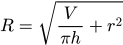
R = √(V / (π h) + r²)
Use this rearrangement when the outer radius is fixed by stock size, the height is known, and you need to size the bore. Common when boring out a solid blank to leave a target amount of wall material.
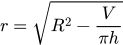
r = √(R² − V / (π h))
Use this rearrangement when the cross-section (R, r) is fixed by an existing pipe spec and you need the length that contains a target wall volume — for example, cutting a tube to match a required mass.
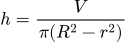
h = V / (π (R² − r²))
This hollow cylinder calculator uses V = π (R² − r²) h plus the surface-area formula S = 2π [(R² − r²) + (R + r) h] to solve for any of volume, total surface area, outer radius, inner radius, or height. Pick the unknown with the solve-for toggle, enter the remaining three values with any supported length, area, or volume units, and the calculator converts to SI internally before computing all related quantities — including the annular cross-section area Aₓₛ = π (R² − r²), wall thickness t = R − r, outer diameter d₀ = 2R, and inner diameter dᵢ = 2r — so you can size pipes, tubes, sleeves, coaxial cables, and pressure-vessel shells from a single page.
A steel pipe segment has an outer radius of 5 cm, an inner radius of 3 cm, and a length of 10 cm. What volume of steel does the wall contain?
Round trip check: from V ≈ 502.65 cm³, r = 3 cm, and h = 10 cm, the inverse formula R = √(V / (π h) + r²) recovers R = 5 cm, confirming the forward calculation.
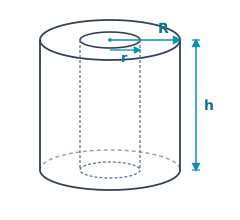
A hollow circular cylinder — a pipe, tube, or sleeve — is the solid that remains when a smaller coaxial cylinder of radius r is removed from a larger cylinder of radius R, with both cylinders sharing the same height h. Its cross-section perpendicular to the axis is an annulus (ring) with area π (R² − r²), and its wall volume is that cross-section multiplied by the height. The total surface area sums four pieces: two annular end caps, the outer lateral surface (a tall rectangle of width 2π R and height h when unrolled), and the inner lateral surface (a rectangle of width 2π r and height h). Wall thickness t = R − r and the outer / inner diameters d₀ = 2R, dᵢ = 2r are the parameters most often quoted on real-world pipe and tube spec sheets — divide by two to get the radii the formulas need.
Use V = π (R² − r²) h, where R is the outer radius, r is the inner radius, and h is the height (length) of the pipe or tube. Square each radius, subtract, multiply by the height, and multiply by π. For example, a pipe with R = 5 cm, r = 3 cm, and h = 10 cm contains V = π · 16 · 10 = 160π ≈ 502.65 cm³ of wall material.
Total surface area is S = 2π [(R² − r²) + (R + r) h], which equals the two annular end caps (2π (R² − r²)) plus the outer lateral surface (2π R h) plus the inner lateral surface (2π r h). For R = 5, r = 3, h = 10 the total is 192π ≈ 603.19 cm².
An annulus is the two-dimensional ring shape between two concentric circles, with area π (R² − r²). A hollow cylinder is the three-dimensional pipe-shaped solid whose cross-section is that annulus — extruding an annulus a distance h along its axis gives a hollow cylinder. The annulus is the cross-section; the hollow cylinder is the full solid.
A pipe wall is a hollow cylinder, so its volume is V = π (R² − r²) h. If you only have the outer diameter d₀ and wall thickness t, compute R = d₀ / 2 and r = R − t first. The wall volume multiplied by the material density gives the pipe's mass — useful for shipping, hanging, and stress calculations.
The cross-section perpendicular to the axis is an annulus with area Aₓₛ = π (R² − r²). For a pipe with R = 5 cm and r = 3 cm, Aₓₛ = π · 16 ≈ 50.27 cm². This is the area carrying axial load in a column, and the area through which heat conducts axially.
Wall thickness is simply t = R − r — the difference between the outer and inner radii. Equivalently, from diameters, t = (d₀ − dᵢ) / 2. The calculator displays t alongside every solve result so you can match it against a pipe schedule (for example, Schedule 40 vs Schedule 80) directly.
Yes — set the inner radius r = 0 and the formulas reduce to the solid cylinder versions: V = π R² h and S = 2π R (R + h). If you only ever need solid-cylinder math, the dedicated cylinder calculator may be a cleaner fit.
Wall volume multiplied by material density gives the mass of a pipe, sleeve, or bushing — the basis for shipping weight, structural dead load, and hoop-stress / longitudinal-stress calculations. The cross-section area Aₓₛ shows up in axial stress (σ = F / Aₓₛ) and in moment-of-inertia formulas for bending, where the hollow cross-section is much stiffer than a solid bar of equal mass.
Reference:
Weisstein, Eric W. "Cylindrical Shell." MathWorld — A Wolfram Web Resource. https://mathworld.wolfram.com/CylindricalShell.html
Steel Pipe
A 1-meter length of steel pipe has an outer diameter of 100 mm (R = 50 mm = 0.05 m) and a wall thickness of 10 mm (r = 40 mm = 0.04 m). Use V = π (R² − r²) h to find the volume of steel — the basis for the pipe's mass and shipping weight.
Wall volume ≈ 2.83 × 10⁻³ m³ per meter of pipe; mass ≈ 22.2 kg/m at typical steel density
Real pipe schedules (Schedule 40, Schedule 80) specify wall thickness directly. From t and the outer diameter d₀, compute r = d₀/2 − t before using the formula.
Paper Tube
A poster-shipping tube is 60 cm long, with an outer radius of 4 cm and a wall thickness of 3 mm — so the inner radius is r = 4 cm − 0.3 cm = 3.7 cm. Find the cardboard cross-section and volume.
Cardboard volume ≈ 435 cm³, mass ≈ 0.30 kg per tube
Paper tubes are often quoted by inner diameter and wall thickness. Convert to (R, r) before computing — and remember caps or end-plugs are extra material not included in V.
Coaxial Cable Insulation
A 50 Ω coaxial cable has an inner conductor radius of 0.5 mm and a dielectric outer radius of 1.65 mm (the outer braid sits at this radius). For a 10-meter length, what volume of dielectric (PTFE / polyethylene) fills the cable?
Dielectric volume ≈ 77.7 cm³ per 10 m of cable; mass ≈ 72 g at polyethylene density
The 50 Ω impedance comes from the ratio R/r ≈ 3.3 combined with the dielectric constant — the hollow-cylinder geometry alone fixes capacitance and inductance per unit length.
All hollow-cylinder (pipe, tube, sleeve) properties are determined by three dimensions: the outer radius R, the inner radius r, and the height (length) h. From those, the wall volume, total surface area, annular cross-section area, wall thickness, and both diameters all follow:
Where:
0 ≤ r < R