How It Works
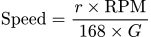
The gear ratio equation links vehicle speed to engine RPM, tire radius, and the final drive ratio: v = (r × RPM) / (168 × G), where v is speed in mph, r is tire radius in inches, RPM is engine speed, and G is the overall gear ratio (transmission gear × differential ratio). The constant 168 handles unit conversion — it comes from 63,360 inches/mile ÷ 60 min/hour ÷ 2π so the formula returns miles per hour directly. Enter any three variables and solve for the fourth.
Example Problem
A truck has 15-inch tire radius, a 3.73 final drive ratio, and is cruising at 3,000 RPM in top gear. What is the vehicle speed?
- Identify the inputs: r = 15 in, RPM = 3,000, G = 3.73.
- Substitute into v = (r × RPM) / (168 × G).
- Numerator: 15 × 3,000 = 45,000.
- Denominator: 168 × 3.73 = 626.64.
- Divide: 45,000 / 626.64 ≈ 71.8 mph.
- Result: at 3,000 RPM with these gears and tires, the truck cruises at about 71.8 mph.
When to Use Each Variable
- Solve for Speed — when you know tire radius, RPM, and gear ratio, e.g., predicting highway speed at a target cruising RPM.
- Solve for RPM — when you know speed, tire radius, and gear ratio, e.g., finding engine RPM at 70 mph after a gear or tire change.
- Solve for Gear Ratio — when you know speed, RPM, and tire size, e.g., choosing a differential ratio that keeps RPM in the engine's sweet spot at highway speed.
- Solve for Tire Radius — when you know speed, RPM, and gear ratio, e.g., back-calculating the tire size needed to hit a target RPM at a given speed.
Key Concepts
The gear ratio formula treats the drivetrain as a rigid mechanical linkage: the engine spins at some RPM, the transmission and differential reduce that rotation by the overall gear ratio G, and the tire converts the resulting wheel rotation into distance per minute through its radius. The constant 168 absorbs the unit conversion so the formula maps inches and RPM directly to mph. Real-world results differ slightly because of tire slip, drivetrain losses, and tire growth at speed — typical errors are 1–3% at highway speed.
Applications
- Re-gearing after a tire size change: predicting the new RPM at highway speed so you can pick a differential ratio that restores the original feel.
- Selecting a final drive for towing vs. fuel economy: lower (numerically higher) ratios trade fuel economy for low-end pull.
- Diagnosing speedometer error after a tire upgrade: the indicated speed is wrong because the speedometer assumes the original tire radius.
- Drag racing: choosing gears that keep the engine at peak-power RPM through the trap.
- Fleet engineering: balancing engine RPM across a range of tire sizes installed on the same chassis.
Common Mistakes
- Using tire diameter instead of tire radius — the formula requires radius (half the diameter). A 31-inch tire has a 15.5-inch radius, not a 31-inch radius.
- Forgetting to multiply transmission gear by differential ratio. The G in the formula is the overall ratio; in top gear with a 0.7:1 overdrive and 3.73 diff, G = 0.7 × 3.73 = 2.61.
- Comparing static (loaded) radius to free-spinning radius. Use the loaded radius — about 97% of free radius — for honest results.
- Ignoring tire growth at speed. Radials grow 1–2% at highway speed, slightly lowering effective RPM.
- Treating the result as exact. The formula assumes no slip and no drivetrain loss; subtract 1–3% for real-world conditions.
Frequently Asked Questions
How do you calculate the gear ratio for a given speed and RPM?
Rearrange v = (r × RPM) / (168 × G) for G: gear ratio G = (r × RPM) / (168 × v). For 15-inch tire radius, 3,000 RPM, and 70 mph: G = (15 × 3000) / (168 × 70) = 45,000 / 11,760 ≈ 3.83. So a 3.83:1 final drive puts the engine at 3,000 RPM at 70 mph.
What is the formula for vehicle speed from RPM and gear ratio?
v = (r × RPM) / (168 × G), where v is speed in mph, r is tire radius in inches, RPM is engine speed, and G is the overall gear ratio (transmission × differential). The constant 168 converts inches and RPM to miles per hour.
What happens if I install larger tires without re-gearing?
Larger tires lower engine RPM at any given speed, which can hurt low-end acceleration, cause transmission hunting between gears, and reduce towing capability. Re-gearing to a numerically higher ratio (e.g., 3.73 to 4.10) restores the original RPM range.
What is a good gear ratio for fuel economy?
Numerically lower ratios like 2.73:1 or 3.08:1 keep RPM down at highway speed, improving fuel economy. They sacrifice acceleration and towing. The best ratio depends on tire size, transmission gearing, and the engine's torque curve.
Does this gear ratio formula account for transmission gears?
Yes — but only if you enter the overall ratio. G is transmission gear × differential ratio. In a 0.7:1 overdrive top gear with a 3.73 diff, G = 0.7 × 3.73 = 2.61. In a direct-drive top gear (1:1), G equals the differential ratio.
Why does the formula use 168?
168 converts inches and revolutions-per-minute into miles-per-hour. The derivation: 1 mile = 63,360 inches and 1 hour = 60 minutes, and a wheel turns through 2π radii per revolution. 63,360 / (60 × 2π) ≈ 168. Plugging in r in inches and RPM yields v in mph.
Reference: Results are approximate and assume no drivetrain losses or tire slip.
Note: Results are approximate and assume no drivetrain losses or tire slip.
Related Calculators
- Effective Gear Ratio Calculator — see how a tire-size change alters your final drive

- Tire Diameter Calculator — convert metric tire sizes (e.g., 225/65R17) to inches
- Crawl Ratio Calculator — low-range reduction for off-road driving
- Gear Equations Hub — all four gear formulas in one tool
- Engine Equations Calculator — volumetric efficiency, displacement, and bore/stroke
- Horsepower Calculator — HP, torque, and RPM relationships
Related Sites
- Dollars Per Hour — Weekly paycheck calculator with overtime
- Compare 2 Loans — Side-by-side loan comparison calculator
- LoanChop — Loan prepayment calculator
- Hourly Salaries — Hourly wage to annual salary converter
- Temperature Tool — Temperature unit converter
- Percent Off Calculator — Discount and sale price calculator