AJ Designer

Effective Gear Ratio Calculator
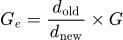
Effective gear ratio equals old tire diameter divided by new tire diameter times gear ratio

Solution

Enter values to calculate
Share:

How It Works

When you install a different tire size, your effective gear ratio changes because the wheel covers more (or less) distance per revolution. The formula G_e = (d_old / d_new) × G scales your original final drive ratio by the diameter ratio. Larger new tires produce a numerically lower effective ratio — less mechanical advantage, lower RPM at any given speed, and slower acceleration. Solve for any of the four variables when re-gearing for a tire swap.

Example Problem

A truck originally ran 28-inch tires with a 3.73 differential. After a tire upgrade to 31-inch tires, what is the new effective gear ratio?

  1. Identify the inputs: d_old = 28 in, d_new = 31 in, G = 3.73.
  2. Substitute into G_e = (d_old / d_new) × G.
  3. Diameter ratio: 28 / 31 ≈ 0.9032.
  4. Multiply by original ratio: 0.9032 × 3.73 ≈ 3.37.
  5. Result: the effective gear ratio drops from 3.73 to about 3.37 — about a 10% loss in mechanical advantage.
  6. To restore the original gearing, you'd want a numerically higher real ratio (e.g., 4.10 or 4.30) on the new tires.

When to Use Each Variable

  • Solve for Effective Gear Ratiowhen you know the old and new tire diameters and the original gear ratio, e.g., previewing the impact of a tire upgrade before you re-gear.
  • Solve for Required Gear Ratiowhen you know the target effective ratio and the new tire diameter, e.g., picking a new differential that restores the original feel after a tire change.
  • Solve for New Tire Diameterwhen you want a specific effective ratio and aren't planning to re-gear, e.g., finding the largest tire you can run without losing too much torque.
  • Solve for Old Tire Diameterto back-calculate the original tire size, e.g., when comparing your current setup to a stock baseline.

Key Concepts

Effective gear ratio is the ratio you'd need on the original tires to produce the same wheel torque and RPM-per-mph relationship as your current setup. It's a useful shorthand because every other drivetrain quantity (acceleration, RPM at cruise, indicated speedometer error, towing capacity) scales linearly with it. The rule of thumb: a tire diameter increase of 10% drops the effective ratio by about 10%, so a 3.73 with 28-inch tires acts like a 3.39 with 31-inch tires. Re-gearing to a numerically higher real ratio restores the original effective ratio.

Applications

  • Sizing the next differential ratio after a tire upgrade so RPM at highway speed stays in the engine's sweet spot.
  • Predicting acceleration loss when going to taller tires for off-road clearance.
  • Quantifying speedometer error after a tire change — indicated speed runs proportionally low.
  • Comparing two truck configurations with different tire sizes on the same chassis.
  • Planning a build: choose tires first, then choose gears to land at a target highway RPM.

Common Mistakes

  • Using tire radius instead of diameter — the formula uses diameter (or any consistent length unit) for both terms. Mixing radius and diameter gives wrong answers.
  • Forgetting that the effective ratio change applies in every gear, not just top gear. First-gear acceleration suffers just as much.
  • Ignoring tire load rating — larger tires are usually heavier and slow acceleration even more than the gear loss suggests.
  • Re-gearing back to the original real ratio when the new tires are taller. You need a numerically higher real ratio than original to match the original effective ratio.
  • Mixing imperial and metric tire diameters — convert both to the same unit before applying the formula.

Frequently Asked Questions

How do you calculate effective gear ratio after a tire change?

Use G_e = (d_old / d_new) × G, where d_old and d_new are the original and new tire diameters and G is your current real differential ratio. Example: 28-inch tires with 3.73 gears, swapped to 31-inch tires, gives G_e = (28/31) × 3.73 ≈ 3.37.

What is the formula for effective gear ratio?

G_e = (d_old / d_new) × G. The ratio of old to new tire diameter scales your original gear ratio. Bigger new tires lower the effective ratio; smaller new tires raise it.

What new gear ratio do I need after going to bigger tires?

To keep the same effective ratio after upgrading from d_old to d_new, install a real ratio G_new = G_old × (d_new / d_old). So 3.73 gears with 28-inch tires upgrading to 31-inch tires need G_new = 3.73 × (31/28) ≈ 4.13 — round to the nearest available ratio, typically 4.10 or 4.30.

How much does going from 33-inch to 35-inch tires change my gearing?

The effective ratio drops by 33/35 = 0.943, so about 5.7%. A 4.10 acts like a 4.10 × 0.943 ≈ 3.87 after the swap. To restore original feel, step up to 4.30 or 4.56 gears.

Does effective gear ratio affect MPG?

Yes, indirectly. A lower effective ratio means lower RPM at highway speed, which can improve fuel economy if the engine still has enough torque to cruise without downshifting. If RPM drops below the engine's efficient range, the transmission hunts and MPG actually gets worse.

Does effective gear ratio affect speedometer accuracy?

Yes. Speedometers calibrate to the original tire diameter. A larger tire makes indicated speed read low by the same percentage the effective ratio drops — 28 to 31 inches drops indicated speed by about 10%, so 70 mph indicated is actually about 77 mph.

Reference: Results are approximate and assume no drivetrain losses or tire slip.

Note: Results are approximate and assume no drivetrain losses or tire slip.
Related Calculators

Related Sites