Tire Diameter Calculator
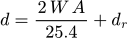
Tire diameter equals 2 times section width times aspect ratio divided by 25.4 plus rim diameter
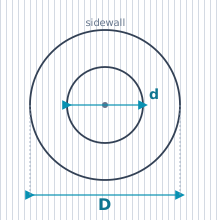
Metric tire sizes encode the sidewall geometry: a tire labeled 225/65R17 has a 225 mm section width, a 65% aspect ratio (sidewall height as a fraction of width), and a 17-inch rim. The overall tire diameter is d = 2 × W × A / 25.4 + d_r, where W is section width in millimeters, A is the aspect ratio as a decimal (0.65 for a 65-series tire), and d_r is the rim diameter in inches. The factor 25.4 converts the metric sidewall portion to inches so the answer is in inches. Solve for any one of the four variables when sizing tires or back-checking a published spec.
What is the overall diameter of a 225/65R17 tire — a 225 mm section width, 65% aspect ratio, and 17-inch rim?
Metric tire sizing is a mixed-unit standard: section width is in millimeters, aspect ratio is a percentage of width, and rim diameter is in inches. The aspect ratio multiplies the section width to give sidewall height; doubling it gives the total contribution to overall diameter from both sidewalls. Lower-profile tires (A = 0.35–0.45) have shorter sidewalls and respond more sharply to steering inputs; taller-profile tires (A = 0.70–0.85) absorb more impact and provide more compliance off-road. Pure inch-spec tires (e.g., 33×12.50R17) state diameter directly and don't need this formula.
Use d = 2 × W × A / 25.4 + d_r, where W is section width in mm, A is aspect ratio as a decimal, and d_r is rim diameter in inches. Example: 225/65R17 → d = 2 × 225 × 0.65 / 25.4 + 17 ≈ 28.5 inches.
d = (2 × W × A) / 25.4 + d_r. The metric sidewall (both sides) converts to inches via 25.4 mm/in, then adds to the rim diameter to give the overall tire diameter in inches.
d = (2 × 285 × 0.70) / 25.4 + 17 = 399 / 25.4 + 17 ≈ 15.71 + 17 ≈ 32.71 inches. Manufacturers often round this to 33 inches in marketing.
It's the aspect ratio — the sidewall height expressed as a percentage of the section width. A 225/65R17 tire has a sidewall that is 65% of 225 mm, or about 146 mm tall (on each side).
Overall diameter sets the effective gear ratio, the speedometer calibration, and the ground clearance under your axle. Two tires that differ by 1 inch in overall diameter give about a 3–4% difference in indicated speed and effective gearing.
25.4 is the conversion factor from millimeters to inches (1 inch = 25.4 mm). The metric portion of the spec (section width × aspect ratio × 2 for both sidewalls) is in mm, so dividing by 25.4 converts it to inches before adding the inch-spec rim diameter.
Reference:
Results are approximate and assume the free-spinning unloaded diameter from the labeled sidewall geometry.
Note: The formula returns the free-spinning unloaded diameter from the labeled spec; loaded (static) diameter is typically about 3% smaller.